* On your first PCB Assembly order!
* Up to $300 discount
 C - A L L E Y
 Home | Events | PCB | About Us | News | Contact Us
When launching a new electronic product, the very first engineering decision—long before placement and reflow profiles are finalized—is often the choice of printed circuit board substrate. Choose wisely, and you get stable electrical performance, reliable thermal management, and cost-effective production. Choose poorly, and you may face signal integrity failures, overheating, or expensive re-spins. Three families dominate the PCB industry: FR-4, high-frequency laminates, and aluminum-based boards. None is universally superior; each serves a distinct set of requirements. This article breaks down their differences from the perspective of a professional PCBA factory, helping you match material to application without guesswork.
FR-4 – The Workhorse of the Industry
FR-4 is not a single chemical compound but a flame-retardant rating applied to glass-reinforced epoxy laminates. It accounts for over 80% of the global PCB substrate market, and for good reason. FR-4 offers a balanced combination of mechanical strength, stable electrical properties, mature processing technology, and low cost. Standard FR-4 has a glass transition temperature (Tg) around 130°C, while high-Tg versions exceed 170°C, comfortably withstanding lead-free soldering temperatures. Its dielectric constant (Dk) typically falls between 4.2 and 4.8, which is perfectly adequate for frequencies up to about 1 GHz.
However, FR-4 has two fundamental weaknesses: poor thermal conduction and relatively high dielectric loss. With a thermal conductivity of only 0.3–0.5 W/(m·K), it cannot efficiently dissipate heat from power-dense components. Its dissipation factor (Df) ranges from 0.018 to 0.025, causing noticeable signal attenuation above a few gigahertz. Therefore, FR-4 is the ideal choice for consumer electronics, industrial controls, power supplies, digital circuits, and general communication equipment where cost and versatility are paramount. For most projects, a high-Tg FR-4 is the safest starting point.
High-Frequency Laminates – Engineered for Speed
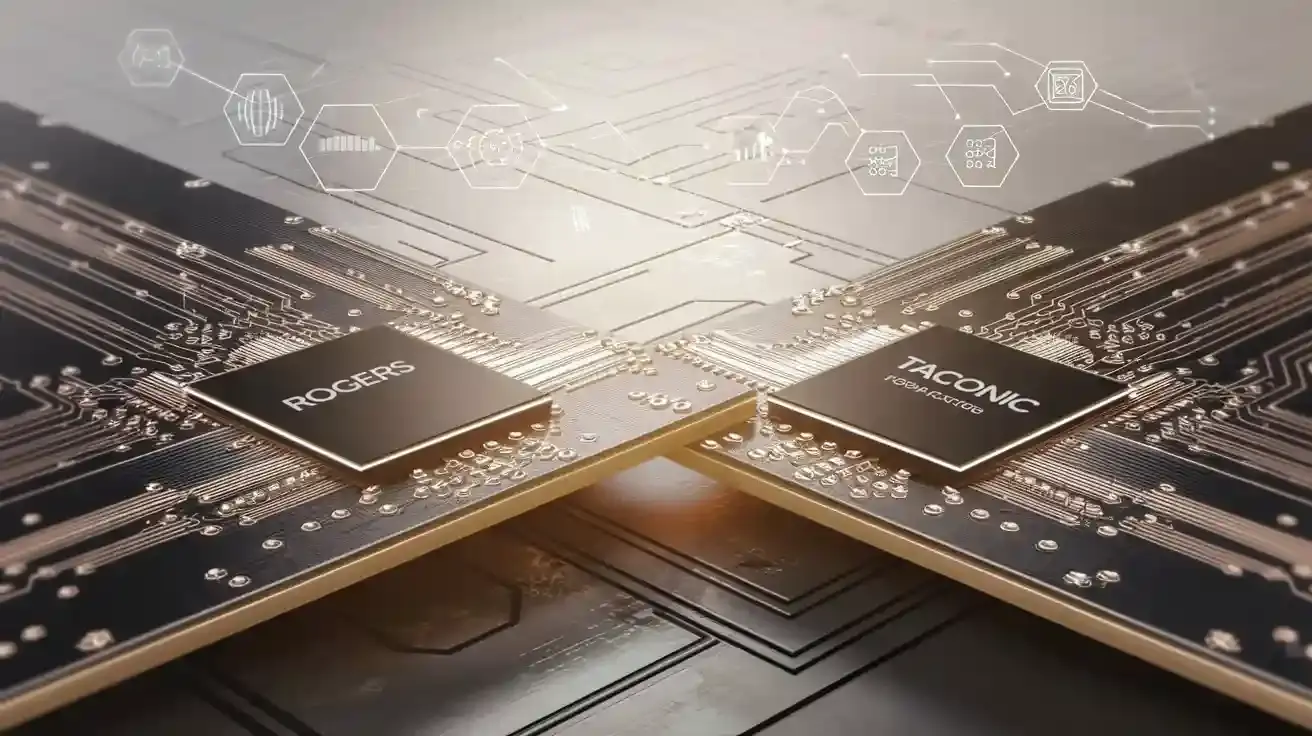
When signals climb into the GHz range—think 5G base stations, automotive radar, satellite communications, or high-speed AD/DA converters—FR-4 simply cannot deliver the required signal integrity. This is where high-frequency materials such as Rogers RO4000/RO3000 series, Taconic, or PTFE-based composites come into play. These laminates are formulated with very low and stable dielectric constants and exceptionally low dissipation factors. For instance, Rogers RO4350B exhibits a Dk of 3.48±0.05 and a Df of only 0.0037 at 10 GHz, ensuring minimal loss, low dispersion, and stable impedance across a wide bandwidth. The RO3000 series, using ceramic-filled PTFE, pushes performance even further for aerospace and military radar applications.
The downsides are significant: high cost and demanding processing. These materials are several times more expensive than FR-4, and they require specialised handling during lamination, drilling, and solder mask application. Their softness and low abrasion resistance demand diamond-coated tools and carefully tuned feed rates to avoid smearing or delamination. Many small shops lack the expertise to process them reliably. Thus, high-frequency laminates should be reserved exclusively for RF, microwave, and ultra-high-speed digital designs—never for ordinary digital boards.
Aluminum-Based Boards – The Thermal Specialists
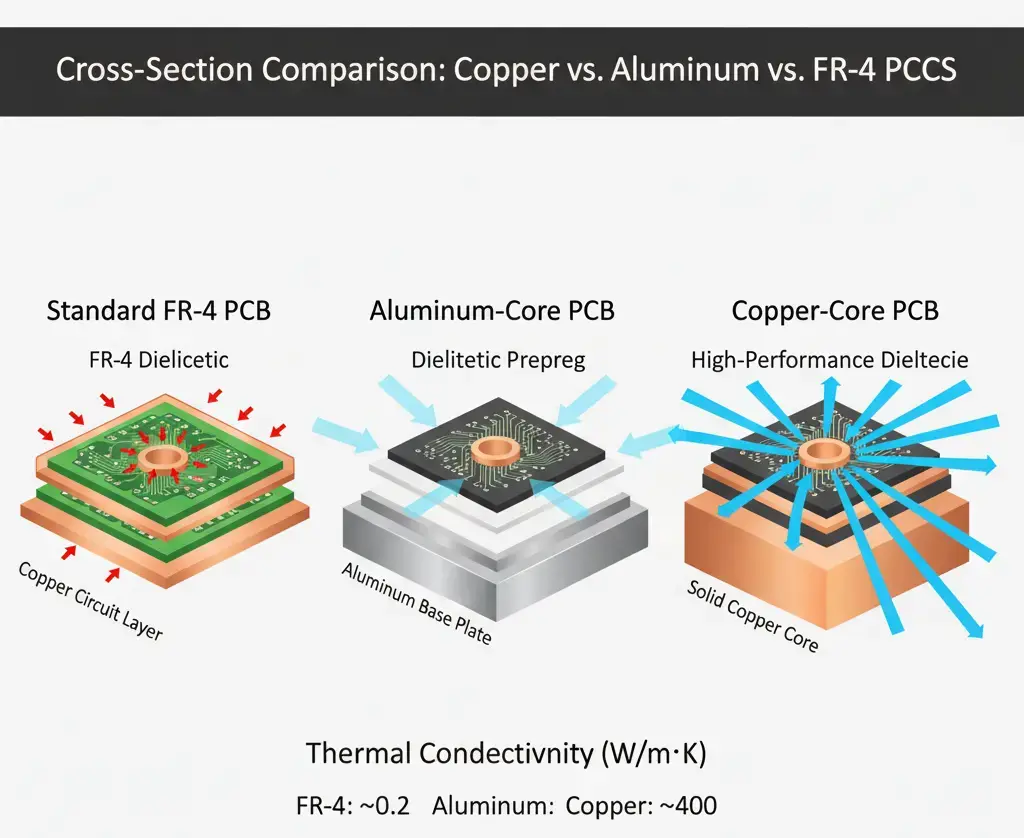
For products that generate substantial heat—high-power LEDs, motor drives, inverters, automotive headlamps, and charging modules—thermal management often dictates substrate choice. Aluminum-based PCBs feature a three-layer structure: a copper circuit layer, a thermally conductive but electrically insulating dielectric layer, and a thick aluminum baseplate. This construction provides thermal conductivity from 1.0 to over 10 W/(m·K), depending on the dielectric, which is tens of times higher than FR-4. The aluminum core also offers excellent mechanical rigidity and acts as an effective EMI shield. Moreover, its coefficient of thermal expansion (CTE) is about 50 ppm/°C, much closer to copper's 17 ppm/°C than FR-4's 110 ppm/°C, reducing thermal stress on plated through-holes and solder joints during temperature cycling.
However, aluminum boards come with inherent limitations. They are almost exclusively single-sided; double-sided designs are tricky and costly, and multilayer structures are essentially impractical because the metal core would short circuit any plated via. The total cost is roughly 3–5 times that of an equivalent FR-4 board. Therefore, they are chosen only when the power density exceeds 0.5 W/cm² and space is constrained—otherwise, FR-4 with thermal vias and copper pours often suffices.
Making the Right Choice – A Practical Decision Framework
Given these distinct characteristics, how should an engineer decide? First, evaluate signal frequency and data rate. For any application above 1–2 GHz, high-frequency materials are mandatory; for lower frequencies, FR-4 works perfectly. Second, assess thermal dissipation. If component junction temperatures or thermal simulations indicate excessive heat, consider aluminum-based boards, but only if the circuit is relatively simple and single-sided. Third, consider structural complexity. Multi-layer, high-density designs point naturally to FR-4 (or hybrid stacks with embedded high-frequency layers), while aluminium is ruled out. Fourth, weigh the budget – high-frequency materials are the most expensive, followed by aluminium, with FR-4 being the most economical.
A useful rule of thumb is: use FR-4 unless you have a compelling reason not to. Use aluminium only when you cannot cool the board by other means. Use high-frequency laminates exclusively when signal integrity at GHz frequencies is non-negotiable. Avoid the common mistake of over-specifying – a 2.4 GHz Bluetooth board might still work on FR-4 with careful layout, while a 28 GHz 5G front-end definitely cannot.
Why Partner with an Experienced PCBA Factory
Selecting the right substrate is only half the battle; the other half is manufacturability. At our PCBA facility, we routinely handle FR-4, multiple high-frequency grades, and aluminium-based boards, each with tailored process parameters. We recommend that customers engage our engineering team early in the design phase – provide your power budget, operating frequency, layer count, and environmental conditions, and we will propose the optimal material with cost, lead time, and yield fully considered. This collaborative approach minimises re-spins, avoids unexpected thermal or signal failures, and ensures your product reaches production smoothly and reliably. When in doubt, let science – and our experience – guide the choice.
Please send Email to kspcba@c-alley.com or call us through +86 13828766801 Or submit your inquiry by online form. Please fill out below form and attach your manufacturing files( PCB Gerber files and BOM List) if need quotation. We will contact you shortly.
 +86 13828766801
 kspcba@c-alley.com
 https://www.kingshengpcba.com/
 2/F, Building 6, Tangtou 3rd Industrial Zone, Tangtou Community, Shiyan Town, Baoan District, Shenzhen, China, 518108
We would also like to thank our customers for their trust and support. The company's outstanding achievements are mainly due to the loyalty of our customers, which also encourages and spurs our company to forge ahead.