* On your first PCB Assembly order!
* Up to $300 discount
 C - A L L E Y
 Home | Events | PCB | About Us | News | Contact Us
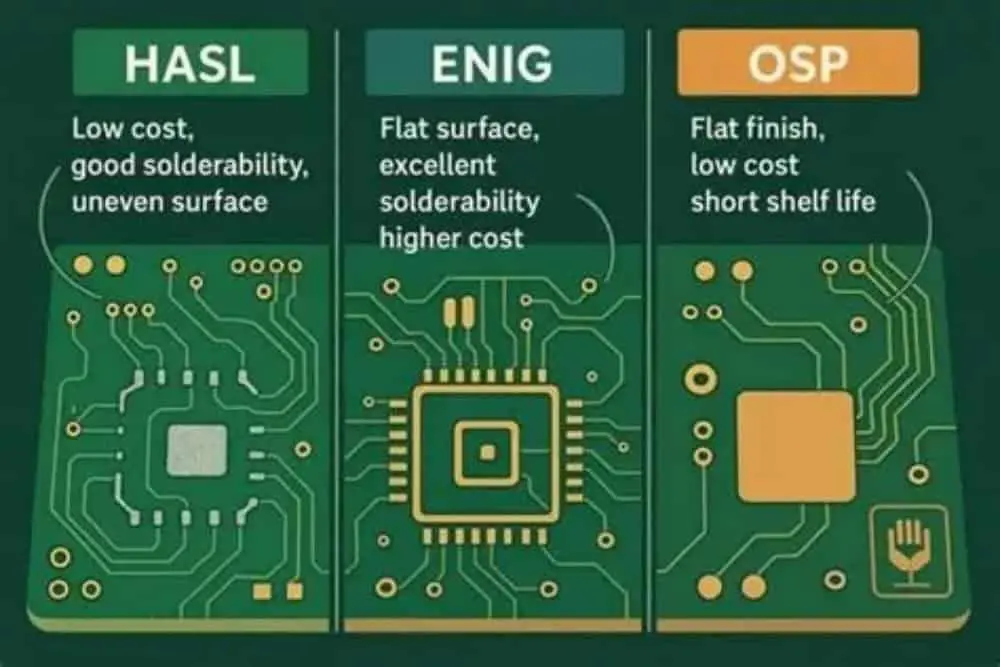
For the PCBA process, how to choose the PCB surface finish directly determines the soldering quality and the long-term stability performance of the components. Different surface finish processes have distinct metal layer structures, wetting properties, and shelf lives. ENIG, OSP, and HASL are the three mainstream surface finishes currently in use. Failure to consider the compatibility between solder joints and surface finishes during selection can lead to soldering defects, abnormal intermetallic compound growth, or field failures. This article analyzes the key compatibility points between these three surface finishes and solder joints based on their process characteristics.
I. Compatibility Between ENIG and Solder Joints
1.1 Interface Structure of ENIG
ENIG (Electroless Nickel Immersion Gold) consists of a nickel layer and a gold layer. The nickel layer acts as a diffusion barrier for soldering, while the gold layer protects the nickel surface and maintains solderability. During soldering, the gold dissolves quickly into the solder, and the actual solder joint forms at the tin-nickel interface.
1.2 Key Points for Solder Joint Reliability
The primary risk of ENIG is the black pad phenomenon. Excessive oxidation or corrosion of the nickel layer can cause brittle fractures along the nickel layer within the solder joint. A compatible, well-formed solder joint should exhibit a uniform nickel-tin intermetallic compound layer, with a controlled thickness between 1 and 3 micrometers.
1.3 Recommended Application Scenarios
ENIG is suitable for fine-pitch components, gold fingers, and products requiring multiple reflow cycles. Solder joint compatibility is sensitive to gold thickness. A gold thickness between 0.05 and 0.1 micrometers is recommended to mitigate embrittlement risks.
II. Compatibility Between OSP and Solder Joints
2.1 Protection Mechanism of OSP
OSP (Organic Solderability Preservative) protects the copper surface with an organic film that prevents copper oxidation. During soldering, the flux removes the OSP film, exposing fresh copper to react with the solder.
2.2 Solder Joint Formation Characteristics
OSP promotes the formation of a robust copper-tin intermetallic compound at the solder joint. This compound grows rapidly, resulting in high solder joint strength. A compatible joint is characterized by a continuous and uniform intermetallic layer, controllable within the range of 1 to 5 micrometers.
2.3 Limitations and Countermeasures
OSP does not withstand multiple reflow cycles well. After two or more reflow passes, partial degradation of the organic film can lead to copper oxidation, reducing solder wetting. OSP compatibility is poor for processes requiring double-sided assembly or multiple rework operations. Solderability should be re-verified if the storage time exceeds six months.
III. Compatibility Between HASL and Solder Joints
3.1 Process Characteristics of HASL
HASL (Hot Air Solder Leveling) coats the copper surface with a tin-lead or lead-free solder alloy. An inherent characteristic of this process is the non-uniform thickness of the solder coating.
3.2 Advantages of Solder Joint Matching
The HASL solder joint composition is identical or similar to the solder paste used during assembly, resulting in a stable intermetallic compound formation. This finish offers high tolerance to typical shop floor conditions, maintaining good wettability even after extended PCB storage.
3.3 Drawbacks and Control Requirements
HASL coating thickness varies significantly, ranging from over 40 micrometers in thick areas to less than 5 micrometers in thin areas. In thin coating areas, the coating may be completely consumed at high temperatures, exposing the bare copper and leading to excessive copper-tin compound growth, which makes the solder joint brittle. For lead-free HASL, peak reflow temperatures should be controlled between 240°C and 250°C to prevent excessive compound growth.
IV. Summary of Selection and Matching
Each of the three surface finishes has distinct characteristics for solder joint compatibility. ENIG is suitable for high-density assemblies and multiple reflows, but nickel layer quality must be strictly controlled. OSP provides high solder joint strength but is best suited for single or double reflow cycles with rapid assembly. HASL offers a mature process with high tolerance, but coating uniformity requires additional attention.
Please send Email to kspcba@c-alley.com or call us through +86 13828766801 Or submit your inquiry by online form. Please fill out below form and attach your manufacturing files( PCB Gerber files and BOM List) if need quotation. We will contact you shortly.
 +86 13828766801
 kspcba@c-alley.com
 https://www.kingshengpcba.com/
 2/F, Building 6, Tangtou 3rd Industrial Zone, Tangtou Community, Shiyan Town, Baoan District, Shenzhen, China, 518108
We would also like to thank our customers for their trust and support. The company's outstanding achievements are mainly due to the loyalty of our customers, which also encourages and spurs our company to forge ahead.