* On your first PCB Assembly order!
* Up to $300 discount
 C - A L L E Y
 Home | Events | PCB | About Us | News | Contact Us
During PCBA processing, flux is used to remove oxides from the surfaces of solder and the PCB substrate, promoting wetting and the formation of reliable solder joints. After reflow or wave soldering, some flux residue remains on the PCB surface, particularly under components, between fine-pitch pins, and around via holes. Surface Insulation Resistance (SIR) is a key indicator of a PCB's insulation performance, reflecting its ability to resist leakage current in high-humidity or contaminated environments. Ionic contaminants (such as halides and organic acids) in flux residue dissolve under humid conditions, forming an electrolytic path that causes SIR to degrade. A drop in SIR does not cause immediate failure but can develop into leakage current, signal crosstalk, or short circuits over months or years of thermal humidity cycling and voltage bias. This article analyzes the mechanism by which flux residue leads to long-term SIR degradation and provides three actionable control measures.
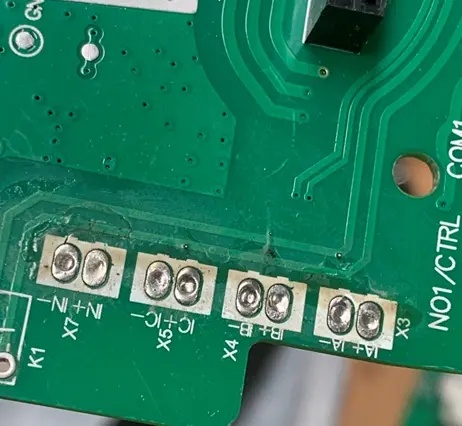
1. Physical-Chemical Mechanism of Ionic Contaminants in Flux Residue Reducing SIR
1.1 Sources and Morphology of Ionic Residues
Fluxes are classified into rosin-based, water-soluble (organic acid-based), and no-clean types. Activators (e.g., adipic acid, salicylic acid) and halogen scavengers (e.g., triethanolamine hydrobromide) in rosin-based fluxes do not fully volatilize at high temperatures, leaving ionic residues. Water-soluble fluxes contain high concentrations of organic acids and halides; if not thoroughly cleaned, they leave the highest ionic residue levels. No-clean fluxes are formulated for low residue, but improper process control (insufficient preheat, excessive conveyor speed) can still leave trace ions such as citric acid, succinic acid, and their metal salts.
1.2 Ionic Migration and Leakage Current Formation in Humid Environments
When ambient relative humidity exceeds 60%, a water film adsorbs onto the PCB surface. Ionic residues (e.g., Br⁻, Cl⁻, Na⁺, carboxylates) dissolve into the water film, electrolytically forming a conductive solution. When a voltage difference exists between two adjacent conductors (pads or pins), ions in the water film directionally migrate, producing leakage current. SIR is calculated by Ohm’s law: SIR = Applied Voltage / Leakage Current. A typical clean PCB exhibits SIR above 10¹¹ ohms, whereas ion-contaminated areas may see SIR drop to 10⁷ to 10⁸ ohms, approaching the high-level input threshold lower limit for logic circuits.
1.3 Dendrite Growth and Irreversible Short Circuits from Electrochemical Migration
Under long-term DC bias (e.g., 5V or 12V between power and signal lines), anode metal (typically tin, lead, or silver) dissolves into metal ions, migrates to the cathode, and reduces/deposits as dendritic metal (dendrites). Dendrite growth typically occurs after 500 to 2,000 hours of hygrothermal aging (85°C/85%RH). Once a dendrite bridges adjacent conductors, creating a permanent low-resistance path, SIR drops below 10³ ohms, causing functional failure or burnout. Flux residue provides the essential electrolyte for dendrite growth.
2. Long-Term Cumulative Effect of Flux Residue on SIR and Failure Time Window
2.1 Deceptively High Initial SIR
A newly manufactured PCBA tested in a dry environment (<30% RH) may show normal SIR (>10¹⁰ ohms). Ionic residues exist as solid, non-conductive crystals. However, when the product enters actual use (e.g., outdoor equipment, home appliance control boards, automotive electronics), experiencing daily temperature and humidity cycles, moisture condenses on the board. With each high-humidity cycle, ionic residues are activated and migrate over a wider area, causing SIR to decrease in steps. Research data (IPC-TM-650 2.6.3.7) shows that panels contaminated with 500 µg/in² NaCl equivalent experience a 4-order-of-magnitude drop in SIR after 1,000 hours at 40°C/90%RH.
2.2 Localized Risk in Concealed Areas
Flux residue under components (e.g., QFN, BGA, LGA packages) and beneath connectors is difficult to detect by visual inspection. The gap in these areas is only 50-150 µm. Once moisture enters, it evaporates slowly, creating a long-term humid microenvironment. Localized ionic enrichment in these areas causes abnormal SIR drops between BGA solder balls or between internal signal lines and ground planes under components. Field failure analysis indicates that electrochemical migration caused by flux residue at the four corners of BGAs is a primary cause of intermittent shorts or I²C communication errors occurring 1 to 3 years after PCBA deployment.
3. Three-Tier Control Measures: From Process, Inspection, to Long-Term Reliability Verification
3.1 Process Source Control: Optimize Flux Selection and Soldering Parameters
3.2 In-Process Inspection and Cleanliness Quantificatio
3.3 Long-Term SIR Verification Testing
Conclusion
The long-term threat of flux residue to SIR is delayed, concealed, and cumulative. Visual inspection or initial functional testing alone cannot identify the risk. By controlling ionic input during process selection, implementing ROSE spot checks during production, and completing SIR-specific testing during product validation, reliability field failures caused by flux residue can be effectively avoided.
Please send Email to kspcba@c-alley.com or call us through +86 13828766801 Or submit your inquiry by online form. Please fill out below form and attach your manufacturing files( PCB Gerber files and BOM List) if need quotation. We will contact you shortly.
 +86 13828766801
 kspcba@c-alley.com
 https://www.kingshengpcba.com/
 2/F, Building 6, Tangtou 3rd Industrial Zone, Tangtou Community, Shiyan Town, Baoan District, Shenzhen, China, 518108
We would also like to thank our customers for their trust and support. The company's outstanding achievements are mainly due to the loyalty of our customers, which also encourages and spurs our company to forge ahead.