* On your first PCB Assembly order!
* Up to $300 discount
 C - A L L E Y
 Home | Events | PCB | About Us | News | Contact Us
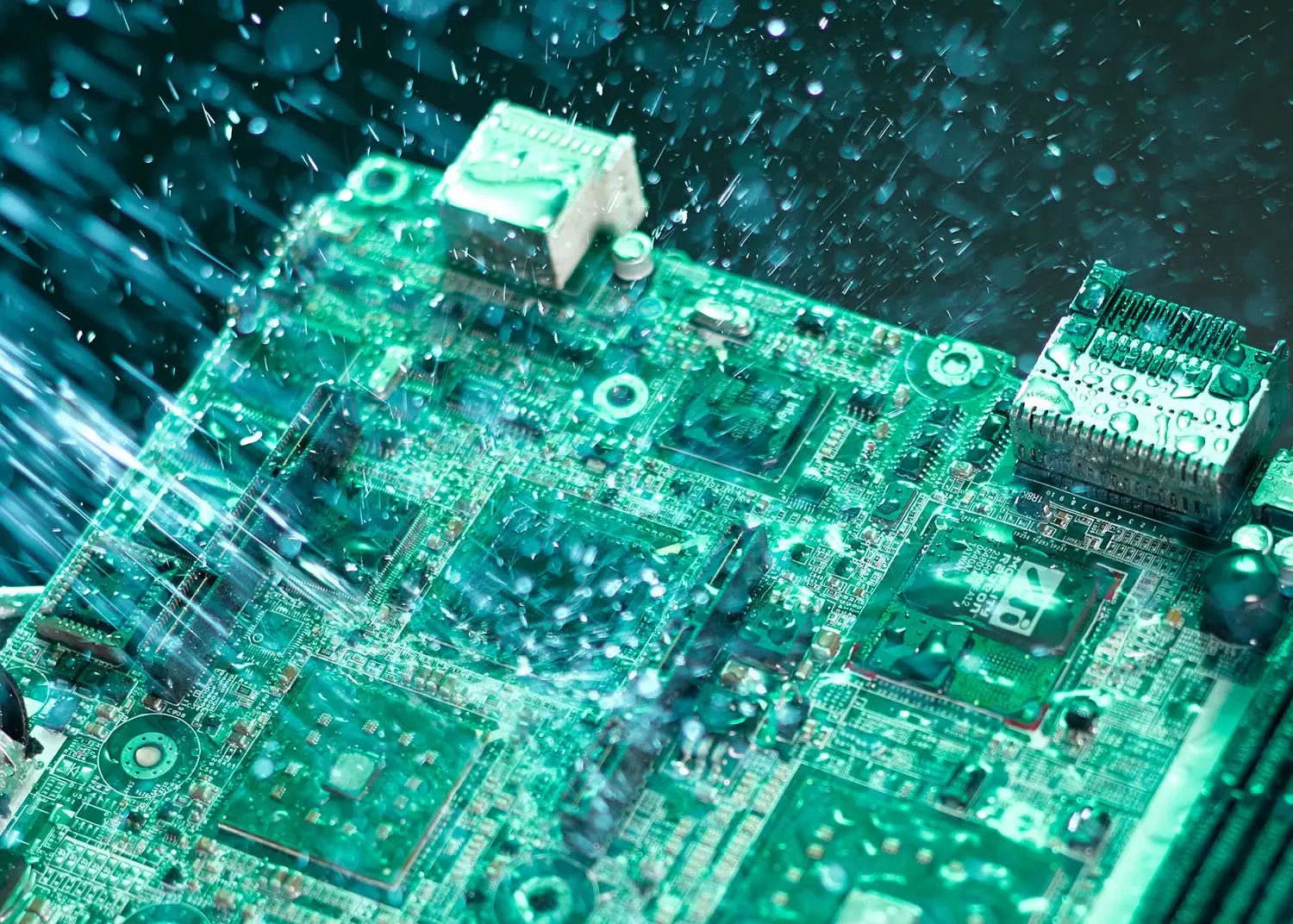
Your product passes lab tests with flying colors. Then, three months into the field, failures start pouring in – coastal surveillance cameras go dark, outdoor power supplies die after a rainy season, and EV battery temperature monitors malfunction. You open the failed units. The conformal coating looks intact. The potting compound appears solid. Yet under a microscope, dendrites have grown between IC pins, or solder joints are covered in green corrosion.
What went wrong? More often than not, the protection strategy – conformal coating vs. potting – was simply the wrong choice for the actual operating environment.

I. Conformal Coating and Potting: Not Just Thick vs. Thin
Many engineers mistakenly believe the difference is only about layer thickness. In reality, they serve fundamentally different purposes.
Conformal coating is a thin polymer layer (20–200 µm) that acts like a "light jacket" for the PCB. It protects against humidity, salt spray, and mold – the classic "three defenses." It adds minimal weight, has little effect on heat dissipation, and allows rework. It is ideal for consumer electronics, telecom gear, and automotive interior modules.
Potting, on the other hand, involves filling an enclosure or encapsulating components with several millimeters of resin, forming a solid block. This provides an almost hermetic seal against severe vibration, shock, extreme temperature swings, prolonged water immersion, and aggressive chemicals. Typical applications include outdoor power supplies, industrial controllers, and automotive ECUs.
Choose incorrectly, and the consequences go far beyond "reduced protection."
Failure 1: Under-protection – Slow, Silent Death of the Circuit
A batch of PCBs destined for a coastal environment received a polyurethane conformal coating. Within six months, nearly ten units failed. Analysis revealed that in hot, humid, salt-laden air, chloride ions penetrated the thin coating, creating an electrolyte film on the PCB surface. Electrochemical migration occurred between pins, dropping isolation resistance to tens of ohms. In extreme cases, residual flux trapped under the coating accelerated creepage and arcing, causing a 380VAC power supply to burn out.
Conformal coating has clear limits. In harsh conditions (high salt, high humidity, or condensation), it cannot block aggressive ions forever. If your environment demands true hermetic sealing, a thin coating will eventually fail – and it will fail catastrophically.
Failure 2: Over-protection – Potting That Kills by Heat or Stress
A low-cost LED power supply manufacturer potted their boards with ordinary resin in an aluminum housing. Lab tests passed. In production, 20% of units shut down within one hour of operation, then restarted after cooling. The reason: the resin had a thermal conductivity below 0.3 W/(m·K), effectively turning the enclosure into a heat trap. ICs constantly tripped thermal protection.
Even orse is mechanical stress from rigid epoxies. One company found that after one year of using epoxy potting, an entire batch showed abnormally high current draw. The epoxy's shrinkage during cure had physically stressed components, altering circuit behavior. For sensitive high-impedance networks, potting compound leakage current can also change voltage divider ratios, triggering false protection signals.
Failure 3: Process Incompatibility – Coating and Potting Fight Each Other
A classic case: a switching power supply worked perfectly before potting. After potting, over-voltage protection triggered immediately. The culprit? Potting compound had altered the feedback network's dielectric environment. A few high-value resistors changed their effective division ratio due to the compound's leakage current.
Similarly, acrylic conformal coating was found to wick under BGA packages during spraying. During temperature cycling, the coating's thermal expansion mismatch caused solder ball cracking. The "protection" became the root cause of failure.
Three Golden Rules for Getting It Right
Light environment → Conformal coating. Harsh environment → Potting. If your product sees mild indoor use, a quality coating is enough. If it faces vibration, temperature shock, or water, potting is non-negotiable.
Extreme conditions → Use both, in the right order. Apply conformal coating first to protect fine-pitch components and hard-to-reach areas. Then selectively pot critical zones. This combines the coverage of coating with the brute-force protection of potting.
Material matching and process control are everything. Even the best coating fails if the PCB is not perfectly clean before application. Even the best potting compound fails if curing conditions are wrong or if it is not matched to the board's thermal expansion.
Why a Professional PCBA Factory Matters
A truly professional contract manufacturer never treats coating or potting as an afterthought. They validate material compatibility, control process parameters (e.g., viscosity, spray pattern, cure profile), and inspect results – using UV fluorescence to detect unintended wicking under components, or thermal imaging to verify potting integrity. They also test for post-potting electrical drift on sensitive networks.
Don't let the wrong protection choice become your product's Achilles' heel. Choose wisely, and partner with a PCBA factory that understands the difference between a jacket and a safe.
With 17 years of expertise in PCBA design, manufacturing, and service, KingshengPCBA is ready to help turn your ideas into reality. Feel free to contact us anytime to discuss your requirements and get a professional quotation.
Please send Email to kspcba@c-alley.com or call us through +86 13828766801 Or submit your inquiry by online form. Please fill out below form and attach your manufacturing files( PCB Gerber files and BOM List) if need quotation. We will contact you shortly.
 +86 13828766801
 kspcba@c-alley.com
 https://www.kingshengpcba.com/
 2/F, Building 6, Tangtou 3rd Industrial Zone, Tangtou Community, Shiyan Town, Baoan District, Shenzhen, China, 518108
We would also like to thank our customers for their trust and support. The company's outstanding achievements are mainly due to the loyalty of our customers, which also encourages and spurs our company to forge ahead.