* On your first PCB Assembly order!
* Up to $300 discount
 C - A L L E Y
 Home | Events | PCB | About Us | News | Contact Us
For any PCBA factory, a quality management system (QMS) is not just a certificate on the wall. It directly impacts yield, delivery stability, and customer trust. Many start with ISO 9001, but when they enter the automotive electronics supply chain, they inevitably face IATF 16949. Though related, these standards differ significantly in depth, scope, and philosophy.
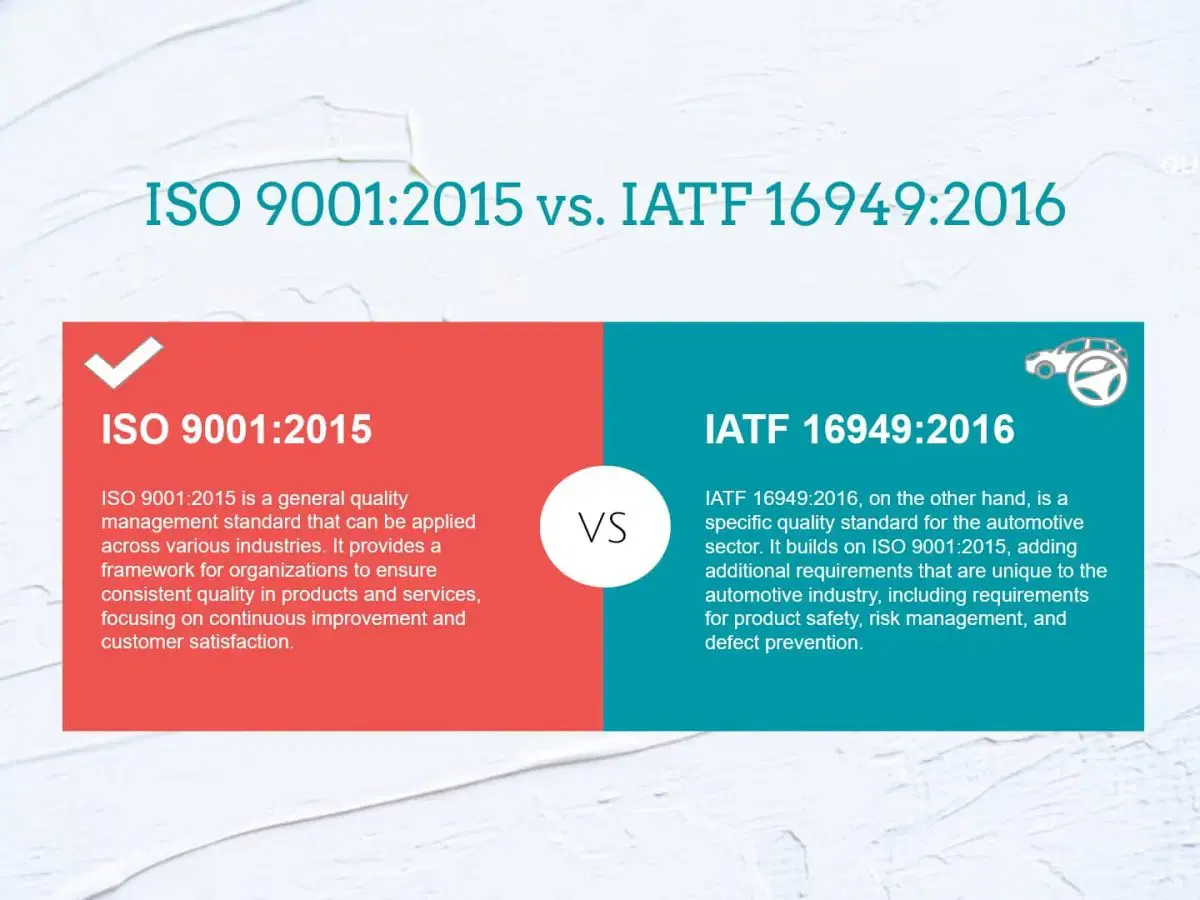
General vs. Automotive-Specific
ISO 9001 is a universal standard applicable to any industry. It establishes a basic framework: customer focus, leadership, engagement, process approach, and continual improvement. For a PCBA factory, ISO 9001 covers incoming inspection, SMT process control, reflow soldering monitoring, and final sampling.
IATF 16949 is not a standalone standard. It builds directly on ISO 9001 by adding automotive-industry requirements. To be IATF 16949 certified, a PCBA factory must fully meet ISO 9001 plus all supplementary clauses. In short, ISO 9001 is a general-purpose tool, while IATF 16949 is the heavy-duty, automotive-grade extension.
Five Critical Differences for PCBA Factories
First, defect rates and tolerance. ISO 9001 often uses AQL sampling, accepting defect levels like 0.65%. IATF 16949 demands zero-defect thinking and mandatory PPM (parts per million) metrics. For automotive PCBs – such as engine control or battery management modules – a single cold solder joint or solder ball can cause catastrophic failure. Therefore, IATF requires process capability Cpk ≥1.33, and Cpk ≥1.67 for special characteristics.
Second, the process approach becomes prescriptive. ISO 9001 encourages process mapping. IATF 16949 enforces the five core tools: APQP (advanced product quality planning), FMEA (failure mode and effects analysis), MSA (measurement system analysis), SPC (statistical process control), and PPAP (production part approval process). For a new PCBA product, you must run PFMEA on solder paste printing, pick-and-place offsets, and reflow profiles, then use SPC to monitor solder paste thickness and peak temperature. MSA must validate automated optical inspection (AOI) equipment, and PPAP requires 19 deliverables for customer approval.
Third, embedded software management. Many modern PCBAs include microcontrollers with firmware. ISO 9001 barely addresses software. IATF 16949 explicitly requires capability assessment, version control, and regular auditing of embedded software. Your factory must establish a software configuration management system to ensure correct firmware versions and avoid batch failures.
Fourth, traceability. ISO 9001 typically requires lot-level traceability – which batch of PCBs, which lot of resistors, which production date. IATF 16949 demands unit-level traceability for safety-critical parts. Each PCBA must be laser-marked or labeled so you can trace it back to the specific placement machine head, reflow profile, solder paste batch, operator, and test data. This forces a robust manufacturing execution system (MES).
Fifth, process and product audits. Under ISO 9001, internal audits are usually annual. IATF 16949 mandates process audits (often VDA 6.3) every three years, plus product audits covering all automotive parts. Many Tier-1 suppliers require at least one VDA 6.3 audit per year, and a score below 80 means disqualification from new projects.
When Should Your PCBA Factory Upgrade?
If you serve consumer electronics, industrial controls, or non-implantable medical devices, ISO 9001 is sufficient. However, once you receive an automotive order – even for a simple lamp control board or seat heater module – the customer will almost certainly demand IATF 16949. Many require PPAP level 3 and on-site process audits.
Holding IATF 16949 allows you to bid on higher-value automotive jobs, with prices 30–50% higher than consumer PCBA. But the investment is real: consultants, training, audits, MES upgrades, and staff time. A small to medium PCBA factory typically needs 6–12 months of preparation.
No Shortcut, Only Improvement
Remember, IATF 16949 does not replace ISO 9001 – it builds on top of it. You cannot abandon ISO 9001. The mindset must shift from "meeting requirements" to "preventing defects," from sampling inspection to statistical process control, and from lot traceability to unit-level traceability. If your PCBA factory is moving into automotive electronics, first strengthen your ISO 9001 foundation, then gradually implement the five core tools. Do not chase the certificate alone; automotive customers will see through fake SPC data or copied FMEAs during on-site audits. Ultimately, whether ISO 9001 or IATF 16949, the goal is the same: make every PCBA trustworthy.
With 17 years of expertise in PCBA design, manufacturing, and service, Kingsheng PCBA is ready to help turn your ideas into reality. Feel free to contact us anytime to discuss your requirements and get a professional quotation.
Please send Email to kspcba@c-alley.com or call us through +86 13828766801 Or submit your inquiry by online form. Please fill out below form and attach your manufacturing files( PCB Gerber files and BOM List) if need quotation. We will contact you shortly.
 +86 13828766801
 kspcba@c-alley.com
 https://www.kingshengpcba.com/
 2/F, Building 6, Tangtou 3rd Industrial Zone, Tangtou Community, Shiyan Town, Baoan District, Shenzhen, China, 518108
We would also like to thank our customers for their trust and support. The company's outstanding achievements are mainly due to the loyalty of our customers, which also encourages and spurs our company to forge ahead.