* On your first PCB Assembly order!
* Up to $300 discount
 C - A L L E Y
 Home | Events | PCB | About Us | News | Contact Us
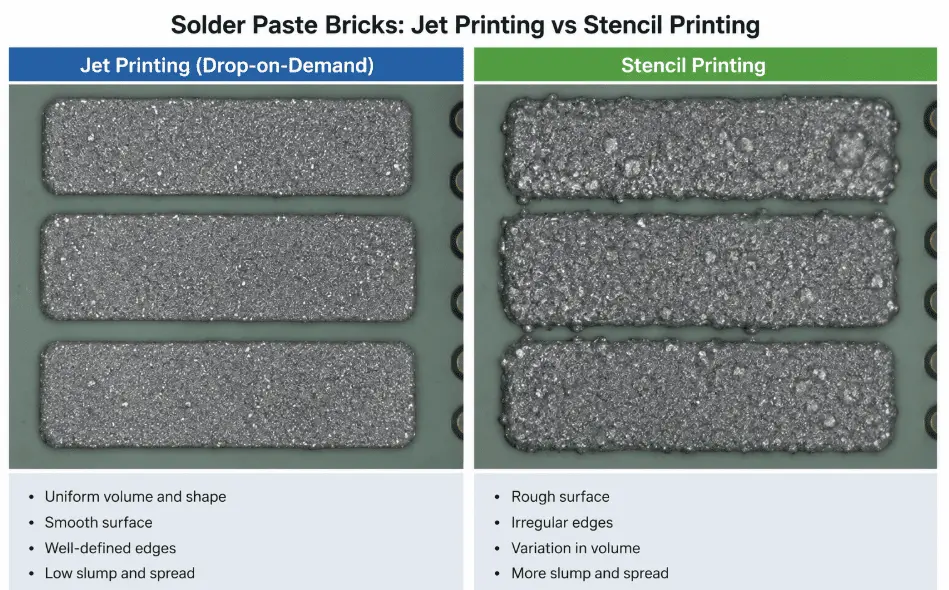
In surface mount technology (SMT), solder paste printing is the first critical process – and often the biggest source of defects. Industry data suggests that up to 60% of assembly failures originate from poor paste deposition. Traditional stencil printing relies on a physical stencil, squeegee, and precise alignment. While proven for mass production, it struggles with frequent changeovers, complex geometries, and non-flat surfaces.
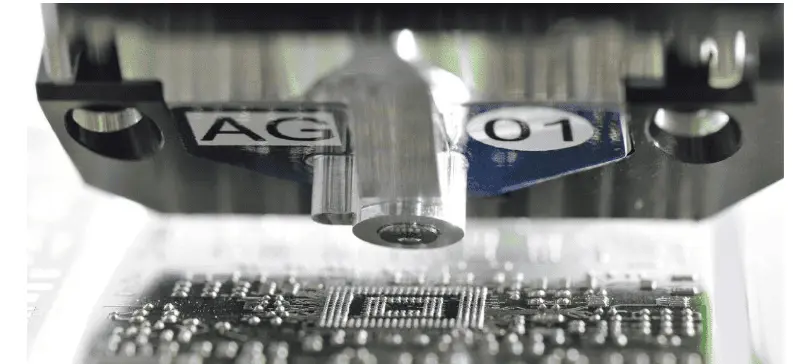
Jet printing (also known as solder paste jetting) offers a radically different approach: non-contact, stencil-free deposition. Instead of pushing paste through a laser-cut foil, a jetting system uses pneumatic or piezoelectric actuators to eject tiny, controlled droplets of solder paste directly onto PCB pads. This raises an important question for PCBA factories – is jet printing a true replacement for stencil printing, or merely a complementary tool?
I. Where Jet Printing Excels
The most immediate benefit of jet printing is flexibility. Without the need to design, order, and store physical stencils, changeovers become purely a software action. For factories handling dozens of small batch orders or rapid prototypes, this can cut lead times from hours to minutes. It also eliminates stencil cleaning, storage, and disposal – reducing both chemical use and waste.
Jet printing also provides precise, programmable solder volume. Different pads on the same board can receive different amounts of paste, which is invaluable for mixed-technology assemblies (e.g., fine-pitch BGAs alongside large power components) or for compensating uneven board surfaces. Because the process is non-contact, it handles warped boards, flexible circuits, and step-stenciling situations effortlessly – areas where traditional printing often causes bridging or insufficient paste.
For PCBA factories that serve R&D, aerospace, medical devices, or other low-volume / high-mix markets, jet printing can significantly reduce inventory costs and improve responsiveness.
II. When Stencil Printing Remains the Better Choice
Despite these advantages, jet printing is not a universal replacement. In high-volume production – batches above a few hundred boards – stencil printing still wins on throughput and cost. A stencil printer can complete a full board in under 30 seconds, while jet printing may take several minutes for dense designs with thousands of pads, such as large server motherboards. The cost per board with stencil printing drops dramatically once the stencil is made, whereas jetting uses specialised (often finer-powder) solder pastes that are more expensive, and consumable jet heads add ongoing maintenance.
For standard FR4 boards with conventional components and batch sizes above 100–200 pieces, stencil printing remains the most economical and fastest method.
III. A Practical Hybrid Strategy for PCBA Factories
Rather than an "either-or" decision, leading PCBA shops are moving toward a hybrid model:
1. Stencil printing remains the workhorse for mature, high-volume products.
2. Jet printing is deployed for quick-turn prototypes, engineering change orders, very small batches (e.g., 1–50 boards), and challenging assemblies (0201 passives, flex circuits, or boards with cavity steps).
Jet printing also offers a unique repair capability: it can add precise solder dots inside densely populated areas where a stencil cannot be placed – a game changer for rework and design-of-experiment (DOE) boards.
IV. Feasibility Verdict: Not Replacement, but Powerful Complement
From today's market perspective, jet printing will not replace stencil printing for mainstream mass production. However, for a growing segment of customised, quick-turn, and high-complexity orders, it is becoming a competitive necessity. The global jet printing solder paste market was valued at approximately $126 million in 2024 and is projected to grow at around 5.8% CAGR through 2032 – a clear signal that more factories are adopting the technology.
For PCBA managers evaluating investment: if your product mix involves frequent changeovers (>20 different boards per week), small batches (<100 pieces), or demanding form factors (flex, rigid-flex, or uneven surfaces), adding a jet printing station can reduce your stencil inventory and scrap rates. If your shop runs long, stable production lines, stick with stencil printing – but keep an eye on jetting as a secondary station for niche tasks.
Ultimately, the most efficient PCBA factory of the near future will likely use both technologies side by side: stencil printing for volume and speed, jet printing for agility and precision. The question is not "which one wins?" but "how to integrate both for maximum overall equipment effectiveness (OEE)?". Jet printing has earned its place on the SMT floor – as a powerful complement, not a total replacement.
With 17 years of expertise in PCBA design, manufacturing, and service, Kingsheng PCBA is ready to help turn your ideas into reality. Feel free to contact us anytime to discuss your requirements and get a professional quotation.
Please send Email to kspcba@c-alley.com or call us through +86 13828766801 Or submit your inquiry by online form. Please fill out below form and attach your manufacturing files( PCB Gerber files and BOM List) if need quotation. We will contact you shortly.
 +86 13828766801
 kspcba@c-alley.com
 https://www.kingshengpcba.com/
 2/F, Building 6, Tangtou 3rd Industrial Zone, Tangtou Community, Shiyan Town, Baoan District, Shenzhen, China, 518108
We would also like to thank our customers for their trust and support. The company's outstanding achievements are mainly due to the loyalty of our customers, which also encourages and spurs our company to forge ahead.