* On your first PCB Assembly order!
* Up to $300 discount
 C - A L L E Y
 Home | Events | PCB | About Us | News | Contact Us
Electrolytic capacitors are widely used in power supplies, filtering, and signal coupling circuits. However, they are also one of the most failure-prone components on a PCBA. Among all stress factors, high temperature is the number one killer. Understanding the failure mechanisms under thermal stress is essential for any PCBA factory that aims to deliver long-life, reliable products.
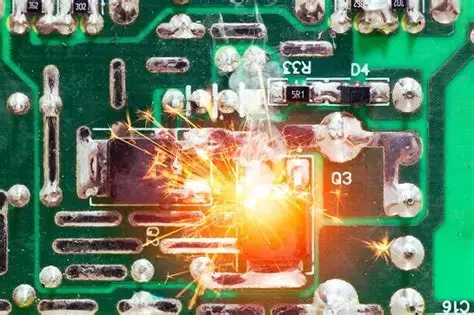
I. Why Are Electrolytic Capacitors So Sensitive to Heat?
A typical aluminum electrolytic capacitor consists of anode foil, cathode foil, an electrolyte, and separator paper. The electrolyte is the key material that enables self-healing of the oxide layer. Unfortunately, electrolyte is highly temperature-sensitive. High temperatures accelerate evaporation and chemical degradation.
The Arrhenius model shows a well-known "10-degree rule": every 10 °C rise in operating temperature halves the capacitor's lifetime. For example, a capacitor rated for 5 000 hours at 105 °C will last only 2 500 hours at 115 °C, but up to 20 000 hours at 85 °C.
II. Typical Failure Modes Caused by High Temperature
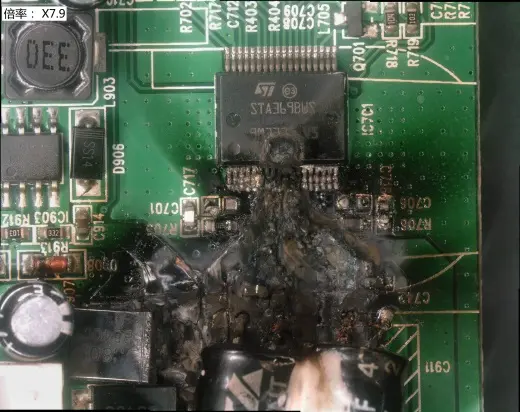
2.1 Electrolyte dry-out – This is the most common failure. Heat causes the electrolyte to slowly escape through the rubber seal. As the electrolyte decreases, equivalent series resistance (ESR) rises sharply, leading to more internal heating and thermal runaway. The result: reduced capacitance, high ripple, unstable power rails, and system resets.
2.2 Pressure build-up and venting – Excessive heat (or high ripple current) generates gas inside the capacitor. When pressure exceeds the vent design limit, the top bulges or cracks, leaking electrolyte. This not only kills the capacitor but may also corrode nearby PCB traces and components.
2.3 Oxide layer degradation – High temperatures weaken the anodic oxide film, increasing leakage current. Higher leakage generates more heat, forming a positive feedback loop that eventually causes short circuits.
III. Hidden Heat Stress During PCBA Manufacturing
Many PCBA factories overlook that heat damage can begin during assembly, not just in end-use applications.
3.1 Reflow soldering – SMD electrolytic capacitors typically require a peak temperature ≤260 °C, with time above 240 °C under 30 seconds. Improper thermal profiles or poorly calibrated ovens can cause latent damage.
3.2 Wave soldering and hand touch-up – Through-hole capacitors are sensitive to soldering iron temperature and contact time. Operators using 350 °C irons for too long can transfer heat directly into the capacitor body, damaging electrolyte and seals.
3.3 Conformal coating curing / baking – Uneven temperature zones in curing ovens may expose capacitors to prolonged moderate heat beyond their rated limits.
IV. How a Professional PCBA Factory Controls Thermal Risks
To deliver reliable assemblies, a PCBA factory must address high-temperature stress from design through final verification.
4.1 Component selection – Choose high-temperature grade (e.g., 125 °C) capacitors based on actual operating conditions and ripple current. Demand lifetime calculation reports from suppliers; avoid low-cost underspecification.
4.2 Process control – Strictly follow the soldering profile specified in capacitor datasheets. Regularly calibrate reflow ovens, wave soldering machines, and curing ovens. For rework stations, set iron temperature limits (e.g., ≤300 °C) and time limits (≤3 seconds per joint).
4.3 PCB layout and thermal management – Keep electrolytic capacitors away from high-power dissipating components (MOSFETs, processors, power resistors). Ensure proper airflow and add copper pours or thermal pads when needed.
4.4 Reliability verification – Perform high-temperature operating life (HTOL) tests and thermal cycling on key batches. Monitor ESR and capacitance trends. Establish failure analysis (FA) capability to trace early failures back to process anomalies.
V. Conclusion
Electrolytic capacitors rarely fail suddenly – high-temperature stress accumulates over time. Every "compromise" on soldering temperature, every ignored hot spot on the PCB, can later become a field failure and a customer complaint.
As a professional PCBA factory, we treat thermal management of electrolytic capacitors as a core process control point. Because the lifetime of every capacitor represents our commitment to product reliability. Contact us to discuss how we can help you avoid heat-related capacitor failures in your next project.
With 17 years of expertise in PCBA design, manufacturing, and service, KingshengPCBA is ready to help turn your ideas into reality. Feel free to contact us anytime to discuss your requirements and get a professional quotation.
Please send Email to kspcba@c-alley.com or call us through +86 13828766801 Or submit your inquiry by online form. Please fill out below form and attach your manufacturing files( PCB Gerber files and BOM List) if need quotation. We will contact you shortly.
 +86 13828766801
 kspcba@c-alley.com
 https://www.kingshengpcba.com/
 2/F, Building 6, Tangtou 3rd Industrial Zone, Tangtou Community, Shiyan Town, Baoan District, Shenzhen, China, 518108
We would also like to thank our customers for their trust and support. The company's outstanding achievements are mainly due to the loyalty of our customers, which also encourages and spurs our company to forge ahead.