* On your first PCB Assembly order!
* Up to $300 discount
 C - A L L E Y
 Home | Events | PCB | About Us | News | Contact Us
In today's electronics industry—where miniaturization, high density, and long-term reliability are non-negotiable—solder joint integrity is paramount. Among all failure modes, brittle fracture is particularly insidious. It often occurs during assembly, testing, or early customer use, without obvious warning. For a professional PCBA factory, understanding the root causes of brittle fracture is not just about yield improvement; it's about earning trust in mission-critical applications like automotive, medical, and industrial controls.
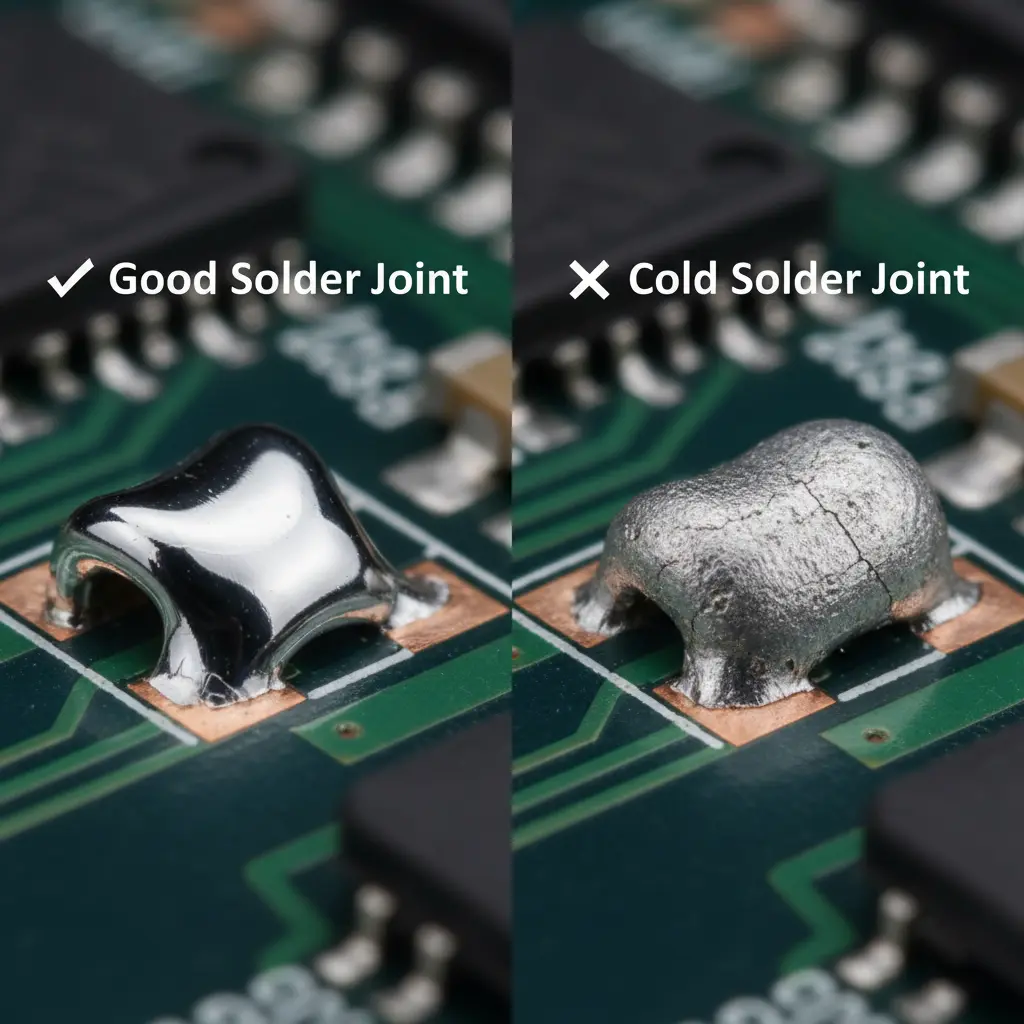
I What Is Brittle Fracture?
Brittle fracture refers to a crack that propagates along grain boundaries or intermetallic interfaces with little or no plastic deformation. Unlike ductile failure, the fracture surface appears bright, flat, and granular. Cracks typically run through or along the intermetallic compound (IMC) layer. The danger? Electrical tests may pass intermittently, while real-world stresses like drop impact, vibration, or thermal cycling trigger field failures.
II Four Root Causes of Brittle Fracture
2.1 Excessive or Abnormal IMC Growth
A moderate IMC layer (1–3 µm) ensures good metallurgical bonding. However, when the IMC exceeds 5–8 µm, its inherent brittleness dominates.
Root sources: Excessive peak reflow temperature (>260 °C), overly long time above liquidus (>90 s), or multiple reflow cycles. Aging further promotes Cu₃Sn growth and Kirkendall voids, weakening the interface.
2.2 Improper Surface Finish
Different PCB finishes have different brittle fracture risks:
ENIG (Electroless Nickel Immersion Gold) – "Black pad" due to excessive corrosion leads to a phosphorus-rich layer, drastically reducing interface strength.
Immersion Silver (ImAg) – Micro-voids aggregate under high temperature/humidity.
OSP (Organic Solderability Preservative) – Residual oxidation results in weak local IMC formation, concentrating stress.
2.3 Mechanical Stress & Design Mismatch
Flex zones in rigid-flex boards: if solder joints are not on the neutral axis, repeated bending stress transfers directly to the IMC.
CTE mismatch between large components and PCB: thermal cycling generates shear strain concentrated at the joint interface.
Secondary processes (depanelization, screw fastening, connector mating) can apply instantaneous shocks that initiate micro-cracks.
2.4 Solder Alloy & Process Window Selection
High-silver alloys (e.g., SAC305) offer high strength but have higher strain rate sensitivity, making them more prone to brittle fracture under high-speed impact.
Low-silver or SAC-Bi alloys improve drop resistance but require revalidation of IMC growth behavior.
Slow cooling rates promote coarse, needle-like Cu₆Sn₅, degrading interface toughness.
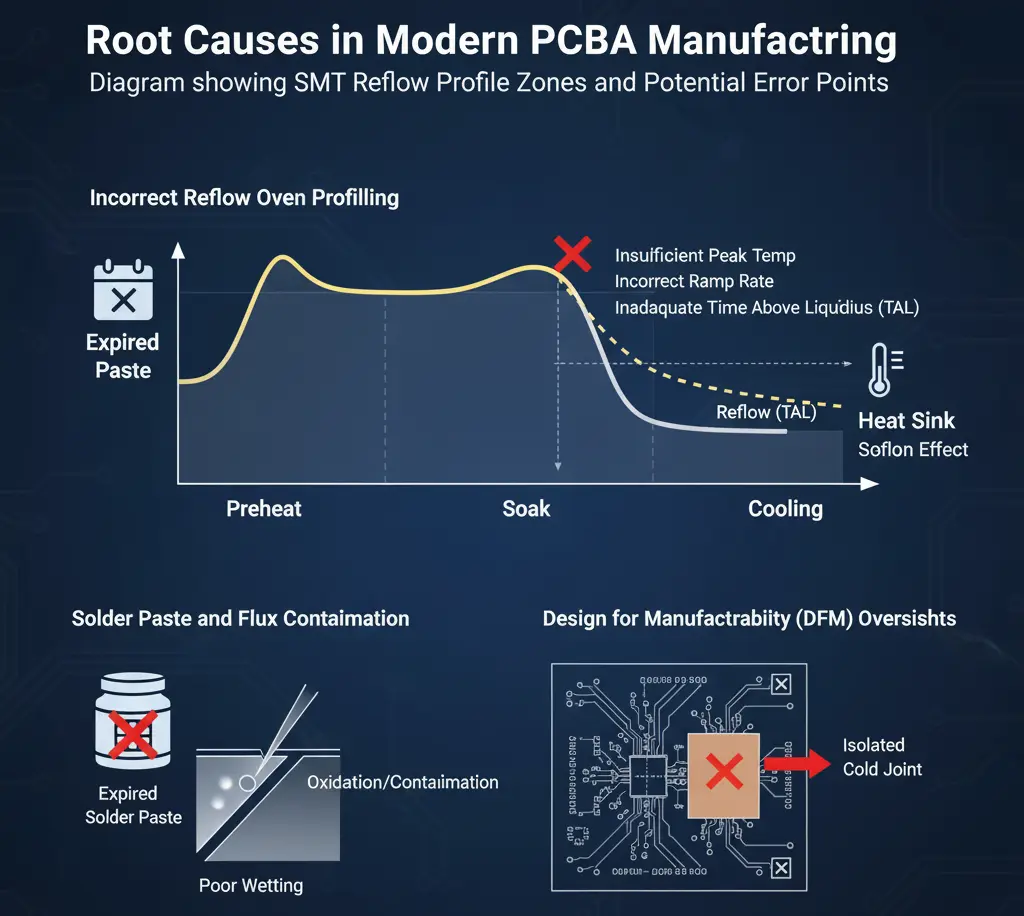
III How a Professional PCBA Factory Prevents Brittle Fracture
Prevention must go beyond inspection. A closed-loop system covering process control, incoming material verification, design collaboration, and reliability testing is essential.
3.1 Fine-Tuned Reflow Process Control
For each PCB finish + solder paste combination, use DSC profiling to lock peak temperature (typically 240–250 °C) and time above liquidus (60–90 s) to avoid IMC overgrowth.
For double-sided reflow, use thermal simulation to predict worst-case thermal history and lower the second peak if needed.
3.2 Strict Incoming & In-Process Quality
ENIG boards: perform quick black-pad screening (acid leaching + SEM) to reject batches with abnormal phosphorus content.
OSP boards: enforce shelf-life control (<6 months) and solderability testing before use.
First-article cross-section analysis per shift to quantify IMC thickness and morphology.
3.3 Design for Manufacturability (DFM) Collaboration
Review customer designs: for flex-zone components, recommend strain relief structures (teardrop pads, reinforcing adhesive).
Suggest tougher finishes like ENEPIG or thick ENIG for brittle-fracture-prone applications.
For large BGAs or ceramic components, propose underfill to share interfacial stress.
3.4 Reliability Testing Beyond ICT/FT
In-circuit and functional tests cannot reliably detect micro-cracks. Implement dynamic bending (IPC-9707), high-speed impact testing, and post-thermal-cycle shear/pull testing. Maintain an in-house failure analysis lab: use SEM/EDS on fracture surfaces to distinguish intergranular from transgranular fracture and trace root causes precisely.
IV Our Commitment to Customers
We know that one brittle solder joint can ruin the reputation of an entire medical device or automotive system. That's why we don't just "follow specs". We proactively:
Update our solder joint reliability control plan quarterly, aligning with IPC-9701, JEDEC, and IATF 16949.
Provide customers with a process window margin report, defining safe boundaries for different stress levels.
Offer failure analysis outsourcing services to eliminate brittle fracture risks from the design phase onward.
V Conclusion
Brittle fracture is the result of uncontrolled interactions between heat, mechanics, and materials. A truly professional PCBA factory must master the entire chain—from micro-mechanisms to macro-processes. Choose a partner that makes every solder joint withstand the test of time and stress.
Need a risk assessment for your current design? Contact our process engineering team for a free first-article cross-section analysis and brittle fracture evaluation.
With 17 years of expertise in PCBA design, manufacturing, and service, KingshengPCBA is ready to help turn your ideas into reality. Feel free to contact us anytime to discuss your requirements and get a professional quotation.

Please send Email to kspcba@c-alley.com or call us through +86 13828766801 Or submit your inquiry by online form. Please fill out below form and attach your manufacturing files( PCB Gerber files and BOM List) if need quotation. We will contact you shortly.
 +86 13828766801
 kspcba@c-alley.com
 https://www.kingshengpcba.com/
 2/F, Building 6, Tangtou 3rd Industrial Zone, Tangtou Community, Shiyan Town, Baoan District, Shenzhen, China, 518108
We would also like to thank our customers for their trust and support. The company's outstanding achievements are mainly due to the loyalty of our customers, which also encourages and spurs our company to forge ahead.