* On your first PCB Assembly order!
* Up to $300 discount
 C - A L L E Y
 Home | Events | PCB | About Us | News | Contact Us
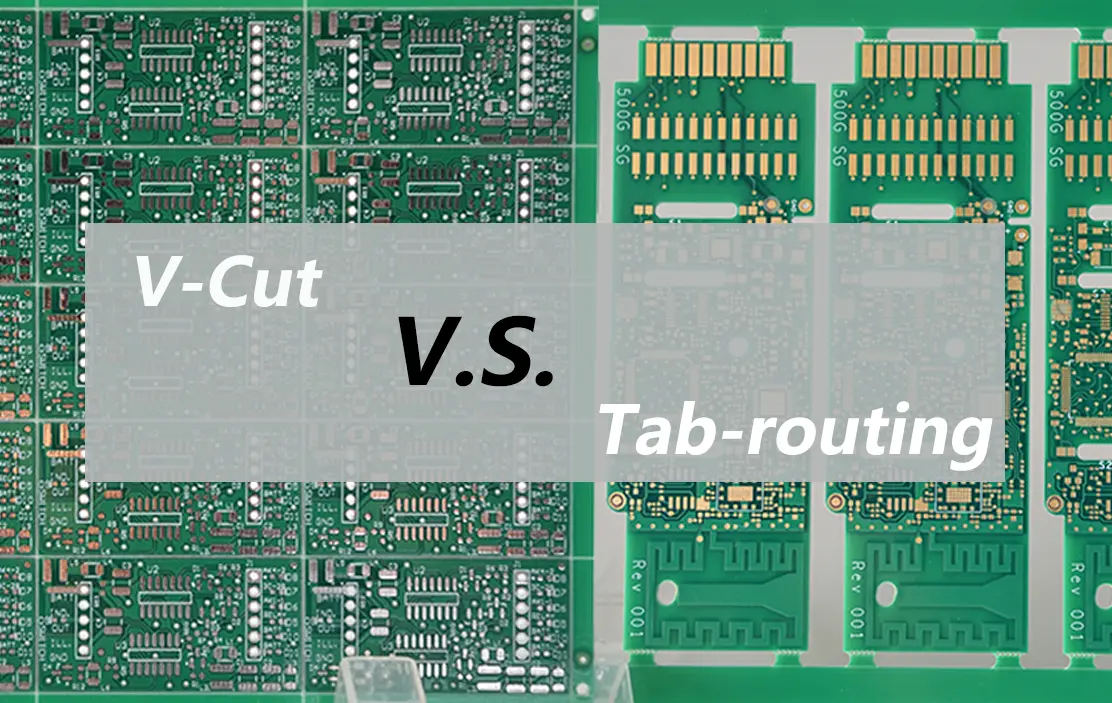
In PCBA manufacturing, depanelization is the process of separating individual PCBs from a production panel after SMT and DIP assembly. Choosing the right method—V-Cut or Routing—directly affects product quality, efficiency, and cost. As a professional PCBA factory, we help customers make this decision based on their board design and production volume. Here is a clear, practical comparison.
I V-Cut: Fast and Economical for Straight Lines
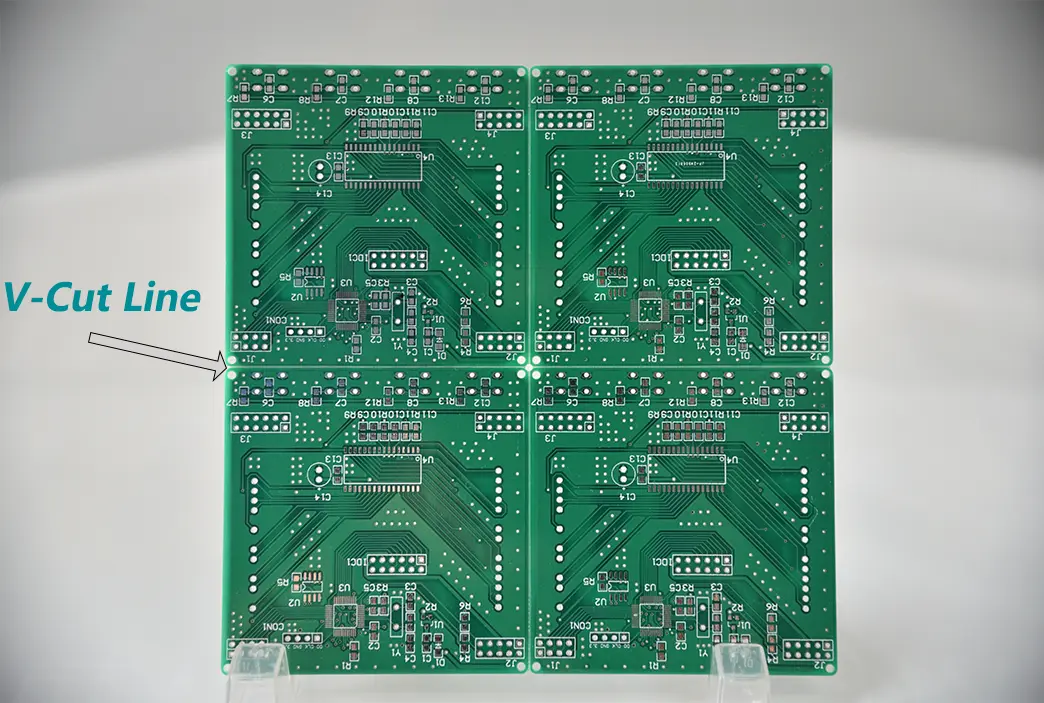
V-Cut involves cutting V-shaped grooves along the breakaway lines of a PCB panel, leaving about one-third of the board thickness connected. Depaneling is then done by snapping along the groove, either manually or with a dedicated machine.
The main advantages of V-Cut are high throughput and low cost. In-line V-Cut machines can process thousands of boards per hour, and the V-grooves are created during PCB fabrication with almost no additional expense. When a professional V-Cut scorer is used, the bending stress is well controlled and far more consistent than hand breaking.
However, V-Cut has significant limitations. It works only for straight lines—curves, circles, or any irregular shape are impossible. The PCB edges must be perfectly straight, and no components can protrude over the edge. The resulting break edge is square, not rounded.
V-Cut is best suited for regular rectangular boards, high-volume consumer electronics such as LED light strips, power supplies, and simple control boards.
II Routing: Flexible and Precise for Complex Shapes
Routing uses a high-speed carbide router bit (typically 2.0 mm or 2.4 mm diameter) to cut along a programmed path. A small gap of about 1.5–2 mm is created between boards, leaving only a few tiny "tab" connections that are broken manually or with a fixture at the end.
The key strengths of Routing are its unlimited shape capability and clean cut quality. It can handle any curve, arc, internal cutout, or irregular outline. The cut edges are smooth and precise, with no risk of damaging nearby components. Routing also allows more compact panel designs, improving material utilization. Moreover, the mechanical stress during both cutting and final tab separation is very low, making it ideal for stress-sensitive components.
On the downside, Routing equipment costs three to five times more than a V-Cut machine. Throughput is lower because the router must trace the full contour of each board. The router bits are consumables and need periodic replacement. Additionally, the process generates dust, requiring an effective vacuum collection system.
Routing is the right choice for irregular shapes, boards with components extending over the edge, thick copper or ceramic PCBs, and high-reliability products in medical, military, or aerospace applications.
III How to Choose Between V-Cut and Routing
In practice, the decision depends on four main factors: PCB shape, component placement, board thickness, production volume, and stress sensitivity.
For PCB shape, if your board is a simple rectangle with straight edges, V-Cut works perfectly. If it is round, polygonal, has slots, or requires curved edges, you must use Routing.
For component placement, V-Cut requires at least 5 mm clearance from the board edge with no protruding parts. Routing can handle components right up to or even over the edge.
For board thickness, V-Cut is comfortable between 0.6 mm and 1.6 mm. Routing works from as thin as 0.4 mm up to 3.2 mm, and it is particularly suitable for thick boards.
For production volume, V-Cut excels at high volumes above 100,000 panels per month. Routing is more economical for volumes below 50,000 panels per month or for high-mix, low-volume production. Finally, stress sensitivity is a critical consideration. If your PCB contains large MLCCs (multilayer ceramic capacitors), especially size 1206 and above, Routing is often the safer choice. The bending stress from V-Cut can create hidden micro-cracks inside ceramic capacitors, leading to field failures that are difficult to trace.
IV Real Factory Examples
One of our customers produced a smart plug with a rectangular 1.2 mm board. All components were placed more than 5 mm from the edge, and the monthly volume was 500,000 units. We recommended V-Cut with an inline depanelizer. The result was high efficiency, low cost, and zero stress-related quality complaints over one year of production.
Another customer needed a drone ESC board with an irregular hexagonal shape. MOSFETs and connectors were located right at the board edge, making V-Cut impossible. We switched to Routing with custom fixtures. By optimizing the tool path, we reduced cutting time to 3.5 seconds per board and met the customer’s 50,000-unit monthly demand.
V Conclusion
V-Cut and Routing are not competing technologies—they are complementary. The right choice depends entirely on your board geometry, component placement, volume, and stress tolerance. As a professional PCBA factory, our role is to guide you to the optimal solution.
In summary, for straight-line, high-volume, simple rectangular boards, V-Cut gives you speed and low cost. For complex shapes, edge-mounted components, or stress-sensitive designs, Routing delivers precision and reliability.
If you are unsure which depanelization method fits your product, contact us. We offer free process evaluations based on your Gerber files and production requirements. Follow us for more PCBA manufacturing insights.
With 17 years of expertise in PCBA design, manufacturing, and service, KingshengPCBA is ready to help turn your ideas into reality. Feel free to contact us anytime to discuss your requirements and get a professional quotation.
Please send Email to kspcba@c-alley.com or call us through +86 13828766801 Or submit your inquiry by online form. Please fill out below form and attach your manufacturing files( PCB Gerber files and BOM List) if need quotation. We will contact you shortly.
 +86 13828766801
 kspcba@c-alley.com
 https://www.kingshengpcba.com/
 2/F, Building 6, Tangtou 3rd Industrial Zone, Tangtou Community, Shiyan Town, Baoan District, Shenzhen, China, 518108
We would also like to thank our customers for their trust and support. The company's outstanding achievements are mainly due to the loyalty of our customers, which also encourages and spurs our company to forge ahead.