* On your first PCB Assembly order!
* Up to $300 discount
 C - A L L E Y
 Home | Events | PCB | About Us | News | Contact Us
In PCBA manufacturing, golden fingers—the gold-plated edge connectors that interface between the board and external systems—are among the most sensitive components on any printed circuit board. Their surface integrity directly determines signal transmission stability, contact resistance, and long-term reliability. Solder contamination on golden fingers is a persistent quality challenge that can lead to intermittent connections, signal loss, or complete board failure. At KING SHENG, we have developed a systematic approach to prevent this issue through rigorous process control and comprehensive quality management.
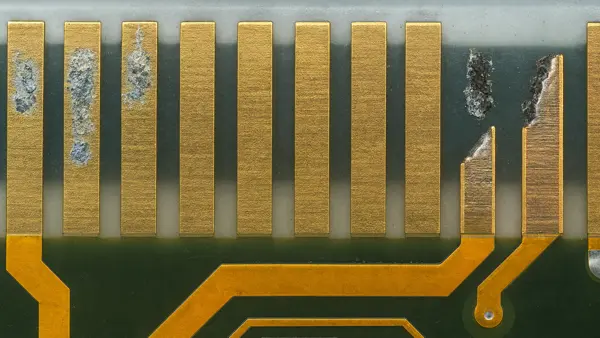
I Root Causes of Golden Finger Solder Contamination
Based on extensive production data and failure analysis, KING SHENG’s engineering team has identified five primary causes of solder contamination on golden fingers.
Reflow soldering solder splash is the most frequent contributor. During the reflow process, if the temperature ramp-up rate exceeds optimal levels, solvents within the solder paste vaporize rapidly, causing micro-sized solder balls to scatter onto surrounding areas. Poor solder paste quality, inadequate thawing, moisture absorption, and contaminated stencils all increase the likelihood of splash. Our process optimization has shown that controlling ramp rates between 1.8°C and 2.2°C per second significantly reduces this risk.
Wave soldering protection failure presents another major risk, particularly for mixed-technology assemblies. When carriers do not maintain tight contact with the board—typically with gaps exceeding 0.5mm—molten solder can seep through during wave contact. Worn fixtures, excessive wave height, improper conveyor angles, and over-application of flux all contribute to this issue.
Manual soldering errors during touch-up and rework operations are a common source of contamination. Improper soldering iron technique, incorrect wire feeding positions, and residual solder debris on workbenches can all result in accidental contact with golden fingers.
Inadequate protective materials compromise shielding effectiveness. Standard high-temperature tape that cannot withstand peak reflow temperatures may peel, curl, or leave adhesive residue. Poorly fabricated fixtures with loose tolerances fail to provide complete coverage.
Cross-contamination between processes occurs as boards move through SMT, DIP, testing, and packaging. Contact with conveyor rails carrying residual flux or solder particles, operator handling, and contaminated work surfaces can all transfer contaminants onto unprotected golden fingers.
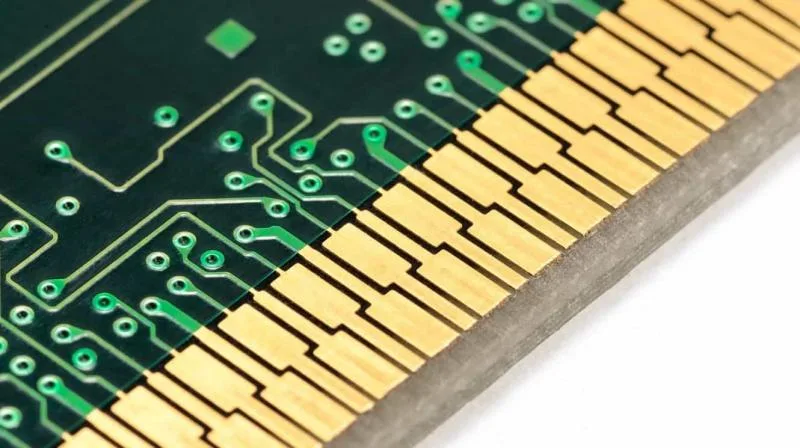
II KING SHENG’s Comprehensive Prevention System
To address these root causes, KING SHENG has implemented a multi-layered prevention strategy that spans process optimization, physical protection, standardized operations, and continuous monitoring.
Process optimization begins with material control. All solder paste follows strict FIFO inventory management and is used within four hours of opening. Reflow profiles are verified during first-piece inspections, with ramp rates, soak times, and peak temperatures optimized for each product. We select high-quality, low-splash solder paste formulations to minimize risk at the source.
Physical protection employs robust materials and precision tooling. We use polyimide tape rated above 260°C, applied with dedicated tools to ensure complete coverage without bubbles or wrinkles. For high-volume products, custom fixtures with precision-machined shielding provide consistent, repeatable protection. Wave soldering carriers are designed with fully enclosed golden finger protection and maintained to gap tolerances under 0.5mm.
Standardized operations are documented in detailed work instructions. All manual soldering personnel must complete certification and undergo regular requalification. Workstations are cleaned on a scheduled basis, and anti-static gloves are mandatory—direct contact with golden fingers is strictly prohibited throughout the facility.
Quality monitoring integrates automated and manual inspection. AOI systems are programmed with dedicated golden finger inspection zones to detect contamination, scratches, and other defects. When issues arise, quality engineers conduct root cause analysis and implement corrective actions within a closed-loop improvement system. SPC monitoring tracks process capability, and monthly quality reviews drive continuous refinement.
III Conclusion
Golden finger protection reflects a PCBA manufacturer’s process discipline and commitment to quality. At KING SHENG, we believe that reliability is built through attention to every detail—from solder paste storage temperature to fixture machining accuracy, from tape application technique to AOI inspection algorithms.
For partners seeking a PCBA manufacturer dedicated to uncompromising quality, KING SHENG offers experienced engineering support, robust process controls, and a comprehensive quality system. Contact us to learn more about our capabilities or to schedule a facility tour.
With 17 years of expertise in PCBA design, manufacturing, and service, KingshengPCBA is ready to help turn your ideas into reality. Feel free to contact us anytime to discuss your requirements and get a professional quotation.

Please send Email to kspcba@c-alley.com or call us through +86 13828766801 Or submit your inquiry by online form. Please fill out below form and attach your manufacturing files( PCB Gerber files and BOM List) if need quotation. We will contact you shortly.
 +86 13828766801
 kspcba@c-alley.com
 https://www.kingshengpcba.com/
 2/F, Building 6, Tangtou 3rd Industrial Zone, Tangtou Community, Shiyan Town, Baoan District, Shenzhen, China, 518108
We would also like to thank our customers for their trust and support. The company's outstanding achievements are mainly due to the loyalty of our customers, which also encourages and spurs our company to forge ahead.