* On your first PCB Assembly order!
* Up to $300 discount
 C - A L L E Y
 Home | Events | PCB | About Us | News | Contact Us
I .In today’s world, where digital living has become ubiquitous, routers have long been indispensable network hubs in homes, shops and offices, and the PCBA circuit board serves as the router’s central processing unit and communication medium. The stability of a router’s internet speed, signal coverage, ability to penetrate walls, number of connected devices and service life are almost entirely determined by the design, material selection and manufacturing quality of its built-in PCBA. Whether it is a standard home router, a dual-band gigabit router, or an enterprise-grade Wi-Fi 6 or Wi-Fi 7 router, the differences in performance essentially stem from the hardware configuration and manufacturing processes of the PCBA.
II. The router PCBA primarily integrates core components such as the main control chip, Wi-Fi RF module, Ethernet port circuitry, power management, signal amplification unit, memory and flash storage, and antenna interfaces, undertaking critical tasks such as data reception, decoding and forwarding, wireless signal transmission, and the coordination of multi-device networking. With the increasing number of smart devices throughout the home—such as mobile phones, televisions, smart home devices and security cameras—all connecting simultaneously, higher demands are placed on the router PCBA’s multi-concurrent processing capabilities, low latency and resistance to interference. Substandard PCBAs are prone to issues such as sluggish internet speeds, frequent disconnections, overheating and crashes, and signal attenuation, which severely impact the daily network experience.
III.From a design perspective, router PCBs place great emphasis on layout and electromagnetic compatibility (EMC) design. Wireless RF signals are extremely sensitive to cabling; therefore, the PCB employs a multi-layer design with independent ground planes, with digital and RF circuits routed in separate zones and high- and low-voltage circuits isolated, effectively reducing electromagnetic crosstalk. PCB assemblies for Gigabit and higher-speed routers strictly adhere to impedance matching and equal-length differential pair routing to ensure that both wired Gigabit and high-speed wireless signals are transmitted without attenuation. Furthermore, to support concurrent 2.4 GHz and 5 GHz dual-band operation, the board layout is more intricate, with dedicated RF channels reserved to prevent interference between the two bands.
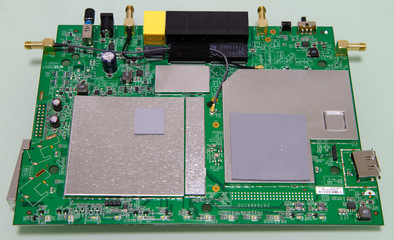
VI.In terms of materials and manufacturing processes, high-quality router PCB assemblies typically utilise high-TG, heat-resistant circuit boards that are resistant to warping and solder joint failure during prolonged operation under heavy loads. Key RF components and power management chips are selected to industrial-grade specifications, offering heat resistance and resistance to ageing, making them suitable for continuous, year-round operation. The SMT assembly process is precise, ensuring high accuracy in the placement of fine-pitch components and producing full, uniform solder joints, thereby minimising the risk of cold solder joints or solder defects at the source. High-quality router PCBs also incorporate heat-dissipating vias and optimised power circuit designs to lower the operating temperatures of the main controller and RF chips, thereby preventing speed throttling or network disconnections caused by overheating.
V. There are also significant differences between home and enterprise-grade router PCBs. Home models prioritise value for money and compact integration, with a streamlined circuit layout to meet the needs of everyday multi-device connectivity; enterprise-grade router PCBs, on the other hand, utilise a multi-layer, thick copper board design to enhance current-carrying capacity and interference resistance, supporting hundreds of devices online simultaneously. They offer greater stability and a longer service life, making them suitable for complex network environments such as office buildings, shopping centres and factories.
VI. With the widespread adoption of Wi-Fi 6 and the gradual rollout of Wi-Fi 7, demands on networks are rising due to whole-home smart systems, high-definition streaming, cloud gaming and remote working. This is driving continuous upgrades in router PCBA towards higher integration, lower power consumption, stronger interference resistance and faster data transmission. It can be said that the unseen PCBA circuit board is the true source of a router’s power; only robust PCBA design and manufacturing processes can deliver a stable, high-speed and enduring whole-home network experience.
With 17 years of expertise in PCBA design, manufacturing, and service, KingshengPCBA is ready to help turn your ideas into reality. Feel free to contact us anytime to discuss your requirements and get a professional quotation.
Please send Email to kspcba@c-alley.com or call us through +86 13828766801 Or submit your inquiry by online form. Please fill out below form and attach your manufacturing files( PCB Gerber files and BOM List) if need quotation. We will contact you shortly.
 +86 13828766801
 kspcba@c-alley.com
 https://www.kingshengpcba.com/
 2/F, Building 6, Tangtou 3rd Industrial Zone, Tangtou Community, Shiyan Town, Baoan District, Shenzhen, China, 518108
We would also like to thank our customers for their trust and support. The company's outstanding achievements are mainly due to the loyalty of our customers, which also encourages and spurs our company to forge ahead.