In the
conformal coating process for
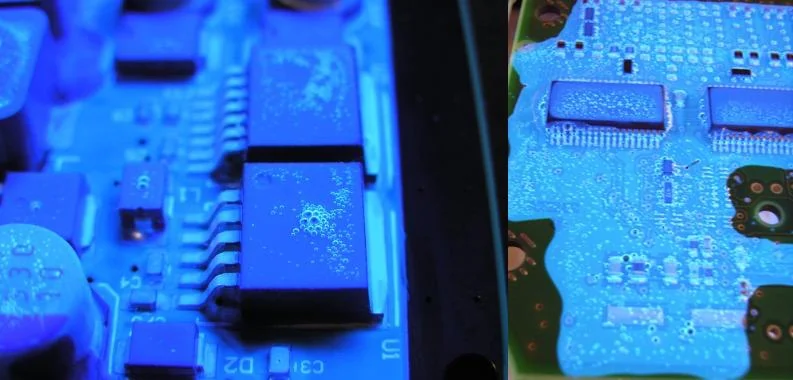
PCBA, bubbles and capillary action are two common defects that affect coating quality and electrical safety. Bubbles can lead to reduced insulation performance, while capillary action may contaminate connectors, switches, or test points. The following methods address these issues from two perspectives: process control and material selection.
Part 1: Causes and Countermeasures for Bubbles
Bubbles mainly originate from trapped air in the coating material, contaminated substrate surfaces, or improper spraying parameters.
1.Material Preparation
Allow the conformal coating to sit and deaerate before use. Store at 20–25°C.
For two-component materials, mix slowly to avoid introducing air. Let the mixture sit for 5–10 minutes before application.
2.Substrate Cleaning
Remove residual flux, moisture, and grease from the board surface before coating. Plasma cleaning or specialized cleaning agents with DI water rinsing are recommended.
Pre-bake the board: bake at 80–100°C for 30 minutes to remove internal moisture, reducing bubbles caused by expanding water vapor during heating.
3.Spray Parameter Optimization
Control film thickness between 25–75μm. Excessively thick coatings trap air that cannot escape easily.
Select nozzle diameter of 0.5–1.0mm and regulate supply pressure to 0.2–0.4MPa to prevent forced air injection into the coating.
Use cross-hatch spraying to ensure uniform overlap.
4.Curing Method
Prioritize stepped temperature ramping. First, level at low temperature (50°C) for 5 minutes, then raise to specified curing temperature. Rapid temperature increases accelerate bubble formation. For UV curing, check the intensity profile to ensure uniform energy distribution.
 Part 2: Causes and Countermeasures for Capillary Action
Capillary action refers to coating liquid wicking along narrow gaps or inner walls of through-holes, affecting areas that should remain uncoated. It commonly occurs at connector gaps, screw holes, or pad clearances around board edges.
1.Design Stage Prevention
Clearly mark no-coat areas on drawings and prioritize physical masking.
Reserve a keep-out zone of at least 0.5mm around through-holes and connectors.
2.Process Parameter Adjustment
Reduce spray viscosity. High-viscosity coatings have higher surface tension, making them prone to stringing and wicking into gaps. Control viscosity at 15–25 seconds (Ford Cup #4) by adding thinner or raising material temperature to 25–30°C.
Lower spray flow rate and atomization pressure to prevent excess coating from accumulating at gap entrances.
3.Masking Strategy
Use precision silicone molds or polyimide tape to cover all connectors, switches, gold fingers, and test points. Masking must adhere tightly to the board without leaving small gaps.
For threaded holes, pre-install temporary screws before coating, then remove after coating.
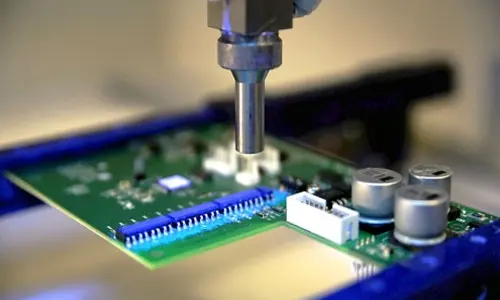
4.Selective Coating Equipment
Use selective spray valves (e.g., jet valves or spray valves) to precisely control coating boundaries, maintaining a safe distance of 0.3–0.5mm from keep-out zones.
Order of coating: first coat areas without gaps, then edge areas, reducing the chance of liquid being drawn into gaps.
 Part 3: Quality Inspection and Validation
- Before each production batch, perform test spraying on a transparent substrate. Inspect bubble count and wicking height under high magnification microscope.
- Perform damp heat testing (40°C, 93% RH, 48 hours) on finished boards to check whether bubbles or capillary action cause insulation resistance reduction or short circuits.
- Cross-section analysis: prepare cross-sections of suspicious areas to confirm whether unintended wicking has occurred on inner walls of through-holes.
Through material pre-treatment, fine control of spray parameters, proper masking, and equipment precision, both bubbles and capillary action can be controlled within acceptable limits. Accumulating a process database for different board types helps quickly identify root causes and optimize parameters.
With 17 years of expertise in PCBA design, manufacturing, and service, KingshengPCBA is ready to help turn your ideas into reality.
Feel free to contact us anytime to discuss your requirements and get a professional quotation.
 +86 13828766801
 kspcba@c-alley.com
 https://www.kingshengpcba.com/
 2/F, Building 6, Tangtou 3rd Industrial Zone, Tangtou Community, Shiyan Town, Baoan District, Shenzhen, China, 518108



 C - A L L E Y