Spray, Dip, or Brush: Choosing the Right Conformal Coating Process
 C - A L L E Y
Home | Events | PCB | About Us | News | Contact Us
In
PCBA manufacturing,
conformal coating is a critical step to protect circuit boards from moisture, dust, and chemical contamination. Different coating processes vary significantly in efficiency, cost, and application scenarios. This article compares spray, dip, and brush coating methods from four perspectives: operating principles, process advantages, limitations, and selection recommendations.
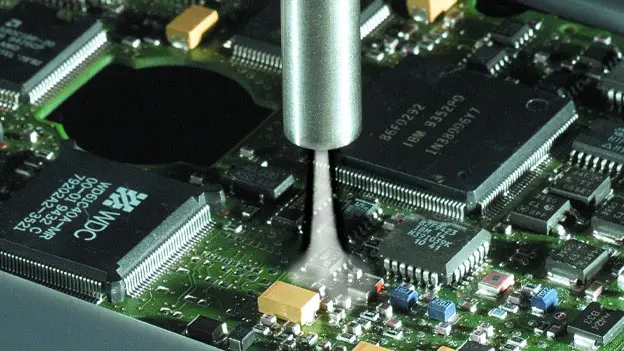
 1. Spray Coating: The First Choice for Automated Production Lines
Spray coating uses spray guns or automated spraying equipment to atomize conformal coating and apply it evenly onto the PCBA surface.
Advantages
High production efficiency, suitable for high-volume manufacturing. Automated lines can apply double-sided coating with cycle times under 30 seconds.
Uniform coating thickness, with precise control over spraying parameters and tolerances as low as ±5μm.
Good coverage on PCBA with complex components. Protection film can form underneath high-density BGA and QFN devices.
Limitations
High equipment investment. An automated spray line (including curing oven) typically requires an initial investment of over RMB 300,000.
When selective coating is required, additional fixtures or masking tape are needed, adding process steps.
Coating material utilization is around 60%–80%. Some coating is atomized and wasted, requiring a recovery system.
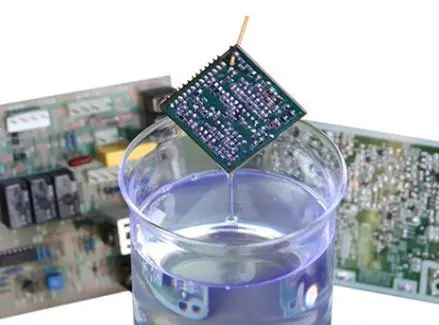
 2. Dip Coating: A Low-Cost Solution with High Filling Performance
Dip coating involves fully immersing the PCBA into a tank of conformal coating, holding it for a few seconds, then withdrawing it at a controlled speed, allowing gravity and surface tension to drain excess coating.
Advantages
Low equipment cost. A manual dip coating line can be set up for RMB 20,000–50,000.
High coating utilization, over 95%, with almost no overspray loss.
Suitable for boards with dense components and narrow gaps. The coating can penetrate gaps below 0.2mm, delivering better filling than spray coating.
Limitations
Connectors, switches, test points, and other areas must be masked, which can be labor-intensive.
Coating thickness is influenced by viscosity and withdrawal speed, offering less control than spraying, with thickness tolerances around ±15μm.
Solvent-based coatings evaporate quickly in open tanks. Changing coating types requires time-consuming tank cleaning.
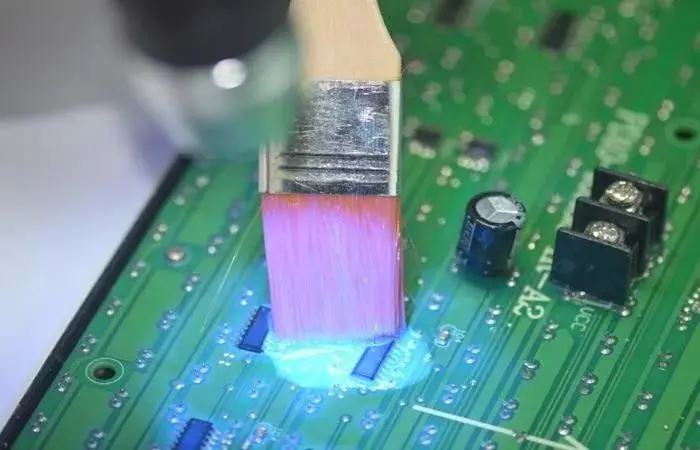
 3. Brush Coating: A Practical Choice for Small Batches and Rework
Brush coating uses an anti-static brush to manually apply conformal coating. It is commonly used for prototyping, small-batch production, or localized touch-up.
Advantages
No equipment investment; tooling costs are negligible.
High flexibility. Operators can target specific areas, avoiding the need for masking.
Suitable for rework scenarios. After removing a localized area of coating, manual reapplication can be performed without affecting nearby components.
Limitations
Low production efficiency. A 200mm × 200mm PCBA takes about 3–5 minutes to coat by hand.
Poor coating thickness consistency. Brush marks often lead to thin or thick spots, with a higher risk of air entrapment.
Highly dependent on operator skill. Inexperienced operators may cause missed areas or sagging.
 4. Specific Selection Recommendations
Annual output >100,000 units with component height <15mm:
4. Specific Selection Recommendations
Annual output >100,000 units with component height <15mm: Prioritize automated spray coating.
Annual output 20,000–80,000 units with many low-height component gaps: Dip coating offers the best cost-performance balance.
Prototyping or rework batches <500 units: Use brush coating combined with localized spray tools where needed.
Choosing the appropriate coating process can reduce per-board manufacturing costs by 15%–30% while maintaining protection performance. After clearly defining the product requirements, choosing the appropriate process can directly reduce the rework rate and extend the service life of the PCBA.
With 17 years of expertise in PCBA design, manufacturing, and service, KingshengPCBA is ready to help turn your ideas into reality.
Feel free to contact us anytime to discuss your requirements and get a professional quotation.
 +86 13828766801
 kspcba@c-alley.com
 https://www.kingshengpcba.com/
 2/F, Building 6, Tangtou 3rd Industrial Zone, Tangtou Community, Shiyan Town, Baoan District, Shenzhen, China, 518108