* On your first PCB Assembly order!
* Up to $300 discount
 C - A L L E Y
 Home | Events | PCB | About Us | News | Contact Us
The Core Raw Materials Driving Flexible PCB Innovation: A PCBA Engineering Perspective
Flexible printed circuit boards (Flex PCBs) have become indispensable in modern electronics, enabling breakthroughs in wearables, medical devices, aerospace systems, and foldable smartphones. As a PCBA engineering specialist, I’ll dissect the critical raw materials that define flexible PCB performance, reliability, and cost-efficiency—focusing on their properties, trade-offs, and real-world applications.
I. Polyimide (PI): The Industry Standard for High-Performance Flex Circuits
Polyimide stands as the backbone of flexible PCBs, prized for its unmatched thermal resilience (operating range: -269°C to +400°C), mechanical endurance, and dielectric stability. Two primary variants dominate the market:
1.Adhesive-Based PI Laminate
① Structure: Polyimide film bonded to copper foil (typically 1/2 oz to 2 oz) via epoxy or acrylic adhesive.
② Pros: Lower cost (~20% cheaper than adhesive-less), easier processing for prototypes.
③ Cons: Adhesive flow during lamination can cause impedance inconsistencies; limited to 5-layer flex designs.
2.Adhesive-Less PI Laminate
① Structure: Copper directly deposited on PI via sputtering/electroplating (e.g., DuPont Pyralux® LF).
② Pros: Thinner profiles (down to 12.5µm), better thermal dissipation, and higher frequency stability (critical for 5G/mmWave).
③ Cons: 30–50% cost premium; requires specialized equipment for processing
II. Polyester (PET): The Cost-Effective Compromise for Simple Designs
PET films (e.g., Mylar®) serve as a budget-friendly alternative for non-demanding applications:
1.Advantages:
① Material costs ~60% lower than PI.
② Adequate for static flex circuits (e.g., printer head cables, RFID antennas).
2.Limitations:
① Low glass transition temperature (Tg ~80°C) prevents soldering (PET melts at 150°C).
② Hygroscopic nature leads to dimensional shifts in humid environments. Niche Use Case: Disposable medical sensors (e.g., glucose test strips), where cost and single-use requirements outweigh durability needs.
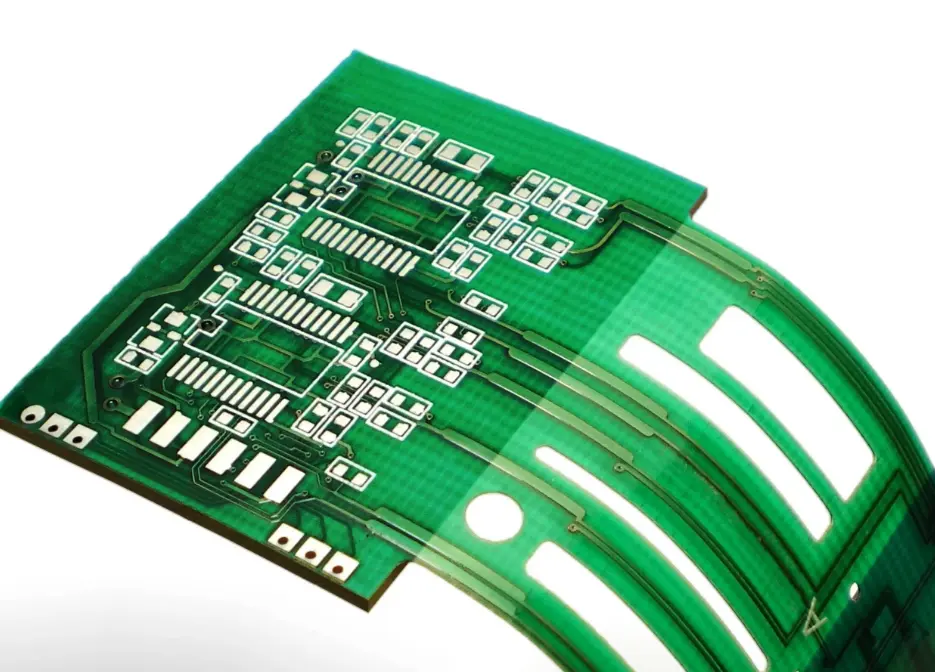
III. Coverlay & Solder Mask: Protecting the Circuit
Flex PCBs require specialized protection versus rigid boards:
1.Solid Polyimide Coverlay
① Construction: PI film + adhesive (acrylic or epoxy), laser-cut for precision.
② Thickness: 25–50µm, with adhesive adding 15–25µm.
③ Best For: High-reliability applications (e.g., satellite flex harnesses).
2.Photoimageable Flexible Solder Mask (PIFSM)
① Benefits: Enables finer pitch traces (<50µm) vs. coverlay; reduces labor costs for complex designs.
② Trade-off: Lower chemical resistance than PI coverlay.
Pro Tip: Use PIFSM for HDI designs with microvias; opt for coverlay in high-flex zones.
Ⅳ. Stiffeners: Balancing Flexibility and Rigidity
Localized reinforcement prevents warping during assembly:
① PI Stiffeners: Matches CTE with flex layers (critical for laser-drilled vias).
② FR4 Stiffeners: Cost-effective for connector areas (e.g., rigid-flex PCB transition zones).
③ Stainless Steel: For ultra-thin designs requiring EMI shielding (e.g., endoscope PCBs).
Case Study: A smartwatch rigid-flex design used 0.2mm PI stiffeners under the BGA to survive 10,000+ bend cycles.
Conclusion:
Material Selection as a Strategic Decision
Choosing flex PCB materials isn’t just technical—it’s a business calculus. While PI delivers performance, PET and hybrid materials (e.g., PI/PET stacks) can optimize costs. As foldable electronics and IoT expand, expect adhesive-less PI and nano-material composites to dominate.
Engage: What’s your biggest flex PCB material challenge? Share your experiences below!.
With 17 years of expertise in PCBA design, manufacturing, and service, KingshengPCBA is ready to help turn your ideas into reality. Feel free to contact us anytime to discuss your requirements and get a professional quotation.
Please send Email to kspcba@c-alley.com or call us through +86 13828766801 Or submit your inquiry by online form. Please fill out below form and attach your manufacturing files( PCB Gerber files and BOM List) if need quotation. We will contact you shortly.
 +86 13828766801
 kspcba@c-alley.com
 https://www.kingshengpcba.com/
 2/F, Building 6, Tangtou 3rd Industrial Zone, Tangtou Community, Shiyan Town, Baoan District, Shenzhen, China, 518108
We would also like to thank our customers for their trust and support. The company's outstanding achievements are mainly due to the loyalty of our customers, which also encourages and spurs our company to forge ahead.