* On your first PCB Assembly order!
* Up to $300 discount
 C - A L L E Y
 Home | Events | PCB | About Us | News | Contact Us
Meta Description: When a PCBA fails, finding the why is critical. This guide details the 8-step failure analysis process used by experts, from visual inspection to SEM/EDS, and how Kingsheng's disciplined approach ensures reliable corrections for automotive, medical, and industrial electronics.
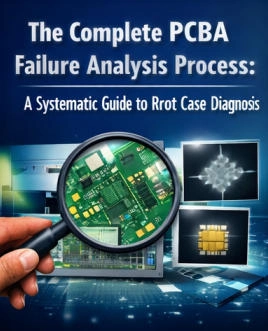
How to analyze PCB failure
Introduction: Beyond Replacement – The Imperative of Understanding Failure
A failed printed circuit board assembly (PCBA) in the field represents more than just a unit cost; it signifies potential system downtime, safety risks in automotive or medical applications, and damage to brand reputation. Simply replacing the board is a reactive and costly cycle if the root cause remains unknown.
A systematic, forensic-level Failure Analysis (FA) process is the only way to transform a field return into a learning opportunity, driving permanent corrective actions that prevent recurrence. For manufacturers serving high-reliability industries, a rigorous FA capability is not optional—it's a core component of quality assurance.
This article outlines the complete, step-by-step FA methodology employed by leading EMS providers like Kingsheng, detailing how each phase uncovers clues to diagnose the true origin of failure.
What is Failure Analysis and Why Does the Process Matter?
Failure Analysis is the systematic investigation of a failed component or assembly to determine the mechanism and, ultimately, the root cause of the failure. A haphazard approach can destroy evidence, lead to incorrect conclusions, and allow the same failure to reoccur in production. A structured process, aligned with standards like those in the IATF 16949 automotive quality framework, ensures:
The 8-Step PCBA Failure Analysis Process: A Forensic Journey
The following process is a synthesis of industry best practices and the disciplined approach necessitated by Kingsheng's work in mission-critical sectors.
Step 1: Failure Data Collection & Background Research
Before touching the board, gather all contextual information. This includes:
Failure Symptoms: How did the unit fail? No power, intermittent operation, specific error codes?
Environmental History: Where was it used? Exposure to temperature extremes, humidity, vibration, or chemicals?
Operational History: At what point in its lifecycle did it fail (first use, after 1000 hours, etc.)?
Design & Manufacturing Data: Schematics, PCB layout, BOM, assembly batch records, and test logs.
Step 2: Preliminary Visual & Documentation Examination
A macro-level inspection under good lighting and magnification can reveal obvious issues.
Document the "As-Received" Condition: Photograph the board from all angles before any cleaning or handling.
Look for: Burn marks, cracked components, broken traces, corroded contacts, poor solder joints, or signs of overheating (discoloration).
Step 3: Non-Destructive Testing (NDT) – Seeing Beneath the Surface
This phase investigates without altering the board.
X-Ray Inspection: Our X-Ray Machine is indispensable for examining solder joints under Ball Grid Array (BGA) and QFN components, looking for voids, cracks, or bridging that are invisible to the eye.
3D Solder Paste Inspection (SPI) Data Review: For failures in production, reviewing historical SPI data for that batch can show if solder paste volume or height was out of spec, leading to weak joints.
Thermal Imaging (if possible): Powering the board in a controlled, current-limited manner while using a thermal camera can identify unexpected hotspots indicating short circuits or failing components.
Step 4: Electrical Characterization & Fault Isolation
Using precision equipment to electrically isolate the failure node.
Continuity & Resistance Checks: Verify power and ground planes for shorts or opens.
Power-Up Testing (with Care): In a controlled fixture, apply power while monitoring current draw to detect shorts.
Signature Analysis & Curve Tracing: Compare the electrical "fingerprint" of suspected components (like ICs) against known-good units to identify subtle degradations.
Step 5: Depotting & Cross-Sectional Analysis
A controlled, destructive step to examine internal structures.
Component Depotting: Carefully removing the epoxy packaging from a semiconductor to expose the die and bond wires.
PCB Cross-Sectioning: Potting a suspect area (e.g., a via or solder joint) in resin, then polishing it to a mirror finish to examine the internal microstructure under a microscope. This reveals issues like plating voids in vias, intermetallic compound (IMC) thickness, or micro-cracks in solder.
Step 6: Advanced Material & Surface Analysis
For complex failures, advanced laboratory techniques are required.
Scanning Electron Microscopy (SEM): Provides extremely high-magnification images to see micro-cracking, grain structures, or foreign material.
Energy Dispersive X-ray Spectroscopy (EDS): Used alongside SEM to determine the elemental composition of a surface or residue. This is critical for identifying electrochemical migration (e.g., detecting chlorine or sulfur from flux residue) or contaminants that caused corrosion.
Step 7: Root Cause Determination & Hypothesis Validation
Synthesizing all evidence to answer "why."
Correlate Findings: Does the electrical fault location match the physical defect found in cross-section? Does the EDS elemental analysis explain the corrosion mechanism?
Classify the Cause: Is it a design flaw (e.g., insufficient creepage distance), a component defect (die crack), a process issue (insufficient reflow temperature), or a material incompatibility (corrosive flux residue)?
Recreate the Failure (if needed): In some cases, recreating the suspected stress condition on a known-good unit validates the root cause hypothesis.
Step 8: Reporting & Implementing Corrective Action
The process is incomplete without closure and prevention.
Comprehensive FA Report: Documents every step, with high-resolution images, data, and a clear conclusion on the root cause and contributing factors.
Corrective & Preventive Action (CAPA): Initiates a formal Corrective Action process. This could involve updating the DFM/DFA checklist in our Strong Engineer Services, changing a solder paste specification, qualifying an alternative component through our Qualified Alternative Options program, or modifying a reflow profile.
The Kingsheng Advantage: A Disciplined FA Process Built on Automotive DNA
At Kingsheng, our failure analysis is not an ad-hoc service but an integral part of our quality ecosystem. Our approach is shaped by the "special and high grade requirements of automotive regulations," which demand rigorous problem-solving.
Conclusion: Turn Field Failures into Lasting Reliability
A systematic PCBA failure analysis process transforms costly field returns into invaluable data for continuous improvement. For industries where reliability is paramount—Automotive, Medical Systems, and Industrial Control—partnering with a manufacturer that has a proven, disciplined FA capability is a strategic advantage.
Facing a puzzling PCBA failure? Don't just replace it—understand it. Contact Kingsheng today to leverage our systematic failure analysis expertise and turn your quality challenge into a foundation for more robust, reliable electronics.
With 17 years of expertise in PCBA design, manufacturing, and service, KingshengPCBA is ready to help turn your ideas into reality. Feel free to contact us anytime to discuss your requirements and get a professional quotation.
Please send Email to kspcba@c-alley.com or call us through +86 13828766801 Or submit your inquiry by online form. Please fill out below form and attach your manufacturing files( PCB Gerber files and BOM List) if need quotation. We will contact you shortly.
 +86 13828766801
 kspcba@c-alley.com
 https://www.kingshengpcba.com/
 2/F, Building 6, Tangtou 3rd Industrial Zone, Tangtou Community, Shiyan Town, Baoan District, Shenzhen, China, 518108
We would also like to thank our customers for their trust and support. The company's outstanding achievements are mainly due to the loyalty of our customers, which also encourages and spurs our company to forge ahead.