* On your first PCB Assembly order!
* Up to $300 discount
 C - A L L E Y
 Home | Events | PCB | About Us | News | Contact Us
2025 marks a milestone year for the PCBA industry. Driven by the dual forces of the global electronics industry’s recovery and the explosive growth in AI computing power, the PCB industry has delivered impressive results: global PCB output value is estimated at approximately US$92.36 billion, representing a year-on-year growth rate of 15.4%. Looking ahead to 2026, as the scale of AI infrastructure development continues to expand, this growth momentum is expected to continue, with output value projected to exceed the US$100 billion mark.
Amidst this industrial boom, PCBA (Printed Circuit Board Assembly), as the core component of electronic products, is undergoing unprecedented technological transformation. From material selection to manufacturing processes, and from design philosophies to testing standards, every aspect is being redefined. This article will provide an in-depth analysis of the core trends in the PCBA industry for 2026, helping professionals keep pace with technological advancements and seize the initiative amidst industry shifts.
I. High-frequency, high-speed materials: A key competitive advantage in the high-end market
The surge in demand for AI servers and 800G/1.6T switches has made high-frequency, high-speed materials the focal point of technological competition. Traditional FR-4 laminates are proving inadequate when it comes to handling high-speed signal transmission at 25 Gbps and above. Resin materials with ultra-low dielectric constants and ultra-low loss, such as M9-grade resin and PTFE, are becoming the preferred choice for high-end designs.
These materials can significantly reduce signal transmission loss, ensuring the stable flow of high-speed data. Taking AI server motherboards as an example, in order to handle the massive data flows between GPUs, CPUs and high-speed interconnect chips, PCB layer counts frequently reach 20–30 layers, or even higher. In such high-density designs, signal integrity becomes a key factor determining system performance. The dielectric loss (Df) of the materials must be kept at an extremely low level, as even the slightest flaw could lead to the failure of the entire, costly system.
Supporting materials are also undergoing upgrades. Glass fibre cloth is evolving towards lower dielectric constants and lower coefficients of thermal expansion, whilst demand for quartz cloth has grown significantly in high-end switches due to its low-loss properties. Ultra-smooth HVLP copper foil and ultra-thin copper foil, owing to their ability to enhance signal integrity, have become indispensable key materials for high-end PCBs. This series of material upgrades is driving a continuous doubling of the value per board, whilst also presenting PCB assembly manufacturers with higher technical barriers and greater profit margins.
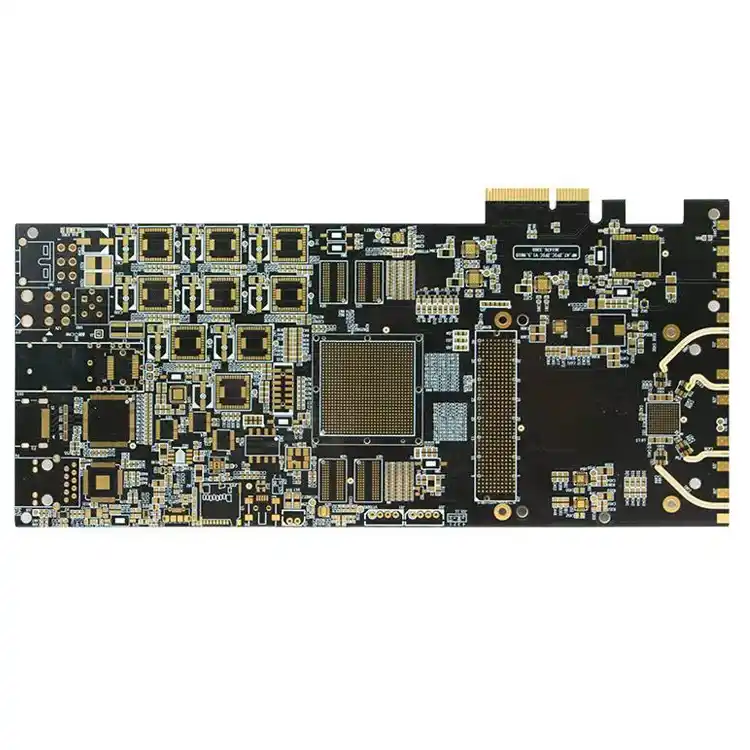
II. High-Density Interconnect (HDI) and Multi-Layer PCB Manufacturing: Manufacturing Challenges in the Age of Computing
To meet the high computing power demands of AI chips, PCBs are evolving towards higher layer counts and denser circuit patterns. 70-layer high-layer boards have already entered mass production, whilst 18–22-layer PCBs have become the mainstream configuration in AI servers. At the same time, line width and spacing can now achieve a precision of less than 10 μm through mSAP/SAP processes.
This poses a significant challenge to PCBA manufacturing. Firstly, high-density interconnect (HDI) design significantly increases the difficulty of surface-mount assembly. Micro-package components, such as 01005 and 0201, place extremely high demands on the precision of placement machines. Although modern high-speed placement machines can achieve placement speeds of tens of thousands of components per hour, for these micro-components, a vision alignment system must be employed to ensure that placement deviation is controlled within ±0.05 mm.
Secondly, drilling technology is undergoing a revolution. In high-layer-count boards, traditional mechanical drilling is no longer sufficient to meet the demands of micro-hole processing, and laser drilling is gradually becoming the mainstream process. Laser drilling not only supports the production of HDI boards with 20 or more layers, but also enables the machining of micro-holes, laying the foundation for high-density interconnects. However, laser drilling demands extremely precise control of process parameters; excessive energy leads to over-ablation, whilst insufficient energy fails to penetrate the dielectric layers. This necessitates close collaboration between PCBA manufacturers and PCB suppliers to establish a rigorous process control system.
III. Embedded Technology: A New Approach to System Integration
In the quest for greater integration, embedded processes are breaking down the functional boundaries of traditional PCBs. Technologies that embed power chips directly into the PCB (such as Chip-on-Substrate) are becoming increasingly mature. This approach eliminates the need for traditional heat sinks, enabling system miniaturisation and cost reduction, whilst simultaneously improving thermal efficiency and signal transmission speeds.
For PCBA manufacturers, the widespread adoption of embedded processes signifies a profound transformation in production models. Whereas traditional SMT assembly involves mounting components on the surface of the PCB, embedded processes require chips to be embedded within the PCB during the board fabrication stage. This necessitates PCBA factories extending their operations upstream to establish closer collaborative relationships with PCB manufacturers. Furthermore, embedded processes impose extremely high demands on the production environment, requiring semiconductor-grade cleanrooms to ensure manufacturing precision. Currently, this process is gradually being implemented in applications such as high-end power modules, and is expected to be adopted in a wider range of sectors in the future.
IV. Smart Manufacturing: From Manual Operations to Data-Driven Processes
Faced with increasingly complex product structures and stringent quality requirements, PCBA manufacturing is undergoing a comprehensive transition from ‘manual operations’ to ‘intelligent production’. Laser Direct Imaging (LDI) equipment, with its micron-level resolution and alignment accuracy, has become a core component in high-density PCB production. During the surface mount assembly stage, the widespread adoption of Solder Paste Inspection (SPI) systems enables real-time monitoring of solder paste printing quality—data indicates that approximately 70% of soldering defects stem from poor solder paste printing.
More importantly, data-driven quality management is becoming the industry standard. Leading PCBA factories use MES systems to track production parameters at every workstation in real time, employing SPC (Statistical Process Control) methods to promptly identify abnormal fluctuations. A telecommunications equipment manufacturer reduced its AOI false positive rate from 15% to 2% by introducing an AI inspection system; this case clearly demonstrates the immense potential of intelligent manufacturing.
V. Green Manufacturing and Sustainable Development
Tighter environmental regulations are driving the PCBA industry towards a green transition. From wastewater and exhaust gas treatment to the prohibition of hazardous substances, industry standards continue to rise, accelerating the phasing out of outdated production capacity. Leading companies have gone beyond basic compliance requirements to establish carbon emission management systems covering the entire product lifecycle, reducing chemical consumption through process optimisation and minimising environmental impact by adopting eco-friendly materials.
It is worth noting that green manufacturing is no longer an additional cost; rather, it has become a core competitive advantage for companies seeking to enter high-end markets and win customer trust. For instance, in the automotive electronics sector, original equipment manufacturers (OEMs) impose stringent environmental certification requirements on suppliers; in the consumer electronics sector, international brands have pledged to achieve carbon neutrality by 2030, thereby compelling the upstream supply chain to accelerate its green transition.
Conclusion
In 2026, the PCBA industry stands at the cusp of a technological leap. AI computing power is the core driving force, breakthroughs in materials and processes are the pathway to realisation, and sustainability and intelligence are the inevitable direction. For industry players, their ability to keep pace with material upgrades, master high-end processes and integrate into the innovation ecosystem will determine their standing in this new round of industrial transformation.
In the future, PCBA will no longer be merely a simple circuit carrier, but will become a core component underpinning the digital economy, smart manufacturing and green mobility. Amidst the tide of technological iteration, only those enterprises that persist in innovation and dedicate themselves to meticulous craftsmanship will be able to remain invincible in the face of fierce market competition.
With 16 years of expertise in PCBA design, manufacturing, and service, KingshengPCBA is ready to help turn your ideas into reality. Feel free to contact us anytime to discuss your requirements and get a professional quotation.
Please send Email to kspcba@c-alley.com or call us through +86 13828766801 Or submit your inquiry by online form. Please fill out below form and attach your manufacturing files( PCB Gerber files and BOM List) if need quotation. We will contact you shortly.
 +86 13828766801
 kspcba@c-alley.com
 https://www.kingshengpcba.com/
 2/F, Building 6, Tangtou 3rd Industrial Zone, Tangtou Community, Shiyan Town, Baoan District, Shenzhen, China, 518108
We would also like to thank our customers for their trust and support. The company's outstanding achievements are mainly due to the loyalty of our customers, which also encourages and spurs our company to forge ahead.