* On your first PCB Assembly order!
* Up to $300 discount
 C - A L L E Y
 Home | Events | PCB | About Us | News | Contact Us
With the low-altitude economy formally incorporated into national strategy in 2024, the drone industry has ushered in unprecedented development opportunities. Projections indicate that by 2025, China's low-altitude economy market will reach 1.5 trillion yuan. Within this, drones serve as a core application scenario, where their high-density, high-reliability PCBA (printed circuit board assemblies) form the technological foundation for the entire industry's safe “take-off”. This article delves into the technical challenges, design considerations, manufacturing processes, and future development trends facing drone PCBA.
一.Surging Demand for PCBA Amid the Low-Altitude Economy Wave
The low-altitude economy refers to an emerging industry centred on airspace below 1,000 metres, encompassing applications such as drones, eVTOLs (electric vertical take-off and landing aircraft), and general aviation aircraft. It finds extensive use in logistics, rescue operations, agriculture, and urban transport. Against a backdrop of concentrated policy incentives, printed circuit boards (PCBs) – as core electronic components – exhibit four key demand characteristics: high-density lightweighting, high-frequency and high-speed materials, extreme environmental adaptability, and infrastructure compatibility.
According to a Research and Markets report, the global drone market reached a value of US$43 billion by December 2022, with personal drones accounting for 94% of unit sales. The US Federal Aviation Administration recorded 855,860 registered drones in 2023. This explosive growth has directly fuelled expansion in the aerospace and defence PCB market, projected to reach US$1.53 billion by 2029.
二.Design-End Challenges in UAV PCB Assembly
2.1 High-Density Integration and the Spatial Paradox
The design trend for modern drones is ‘smaller, lighter, smarter’, yet this presents a significant engineering conundrum: how to integrate more powerful processors, additional sensors, and efficient power management systems within the limited PCB footprint?
Take the flight controller board of a compact quadcopter as an example. Its PCB dimensions are constrained within a 100mm × 100mm irregular shape (moulded to the drone's frame), yet it must integrate an ESP32-S3 processor (handling flight computations and AI processing), an OV2640 camera (for FPV video transmission), an MPU-6050 six-axis gyroscope/ accelerometer (for attitude sensing), a high-speed SD-MMC interface (for data storage), and a complete power management subsystem.
To accommodate all these functions, 'double-sided SMT assembly technology' must be employed, placing components on both the top and bottom layers. This involves integrating over 70 SMD components from 31 different production lines, including fine-pitch packages such as QFN and SOT-23-6, alongside a large quantity of 0402 passive components.
2.2 High-Speed Signal Integrity Challenges
Handling high-speed signals on double-layer boards represents one of the most significant technical hurdles in drone design. The SD-MMC (4-bit) interface with the OV2640 camera (8-bit parallel DVP) operates as a high-speed parallel bus, whose clock signals are highly susceptible to signal skew (unequal trace lengths) and noise.
Due to the absence of a complete inner ground plane on double-layer boards, these sensitive signal traces must be routed in close proximity to one another. They may even coexist with high-current motor drive lines and switching power supply lines, making them highly susceptible to **crosstalk**. Mild cases may result in snowflake-like interference on video transmission, while severe instances can lead to flight control data loss or even catastrophic failure.
2.3 Complexity of Power Distribution Networks
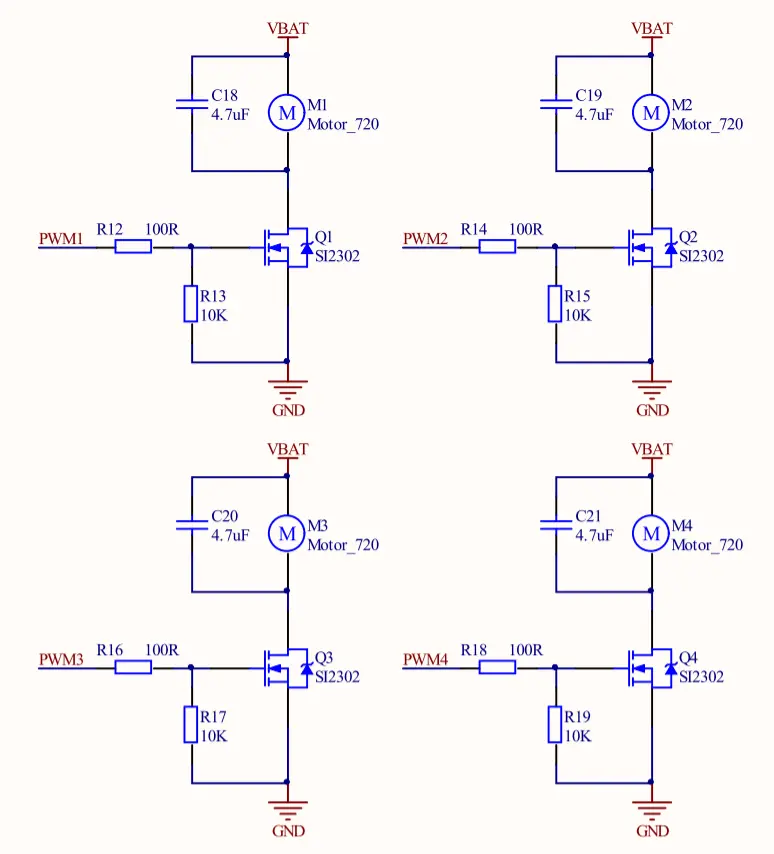
The drone's PCBA not only transmits control signals but also functions as a 'power distribution board'. High currents from the battery must be distributed via the PCB to four or more motors (such as 8520 hollow cup motors), while simultaneously supplying clean power to precision sensors like the MPU-6050. Electromagnetic fields generated by high-current traces may induce interference on adjacent sensitive analogue power rails, leading to increased sensor noise and causing flight instability.
2.4 Environmental Adaptability Requirements
Industrial-grade drones must operate reliably within temperatures ranging from -40°C to 120°C, necessitating PCB materials with a high glass transition temperature (≥170°C). Concurrently, drones endure severe vibration during flight (across a frequency range of 5–500Hz), leading to solder joint fatigue and connector loosening. An automotive electronics case study indicates that vibration can elevate PCB failure rates by 40%.
三.Manufacturing Process: The Lifeline Ensuring High Reliability
3.1 DFM Design for Manufacturability
It is crucial to fully consider manufacturing feasibility and cost-effectiveness during the product design phase. A standardised DFM process enables systematic review of design drawings, optimising component placement, pad design, via placement, and heat dissipation pathways. This eliminates 75% of manufacturing issues stemming from design flaws at source. Specific measures include:
3.3 Processing of Special Materials
To meet high-frequency and high-speed requirements, the PCBA assembly for unmanned aerial vehicles necessitates proficient application of processing techniques for specialised high-frequency substrates such as PTFE (polytetrafluoroethylene), PI (polyimide), and hydrocarbon materials. These materials present challenges including difficult via plating, susceptibility to excessive wicking, and copper fracture within vias.
Consequently, equipment such as CO₂ lasers and picosecond lasers must be introduced to optimise processes for removing drill residue and forming micro-vias.
3.4 Surface Treatment Selection
For unmanned aerial vehicle PCBA assemblies incorporating fine-pitch SMD component packages, 'ENIG (electroless nickel immersion gold)'surface finishing is the preferred choice over HASL (hot air solder level). ENIG delivers a perfectly flat, lead-free surface that minimises the risk of solder shorts and ensures reliable solder joints form on every pad of leadless components during the reflow process.
3.5 Triple-proof coating
Industrial drones frequently operate in dusty, humid, or even salt-spray environments (such as maritime rescue missions or pesticide spraying). To protect circuit boards from corrosion, a layer of 'conformal coating' must be applied after the PCBA has been soldered and tested. This transparent protective film effectively shields against moisture, mould, and salt spray, ensuring the drone's long-term operational lifespan in harsh conditions.
四.Testing and Validation: The Final Hurdle Before Delivery
4.1 Automated Optical Inspection
The AOI system employs high-resolution cameras and pattern recognition algorithms to compare manufactured PCB patterns against original Gerber design files, detecting broken traces, unintended copper bridges, open circuits, and line width deviations. Identifying defects prior to reflow soldering prevents them from evolving into permanent assembly failures, thereby avoiding costly rework or circuit board scrap.
4.2 X-ray Inspection
Ball Grid Array (BGA) and Quad Flat No-Lead (QFN) devices feature bottom-terminated components with solder joints concealed beneath the package body, rendering them inaccessible to optical inspection. X-ray inspection penetrates these packages to detect issues such as voids, insufficient solder, and misplaced solder balls. Inspectors measure the void rate within thermal vias, ensuring it remains ≤1% (significantly below the industry standard of 3%), thereby validating the ball shear strength specifications.
4.3 Flying Probe Testing and In-Circuit Testing
Flying probe testing deploys multiple computer-controlled probes to contact test points on the circuit board surface, verifying electrical continuity and isolation without requiring custom test fixtures. This approach is suitable for small to medium-volume drone PCB testing processes. The probe system can simultaneously access both sides of the circuit board, testing component values, polarity, and basic functionality.
For mature designs with stable monthly production volumes exceeding several thousand units, in-line test fixtures can enhance throughput but necessitate significant initial investment.
4.4 Environmental Stress Screening
五.Standard Evolution and Industry Regulations
5.1 IPC Standards System
The manufacture and inspection of unmanned aerial vehicle PCBA assemblies must adhere to a series of IPC standards:
5.2 Key Inspection Points for Aviation PCBs
Visual inspection of aerospace PCBs requires tools such as magnifying glasses and microscopes to conduct comprehensive checks on the surface and edges of the boards:
Dimensional accuracy inspection covers critical parameters including overall board dimensions, hole positioning precision, and trace width/spacing.
For high-frequency/high-speed boards, trace width/spacing deviations must be strictly controlled within ±5% of specified values, as minute variations may cause impedance mismatch, leading to signal reflection or attenuation.
六.Future Outlook: Advancing Green and Intelligent Development in Tandem
6.1 Trends in Technology Convergence
The integration of 5G and AI technologies with PCBA design is propelling the development of drones towards greater intelligence and swarm capabilities. As the autonomous flight capabilities of drones advance, their “brains” will become more powerful, potentially incorporating additional AI processing units and sensors. This presents higher-level challenges for PCBA, including system-level packaging and heterogeneous integration.
6.2 New Materials and New Processes
Emerging technologies such as hydrogen fuel cell drones and solar-powered drones are driving demand for new materials and processes in printed circuit board assemblies (PCBA). For instance, the development of hydrogen fuel cell circuit boards and PCBs for solar drones actively supports carbon neutrality objectives.
6.3 Standardisation
The industry must actively participate in establishing PCB standards for the low-altitude economy to secure technological leadership. The ASTM F3686 standard, published by the American Society for Testing and Materials in 2024, provides detailed implementation specifications for the production approval of unmanned aircraft systems. It establishes a tiered production requirements framework based on the operational risk level of the unmanned aircraft.
Conclusion
The manufacturing of drone PCBA involves more than mere component placement; it entails comprehensive control across the entire process chain: design, materials, assembly, and testing. From material innovation and process optimisation to design collaboration, the industry is addressing dual challenges—customised design and high-frequency vibration reliability—through technological advancement. As the low-altitude economy ecosystem matures, PCBA will evolve towards higher integration and lower power consumption, providing the drone sector with more robust core propulsion.
For drone enterprises, selecting a PCBA partner with expertise in design, precision in craftsmanship, and rigorous testing often determines the distance from prototype to successful mass production. Only by prioritising design for manufacturability from the outset – comprehensively considering layout, signal integrity, thermal management, and back-end manufacturing processes – can one create a core drone component capable of withstanding the rigours of high-altitude operation.
With 16 years of expertise in PCBA design, manufacturing, and service, KingshengPCBA is ready to help turn your ideas into reality. Feel free to contact us anytime to discuss your requirements and get a professional quotation.
Please send Email to kspcba@c-alley.com or call us through +86 13828766801 Or submit your inquiry by online form. Please fill out below form and attach your manufacturing files( PCB Gerber files and BOM List) if need quotation. We will contact you shortly.
 +86 13828766801
 kspcba@c-alley.com
 https://www.kingshengpcba.com/
 2/F, Building 6, Tangtou 3rd Industrial Zone, Tangtou Community, Shiyan Town, Baoan District, Shenzhen, China, 518108
We would also like to thank our customers for their trust and support. The company's outstanding achievements are mainly due to the loyalty of our customers, which also encourages and spurs our company to forge ahead.