* On your first PCB Assembly order!
* Up to $300 discount
 C - A L L E Y
 Home | Events | PCB | About Us | News | Contact Us
In consumer electronics, a minor flaw on a PCB might only cause an occasional phone crash. However, in military equipment—whether it's satellite navigation systems, fighter jet avionics, or missile guidance modules—the same minor flaw could directly mean mission failure or even casualties. This is why military-grade PCBs must undergo 100% flying probe testing, rather than ordinary sampling inspection.
I. What is a "Military-Grade" PCB? First, let's define the standards.
Military-grade PCBs adhere to core specifications far exceeding civilian standards:
Material Grade: Typically uses IPC-6012DA (Aerospace Electronics Applications), MIL-PRF-31032 (General Specification for Military Printed Circuit Boards), or GJB 362B (military standard). The substrate must possess extremely low CTE (Coefficient of Thermal Expansion) and high Tg (Glass Transition Temperature).
Design Redundancy: Sufficient margins are provided for key parameters such as trace width, spacing, and vias, and stability under extreme vibration, temperature (commonly -55℃ to 125℃), and humid environments is considered.
Process Requirements: Immersion gold or gold plating is common to ensure soldering reliability and long-term oxidation resistance; conformal coating (moisture-proof, mildew-proof, salt spray-proof) is almost standard.
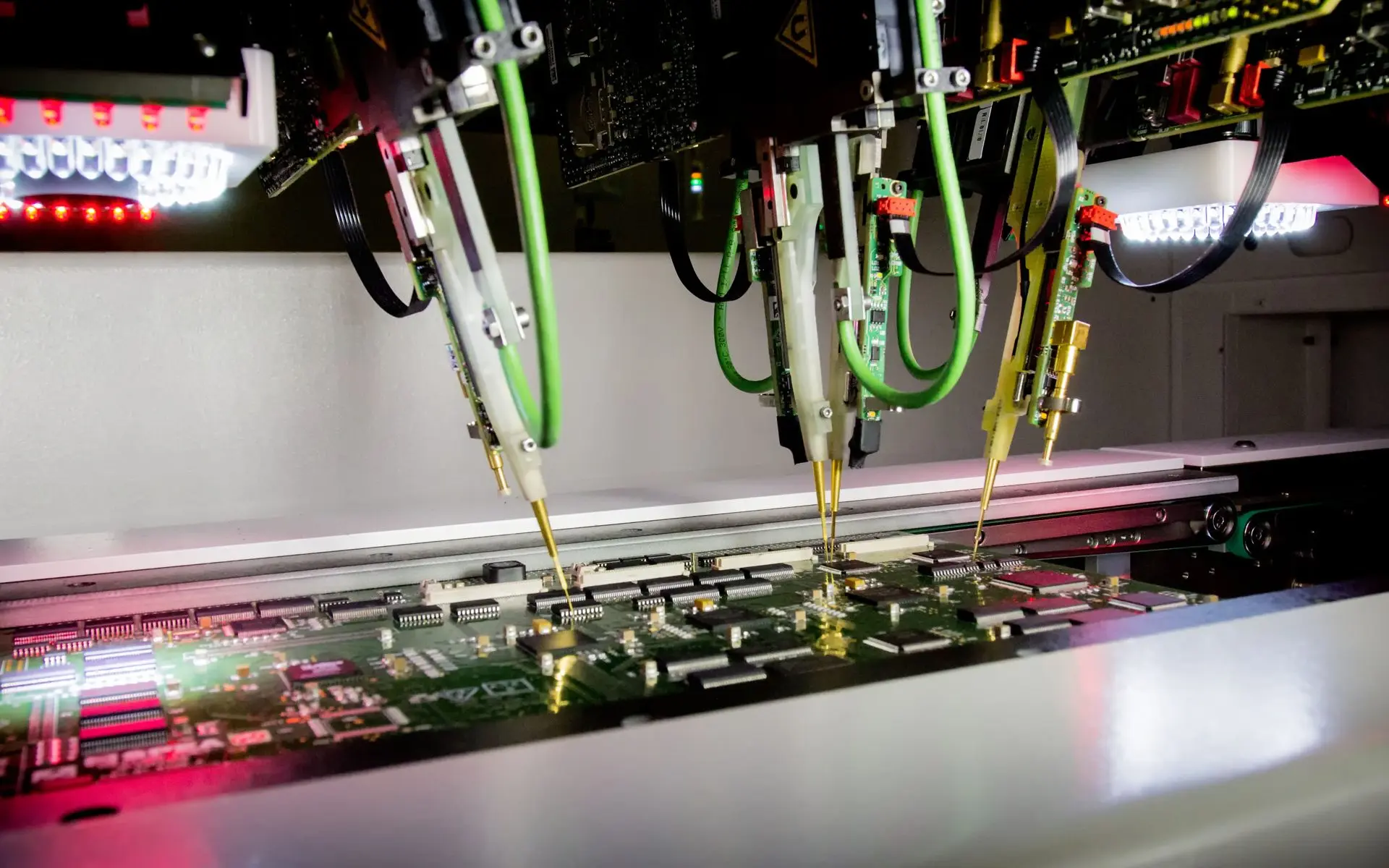
II. 100% Flying Probe Testing: More Than Just Continuity Testing
The application of flying probe testing in the military field far surpasses that of ordinary four-wire testing:
1. Test coverage must reach 100%
Every board, every network: Sampling inspection is ineffective in the military field. Every board in a batch must undergo equally rigorous testing.
Four-wire Kelvin testing method: Employs independent drive and detection circuits, eliminating the influence of cable and contact resistance, and is sensitive to milliohm-level impedance differences (detecting anomalies below 5 milliohms).
2. Precision Parameter Testing Beyond Continuity Interruption
Insulation Resistance Test: Applying a DC voltage of 100V-500V, measure the insulation resistance between adjacent networks. Typically, ≥100MΩ is required (10MΩ may be sufficient for civilian applications).
Capacitance Test: Detecting network-to-ground or inter-network capacitance and comparing it to design values. Capacitance exceeding tolerances may indicate internal short circuits or dielectric problems. High-Definition Mapping: Flying probes are programmable and can be moved to any location to test hard-to-reach points such as under high-density BGAs.
3. Other Testing Methods
Flying probe testing is not isolated but a crucial link in the certification chain:
Prerequisites: 100% Automated Optical Inspection (AOI) and X-ray inspection (for buried vias and solder joints) must be completed.
Subsequent Tests: Environmental Stress Screening (ESS), such as temperature cycling and random vibration, must be repeated to capture potential defects.
III. Certification Requirements: Documentation and Traceability are Lifelines
One of the core requirements of military projects is full lifecycle traceability:
Test Data Packages: Flying probe test data (actual resistance and capacitance values, not just "pass/fail") for each PCB must be independently archived, typically for a period exceeding the product's lifespan.
Serialization Binding: Each board has a unique identifier, bound to test data, material batch number, production equipment parameters, operator information, etc.
Zero Tolerance for Failures and Root Cause Analysis: Any test failure on any board will trigger a rigorous "Root Cause Analysis" (RCA) process, potentially leading to the scrapping of the entire batch; "acceptance with compromise" is absolutely not permitted.
IV. Key Takeaways: The Criteria for Implementing Military-Grade Flying Probe Testing
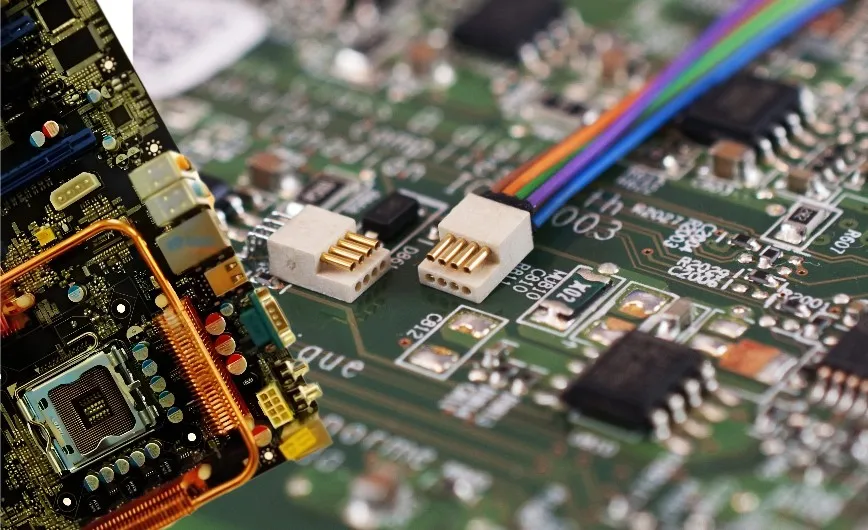
Equipment Calibration: The testing machine must be calibrated daily using standard boards to ensure absolute data accuracy.
Tip Maintenance: Tungsten steel or gold-plated tips require frequent inspection and replacement to prevent oxidation or wear leading to poor contact.
Test Coverage Verification: Regularly verify the effectiveness of the procedure by implanting test boards with known defects.
Environmental Control: Testing should be conducted in a controlled temperature and humidity environment (e.g., 23±2℃, 50%±10%RH) to ensure data consistency.
Conclusion
In the military field, PCB reliability is not a matter of probability, but an absolute bottom line that must be ensured. 100% flying probe testing, coupled with a complete certification system, is the core technological guarantee that transforms "absolute reliability" from a concept into reality. Behind it lies a philosophy: in matters concerning national security and the lives of soldiers, any "good enough" mentality is an unacceptable risk.
With 16 years of expertise in PCBA design, manufacturing, and service, KingshengPCBA is ready to help turn your ideas into reality. Feel free to contact us anytime to discuss your requirements and get a professional quotation.
Please send Email to kspcba@c-alley.com or call us through +86 13828766801 Or submit your inquiry by online form. Please fill out below form and attach your manufacturing files( PCB Gerber files and BOM List) if need quotation. We will contact you shortly.
 +86 13828766801
 kspcba@c-alley.com
 https://www.kingshengpcba.com/
 2/F, Building 6, Tangtou 3rd Industrial Zone, Tangtou Community, Shiyan Town, Baoan District, Shenzhen, China, 518108
We would also like to thank our customers for their trust and support. The company's outstanding achievements are mainly due to the loyalty of our customers, which also encourages and spurs our company to forge ahead.