* On your first PCB Assembly order!
* Up to $300 discount
 C - A L L E Y
 Home | Events | PCB | About Us | News | Contact Us
1. Visual Inspection Method
Visual inspection forms the foundation of all maintenance work and is an indispensable first step. Observation with the naked eye constitutes the primary phase of circuit board repair and testing. Upon receiving a faulty PCBA, conduct a thorough and meticulous visual inspection of its appearance. Focus particularly on identifying broken traces, open circuits (Open), short circuits (Short), cold solder joints, missing components, extra components, incorrect components, or bent component leads. Simultaneously, note whether components show signs of displacement, tombstoning, whitening, deformation, or burn damage, and check the PCB for scorching or fractures.
Furthermore, inspect the reverse side for solder bridging and examine BGA solder joints for regularity and potential soldering defects. Though seemingly fundamental, this step provides crucial initial clues for subsequent repairs, directly impacting the efficiency and accuracy of the entire process. Its importance cannot be overstated.
2. Comparative Method
The comparative method serves as an effective shortcut for rapid fault identification. It proves particularly effective for repairing circuit boards without schematics by comparing them against functional boards to pinpoint defects. Moreover, multi-dimensional comparisons enable timely and precise identification of critical issues. This approach can be categorised as follows:
By measurement method:
- Resistance measurement comparison: Assesses anomalies by comparing resistance values at different locations or between functional and defective components.
- Voltage and waveform comparison: Analysing variations in voltage readings and waveform characteristics to investigate circuit operational status.
- Current measurement comparison: Contrasting current levels to understand circuit power consumption and operational conditions.
By visual inspection:
- Multi-component and missing part comparison: Verifying component count against specifications to detect over-assembly or omissions.
- Incorrect component comparison: Confirming part model and specifications to prevent faults caused by misplaced components.
- Comparison of Identical Components from Different Manufacturers: Understand performance variations between manufacturers' parts to determine the impact on PCBA functionality.
Functional Testing Comparison:
- Comparison of Functional Tests Across Different Stations: Analyse PCBA performance during testing at various stations to pinpoint where issues arise.
- Comparison of Functional Tests Between Good and Defective Units: Contrast test results between non-conforming and conforming units to identify performance discrepancies.
- Comparison of functional tests across fixture specifications: Examine fixture variations' impact on test outcomes to eliminate fixture-related factors.
- Comparison of functional tests with external devices: Assess PCBA behaviour when interfacing with diverse peripherals to diagnose compatibility issues.
3. Touch Method
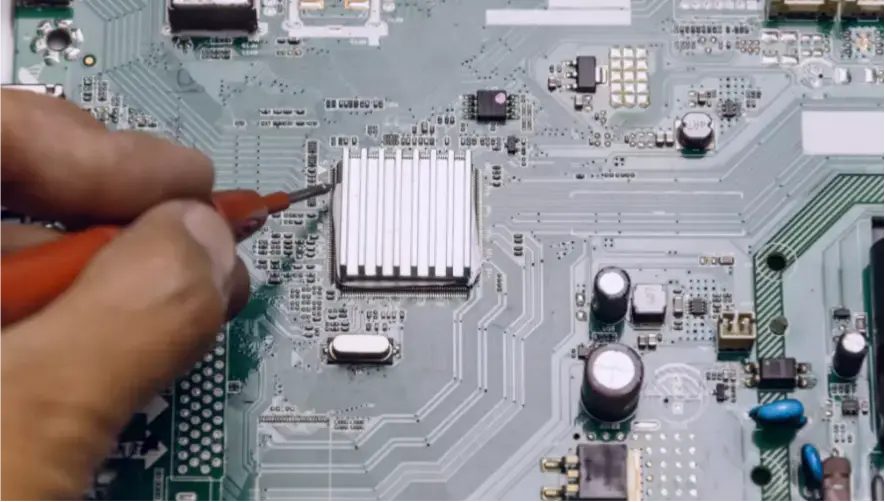
Strictly termed the thermal sensing method, this technique involves manually assessing the temperature of PCBA components—such as chip sets—to intuitively verify operational integrity. This method finds application in both practical maintenance analysis and functional testing on production lines.
For instance, during PCBA manufacturing, where PCBs exhibit thermal signatures yet pass functional tests, operators may employ touch inspection to further assess quality status and identify potential overheating risks.
4. Status Method
The status method primarily diagnoses faults by examining the operational state of components during normal functioning. During PCBA and PCB repairs, close attention must be paid to each component's performance under operational conditions, such as voltage, current, temperature, and signal output parameters. Should a component's operational state deviate from normal parameters—whether through excessive readings or abnormal functionality—it indicates potential issues with the component itself or associated affected parts. This method enables targeted identification of suspected fault areas, providing direction for further investigation.
5. Exhaustive Testing Method
The core of the exhaustive testing method involves inspecting every single component, leaving no potentially faulty part unchecked. Once a damaged component is identified, it is replaced or substituted with another suitable part. However, this approach demands a high degree of meticulousness and a strong sense of responsibility from the operator, as even the slightest oversight can lead to failure in fault diagnosis.
It should also be noted that the comprehensive testing method is not universally applicable. It is unsuitable for issues involving physical connections or parameter adjustments, such as blocked vias, broken copper traces, or improperly adjusted potentiometers. Furthermore, this method should not be used on chips containing programmes or data, as the testing process may compromise critical internal storage information, potentially causing new faults.
6. Manual Pressure Method
The manual pressure method is primarily suited for identifying defects such as open circuits, cold solder joints, or solder cracks in BGAs. It may be employed during power-on testing and standard resistance value testing. Its significant advantage lies in reducing the complexity of related measurement and maintenance procedures, substantially shortening maintenance time.
However, the manual pressure method carries inherent stress risks. For experienced maintenance analysts, applying moderate pressure when pressing the PCBA is essential. Care must be taken not to apply excessive force, nor to lift one end of the PCB before pressing the BGA, to prevent PCB fracture or damage.
7. Disconnection Method
The disconnection method is commonly employed when measuring component resistance values on PCBA. Its core principle involves isolating components for individual inspection after breaking the circuit. This technique is typically used to identify cold solder joints, open circuits, partial component shorts, or abnormally high/low resistance values at specific points.
During circuit disconnection, it may be necessary to remove resistors, inductors, transistors, or other components, or to pry open chip pins. For instance, eliminating drain resistors near chips to measure upper-limit signals represents a typical application of the open circuit method.
8. Contamination Removal Method
Certain malfunctions on PCBA, such as excessive battery leakage current or failed functional tests when connected to external devices, may be addressed by visually inspecting suspect areas for solder residue or foreign debris before measurement or component replacement.
Cleaning these areas when necessary often yields remarkable improvements for such issues, as contaminants can cause poor contact or short circuits.
9. Replacement Method
The application of the replacement method follows certain principles. Maintenance personnel may determine the sequence of component replacements based on their understanding of various PCBA types and maintenance experience. Simultaneously, measurement results from critical signal points can also serve as a basis for replacement decisions.
In practical maintenance, for a faulty PCBA where the root cause is currently difficult to identify, replacing suspected faulty components to troubleshoot the issue represents a typical application of the replacement method. This approach effectively narrows the scope of the fault and enhances repair efficiency.
With 16 years of expertise in PCBA design, manufacturing, and service, KingshengPCBA is ready to help turn your ideas into reality. Feel free to contact us anytime to discuss your requirements and get a professional quotation.
Please send Email to kspcba@c-alley.com or call us through +86 13828766801 Or submit your inquiry by online form. Please fill out below form and attach your manufacturing files( PCB Gerber files and BOM List) if need quotation. We will contact you shortly.
 +86 13828766801
 kspcba@c-alley.com
 https://www.kingshengpcba.com/
 2/F, Building 6, Tangtou 3rd Industrial Zone, Tangtou Community, Shiyan Town, Baoan District, Shenzhen, China, 518108
We would also like to thank our customers for their trust and support. The company's outstanding achievements are mainly due to the loyalty of our customers, which also encourages and spurs our company to forge ahead.