How to Select the Right PCBA Substrate Material: A Guide to Tg, Td, and CTE
 C - A L L E Y
Home | Events | PCB | About Us | News | Contact Us
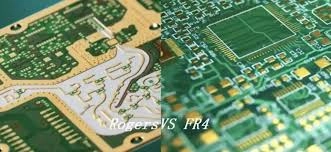
In the world of electronics manufacturing, the performance, reliability, and longevity of a Printed Circuit Board Assembly (PCBA) are fundamentally determined long before the first component is placed. The choice of substrate material—the core laminate of the PCB—is a critical decision that impacts everything from signal integrity in a 5G device to the thermal resilience of an automotive control unit. At Kingsheng PCBA, we combine over a decade of EMS expertise with rigorous material validation to guide our clients through selecting the optimal substrate for their specific application. This article breaks down a systematic approach to PCBA material selection, focusing on key thermal properties as the core criteria.
Understanding Tg, Td, and CTE: The Pillars of PCBA Reliability
To select the right material, it’s essential to understand how thermal properties dictate PCB behavior, especially in harsh environments or during the manufacturing process itself.
Glass Transition Temperature (Tg): The Stability Threshold
Tg is the temperature at which the substrate material transitions from a rigid, glassy state to a soft, rubbery one. Exceeding Tg can lead to dimensional instability and failure.
Standard FR-4 (Tg ~130-140°C): Suitable for consumer electronics with standard operating temperatures and lead-free soldering processes.
Mid-Tg FR-4 (Tg ~150°C): Offers better stability for industrial controls and automotive infotainment systems.
High-Tg FR-4 (Tg ≥170°C): Essential for high-reliability applications like
automotive engine control units (ECUs) and
medical systems where operational temperatures are high. Kingsheng often recommends High-Tg materials for projects requiring robust performance under thermal stress.
Decomposition Temperature (Td): The Point of No Return
Td is the temperature at which the substrate material chemically decomposes, releasing gas and causing permanent damage. A higher Td provides a larger safety margin during soldering and rework.
Selection Rule: Td should be at least 25-30°C higher than the maximum temperature encountered during assembly (e.g., lead-free solder reflow peaks at ~260°C). Materials with low Td risk delamination and "blistering."
Coefficient of Thermal Expansion (CTE): Managing Expansion
CTE measures how much the material expands when heated. A mismatch between the CTE of the substrate and the copper layers can cause warpage, trace cracking, or plated through-hole (PTH) failure.
Low Z-Axis CTE is critical: Materials with a controlled CTE (e.g., ≤ 50 ppm/°C) ensure mechanical stability during thermal cycling, which is vital for
aerospace electronics and long-lifespan industrial equipment.
Step 1: Align Material Properties with Your Application's Demands
The first step is matching the material's profile to your product’s operational environment and performance requirements.
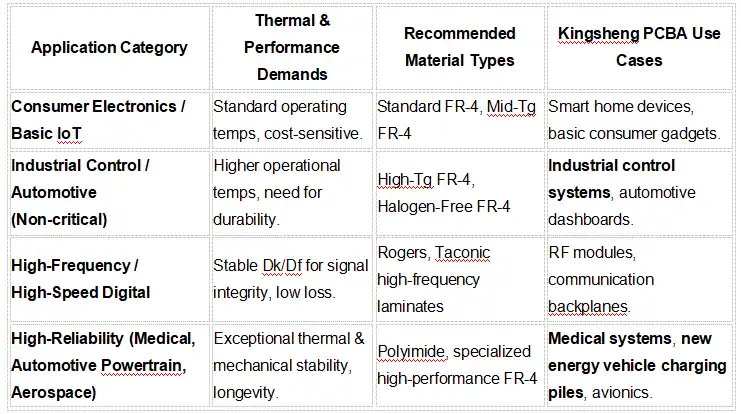
For example, a
medical device like a patient monitor requires a substrate with high Tg and Td to withstand repeated sterilization cycles, while a
new energy vehicle charging pile demands materials with excellent thermal conductivity and CTE control to manage high power loads.
Step 2: Balance Electrical, Thermal, and Mechanical Needs
A material with perfect electrical properties but poor thermal resistance will fail in the field. A holistic view is necessary.
Electrical Performance: More than just FR-4
Dielectric Constant (Dk) & Dissipation Factor (Df): For applications above 1 GHz, these become critical. While standard FR-4 has a high Df (~0.020), materials like Rogers RO4350B (Df=0.0037) offer much lower signal loss, essential for high-speed designs.
Thermal and Mechanical Stability
Thermal Conductivity: Materials with higher conductivity help dissipate heat from power components, improving reliability.
Flexural Strength: For rigid boards, this ensures they can withstand manufacturing and operational stresses. For flexible PCBs (common in wearables and compact devices), polyimide is the go-to material for its excellent flexibility and thermal endurance.
At Kingsheng, we validate materials for this complete set of properties to ensure they perform reliably in your specific operating environment, adhering to strict
ISO 9001, UL, and CCC standards.
Step 3: Navigate Manufacturability and Cost Trade-offs
Advanced materials come with higher costs and specific processing requirements. Balancing performance with practicality is key.
Standard/Mid-Tg FR-4: The most cost-effective and easiest to manufacture. Ideal for high-volume, cost-sensitive projects where high-frequency or extreme thermal performance is not required.
High-Tg/High-Performance FR-4: Offers a great balance of improved thermal properties without a significant jump in manufacturing complexity. This is the "sweet spot" for many
industrial and automotive applications.
Specialized Laminates (Rogers, Polyimide): Offer the best performance but at a higher cost and with specialized manufacturing requirements (e.g., specific drill parameters, handling procedures).
Kingsheng's advanced facilities are fully equipped to handle these materials, ensuring high yield and quality.
Step 4: Partner with Kingsheng for Expert Validation
Selecting the right material is not just about datasheets. It requires practical experience. Kingsheng offers expert material selection services to ensure your project's success:
Collaborative Analysis: Our engineering team works with you to analyze your thermal, electrical, and mechanical requirements to define precise material thresholds.
DFM (Design for Manufacturability) Review: We ensure your chosen material is compatible with our advanced processes, from
SMT and THT assembly to final testing, avoiding potential yield issues.
Prototype Validation: We can produce prototypes using different materials to validate real-world performance before moving to full-scale production.
Conclusion: Choose with Confidence, Partner with Kingsheng
Selecting the right PCBA substrate material is a strategic decision that blends technical knowledge with practical experience. By understanding key properties like Tg, Td, and CTE, aligning them with your application, and balancing performance with cost, you can significantly enhance the quality and reliability of your electronic products.
At Kingsheng PCBA, we simplify this process. With our deep material expertise, state-of-the-art manufacturing capabilities, and commitment to quality, we are your ideal partner for everything from
quick-turn prototypes to
large-scale production runs.
Ready to optimize your PCBA material selection?
[Contact Kingsheng PCBA Today] to consult with our engineering team and get a custom quote. Let us help you build a more reliable and high-performing product.
With 16 years of expertise in PCBA design, manufacturing, and service, KingshengPCBA is ready to help turn your ideas into reality. Feel free to contact us anytime to discuss your requirements and get a professional quotation.
 +86 13828766801
 kspcba@c-alley.com
 https://www.kingshengpcba.com/
 2/F, Building 6, Tangtou 3rd Industrial Zone, Tangtou Community, Shiyan Town, Baoan District, Shenzhen, China, 518108