PCB Layer Count: A Comprehensive Guide from 1 to 20+ Layers
 C - A L L E Y
Home | Events | PCB | About Us | News | Contact Us
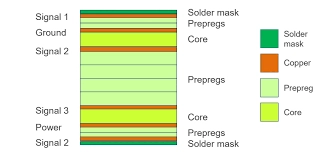
In the world of electronics design, the printed circuit board (PCB) is the foundational bedrock upon which all components are mounted. One of the most critical decisions an engineer makes is selecting the appropriate number of layers for a PCB. This choice, ranging from simple single-sided boards to complex 20+ layer assemblies, fundamentally impacts the board's functionality, performance, cost, and manufacturability. At Kingsheng PCBA, with over a decade of expertise in advanced PCB fabrication and assembly, we understand that navigating this decision is key to a project's success. This guide provides a systematic approach to selecting the optimal PCB layer count for your application.
Understanding PCB Layers: The Building Blocks of Modern Electronics
A PCB is much more than a platform for components; it is a sophisticated sandwich of conductive and insulating layers. To select the right layer count, it's essential to understand the roles these layers play.
Signal Layers: These are the layers containing copper traces that carry electrical signals between components. The number of signal layers directly correlates with the circuit's complexity.
Power Plane: A dedicated, continuous copper layer used to distribute power (e.g., VCC) across the board. This provides stable voltage and reduces noise.
Ground Plane: Another dedicated copper layer connected to the circuit's ground (GND). It serves as a common reference point, shields against electromagnetic interference (EMI), and is critical for signal integrity in high-speed designs.
Dielectric Substrate: The insulating material (e.g., FR-4) that separates the conductive layers, providing the PCB with its structure and electrical isolation.
The Impact of Layer Count: Performance, Size, and Cost
The layer count is a primary driver in three key areas:
Circuit Complexity and Routing Density: Higher component counts and complex integrated circuits (ICs) like BGAs and FPGAs require more traces. Increasing the layer count is the only way to route all these connections without an impossibly large board size.
Signal Integrity and EMI Control: High-speed digital circuits (like those in data centers) and sensitive analog/RF circuits (in automotive radar or medical systems) demand controlled impedance and minimal crosstalk. Dedicated ground planes between signal layers are essential for shielding and providing a stable return path for signals.
Thermal Management: Multi-layer boards can incorporate thick power planes that help dissipate heat generated by high-power components, improving reliability.
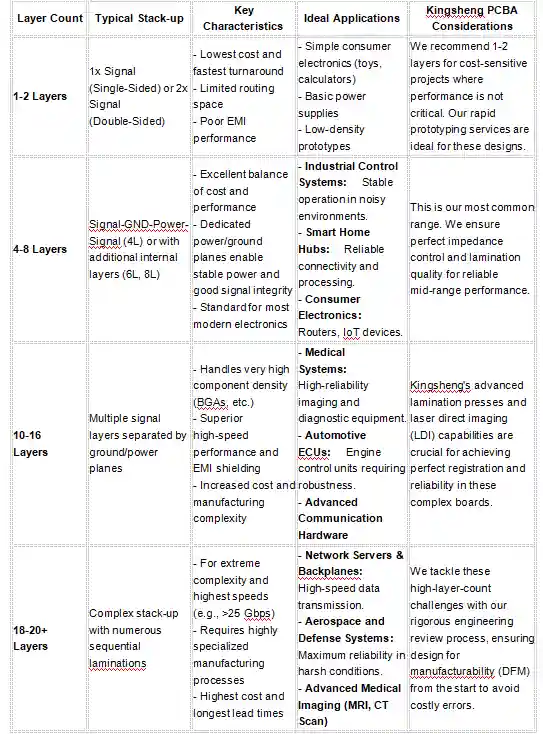
A Layer-by-Layer Breakdown: From Simple to Highly Complex
 Conclusion: Partner with Kingsheng for Optimal Layer Count Selection
Choosing the right PCB layer count is a strategic balance of performance requirements, board size, budget, and timeline. Under-specifying leads to functionality issues, while over-specifying unnecessarily increases cost.
At
Kingsheng PCBA, we simplify this critical decision. Our engineering team provides expert
Design for Manufacturability (DFM) analysis, recommending the most cost-effective layer stack-up to meet your performance goals. From quick-turn 2-layer prototypes to complex 20+ layer production runs for
automotive, medical, and industrial applications, we have the technology and expertise to ensure your design's success.
Ready to optimize your PCB layer stack-up? Contact Kingsheng PCBA today to consult with our engineering team, request a free DFM analysis, or get a competitive quote for your next project.
With 16 years of expertise in PCBA design, manufacturing, and service, KingshengPCBA is ready to help turn your ideas into reality. Feel free to contact us anytime to discuss your requirements and get a professional quotation.
 +86 13828766801
 kspcba@c-alley.com
 https://www.kingshengpcba.com/
 2/F, Building 6, Tangtou 3rd Industrial Zone, Tangtou Community, Shiyan Town, Baoan District, Shenzhen, China, 518108