* On your first PCB Assembly order!
* Up to $300 discount
 C - A L L E Y
 Home | Events | PCB | About Us | News | Contact Us
Core Elements of PCBA Quality Control
Source Control of Components and Substrates: Supplier Selection
Supplier Selection: Choose ISO-certified suppliers to ensure components (e.g., ICs, capacitors) and PCB materials (e.g., FR-4, high-frequency materials) comply with industry standards (IPC-A-610).
Incoming Inspection: Conduct visual and electrical performance tests on components (e.g., capacitance, resistance values); inspect PCB substrates for thickness, warpage, and solder mask integrity.
Precision Process Control
Equipment Calibration: Regularly maintain placement machine accuracy (±0.01mm) and reflow oven temperature profiles (e.g., lead-free process peak 245°C ±5°C).
Soldering Quality: Solder coverage must exceed 75% to prevent cold solder joints/short circuits; X-ray monitoring of BGA soldering for void rate (requirement <25%).
SPC (Statistical Process Control): Real-time monitoring of critical parameters (e.g., solder paste thickness), evaluating process capability via Cpk values (target Cpk ≥1.33).
Environmental and Personnel Management
Workshops must maintain dust-free conditions with constant temperature and humidity (23±3°C, 40–60% RH), with comprehensive anti-static measures in place.
Operators undergo training and certification, adhering to standardised SOPs (e.g., IPC-J-STD-001 soldering standards).
PCBA Common Testing Methodology Framework
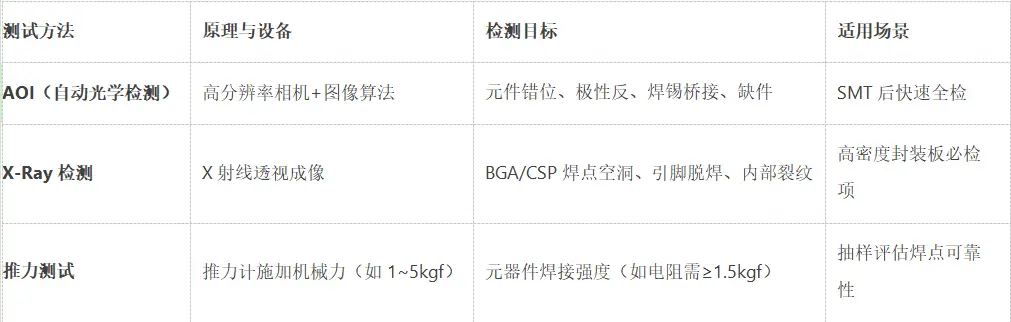
Classified into three categories based on testing objectives:
Classified into three categories based on testing objectives: process defect detection, electrical performance verification, and environmental reliability testing:
Electrical Performance and Functional Testing
ICT (In-Circuit Testing):
Measures circuit continuity, component values (resistance ±5% tolerance), and short/open circuits via probe bed contact points. High efficiency, suitable for high-volume production.
FCT (Functional Testing):
Simulates real-world operating conditions (e.g., input voltage, signal load) to validate overall PCBA functionality (e.g., MCU communication capability). Requires custom test fixtures.
Boundary Scan (JTAG):
Utilises chip-embedded test interfaces to detect interconnect faults between ICs. Preferred for complex digital circuits.
Environmental and Reliability Validation
Temperature-Humidity Cycling:
48-hour cycles from -40°C to 85°C to detect solder joint cracking caused by thermal stress.
Vibration/Shock Testing:
Simulates transport conditions (e.g., 1 hour vibration per axis, 1500G shock) to evaluate structural integrity.
Salt Spray Test:
48 hours at 35°C in salt mist environment to validate coating corrosion resistance (essential for marine equipment).
HALT (Highly Accelerated Life Testing):
Rapidly exposes design flaws under extreme stress (temperature + vibration) to enhance mass production reliability.
How to Select Testing Strategies?
Small batches/prototypes: AOI + flying probe testing (fixture-free) + FCT combination, balancing cost and coverage.
Automotive/medical: Full process coverage required (SPC monitoring + X-ray + ICT + environmental stress screening).
Consumer electronics: AOI + functional testing as primary, with salt spray/vibration sampling verification.
Key insight: Testing is not a final remedy but an integral part of the quality closed-loop system.
For instance, real-time SPC alerts for process drift and DFM (Design for Manufacturability) proactively mitigating soldering risks enable cost reduction and efficiency gains at source.
Summary
Ensuring PCBA quality requires vertical integration across the ‘design-material-process-testing’ chain and horizontal convergence of diverse testing methodologies. The core principles are:
① Preventive control of materials/processes (SPC, DFM);
② Complementary defect detection (AOI/X-Ray) and electrical testing (ICT/FCT);
③ Tailoring reliability validation to end-use scenarios (e.g., enhanced vibration/temperature cycling for automotive electronics).
This framework enables PCBA failure rates to be reduced to <100ppm.
With 16 years of expertise in PCBA design, manufacturing, and service, KingshengPCBA is ready to help turn your ideas into reality. Feel free to contact us anytime to discuss your requirements and get a professional quotation.
Please send Email to kspcba@c-alley.com or call us through +86 13828766801 Or submit your inquiry by online form. Please fill out below form and attach your manufacturing files( PCB Gerber files and BOM List) if need quotation. We will contact you shortly.
 +86 13828766801
 kspcba@c-alley.com
 https://www.kingshengpcba.com/
 2/F, Building 6, Tangtou 3rd Industrial Zone, Tangtou Community, Shiyan Town, Baoan District, Shenzhen, China, 518108
We would also like to thank our customers for their trust and support. The company's outstanding achievements are mainly due to the loyalty of our customers, which also encourages and spurs our company to forge ahead.