* On your first PCB Assembly order!
* Up to $300 discount
 C - A L L E Y
 Home | Events | PCB | About Us | News | Contact Us
In the world of Printed Circuit Board Assembly (PCBA), two manufacturing methodologies form the foundation of modern electronics: Through-Hole Technology (THT) and Surface Mount Technology (SMT). While both aim to secure components to a board, their approaches, applications, and advantages differ significantly. Understanding this distinction is crucial for designers and engineers to optimize performance, cost, and reliability.
The Fundamental Difference: How They Connect
The core distinction lies in the component attachment method. THT components feature long leads that are inserted into pre-drilled holes passing through the PCB. These leads are then soldered to pads on the opposite side, creating a robust physical connection. In contrast, SMT components (Surface Mount Devices, or SMDs) have small metallic terminals. They are placed directly onto solder pads on the board's surface and secured using a reflow soldering process.
This fundamental difference drives all subsequent comparisons.
Contrasting Strengths and Weaknesses
Through-Hole Technology (THT): The Robust Veteran
THT is the older, traditional method. Its key strength is exceptional mechanical bonding. The leads running through the board make connections incredibly resistant to mechanical stress, vibration, and thermal strain. This makes THT ideal for:
- High-power components
- Large transformers and connectors
- Aerospace, automotive, and industrial equipment subjected to harsh environments
However, THT has major drawbacks. The drilling process is slow and expensive, consumes valuable board space, and limits component density. It is poorly suited for modern miniaturization.
Surface Mount Technology (SMT): The Modern Powerhouse
SMT is the dominant technology today, enabling the electronics revolution. Its primary advantage is miniaturization and efficiency. SMDs are much smaller and can be placed on both sides of the board, leading to incredibly dense, compact, and high-performance circuits. The process is highly automated, using pick-and-place machines and reflow ovens, which allows for faster production and lower costs at high volumes.
The trade-off is that SMT connections are generally less robust mechanically than THT and can be more challenging for prototyping and manual rework.
The Modern Reality: A Hybrid Approach
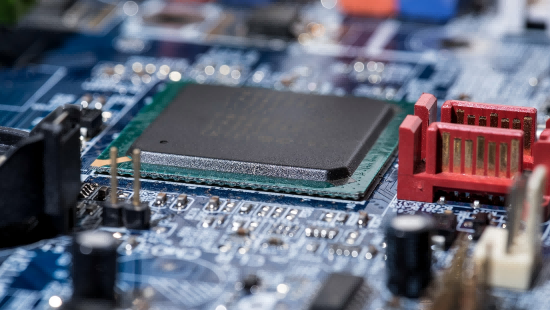
In contemporary PCBA, the question is rarely "THT or SMT?" but rather "Where should we use each?" A typical modern board is a hybrid assembly. The vast majority of components—microprocessors, resistors, capacitors, and integrated circuits—are mounted using SMT for its size and speed benefits. A select few components, such as large electrolytic capacitors, power connectors, or plug-in modules, will use THT where mechanical strength is paramount.
Conclusion
THT and SMT are complementary technologies. THT provides brute mechanical strength for specific, demanding applications, while SMT delivers the miniaturization and speed required for the modern digital world. A successful design strategically leverages both, ensuring the final product is not only functional and reliable but also cost-effective to manufacture.
Thank you for reading. We hope this article provided valuable insights for you.
With 16 years of expertise in PCBA design, manufacturing, and service, KingshengPCBA is ready to help turn your ideas into reality. Feel free to contact us anytime to discuss your requirements and get a professional quotation.
Please send Email to kspcba@c-alley.com or call us through +86 13828766801 Or submit your inquiry by online form. Please fill out below form and attach your manufacturing files( PCB Gerber files and BOM List) if need quotation. We will contact you shortly.
 +86 13828766801
 kspcba@c-alley.com
 https://www.kingshengpcba.com/
 2/F, Building 6, Tangtou 3rd Industrial Zone, Tangtou Community, Shiyan Town, Baoan District, Shenzhen, China, 518108
We would also like to thank our customers for their trust and support. The company's outstanding achievements are mainly due to the loyalty of our customers, which also encourages and spurs our company to forge ahead.