* On your first PCB Assembly order!
* Up to $300 discount
 C - A L L E Y
 Home | Events | PCB | About Us | News | Contact Us
Signal integrity (SI) and power integrity (PI) are fundamental to the performance and reliability of modern electronic products, especially in high-speed and high-density PCB designs. This article outlines essential design considerations for maintaining SI and PI throughout the layout process.
1. Signal Integrity Design Essentials
SI ensures that electrical signals propagate from transmitter to receiver without significant distortion, delay, or interference. Key design measures include:
Impedance Matching: Maintain consistent characteristic impedance along transmission lines by controlling trace width, dielectric thickness, and material properties. Use controlled impedance routing for high-speed signals such as DDR, PCIe, or USB.
Routing Optimization: Keep high-speed traces short and direct. Avoid sharp bends and excessive vias. Use differential pairs for noise immunity where applicable.
Crosstalk Mitigation: Increase spacing between parallel traces, especially for clock and sensitive analog signals. Utilize ground planes as shielding and avoid long parallel runs on adjacent layers.
Via Management: Minimize the number of vias in critical paths. Where necessary, use back-drilling or microvias to reduce stub effects.
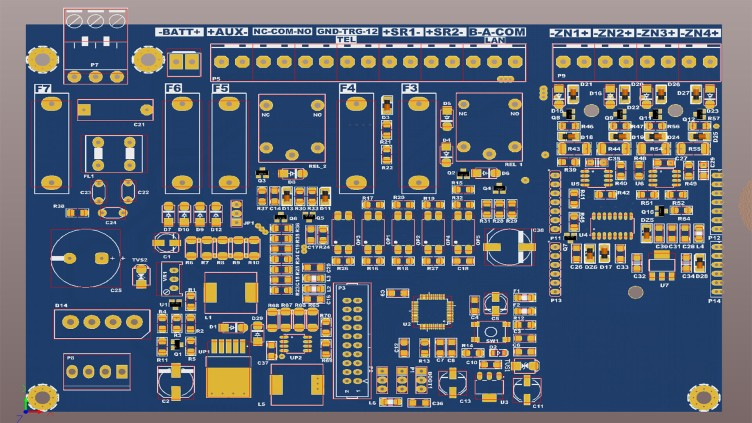
2. Power Integrity Design Essentials
PI focuses on delivering a stable, low-noise power supply to all active components:
Power Plane Design: Use solid power and ground planes in multilayer stackups to provide low-impedance power distribution. Avoid splits or gaps in current return paths.
Power Segmentation: Isolate analog, digital, and RF power domains. Use strategic splits or bridges (e.g., ferrite beads) to prevent noise coupling.
Decoupling Strategy: Place a mix of decoupling capacitors near IC power pins: 0.1 µF for high-frequency noise, and 1–10 µF for bulk decoupling. Optimize capacitor placement to minimize loop inductance.
Current Capacity Planning: Size power traces and planes based on expected current load. Use PCB toolkit calculators to avoid IR drop and overheating.
3. Interaction Between SI and PI
Signal quality is closely tied to power stability. Power supply noise can couple into signals, while transient currents from switching signals can disturb the power delivery network (PDN). A holistic design approach should include:
Co-simulation of SI and PI where feasible
Proper return path design for high-speed signals
Use of integrated PCB design tools with SI/PI analysis capabilities
Conclusion
Successful PCB design requires careful attention to both signal and power integrity from the initial layout stages. By implementing controlled impedance routing, optimized power distribution, and effective decoupling, designers can achieve higher performance and reliability in high-speed digital systems.
At KingshengPCBA, we support customers with SI/PI-aware design reviews and manufacturing expertise to help bring robust, high-performance products to market. Reach out to our team for assistance on your next PCB project.
Please send Email to kspcba@c-alley.com or call us through +86 13828766801 Or submit your inquiry by online form. Please fill out below form and attach your manufacturing files( PCB Gerber files and BOM List) if need quotation. We will contact you shortly.
 +86 13828766801
 kspcba@c-alley.com
 https://www.kingshengpcba.com/
 2/F, Building 6, Tangtou 3rd Industrial Zone, Tangtou Community, Shiyan Town, Baoan District, Shenzhen, China, 518108
We would also like to thank our customers for their trust and support. The company's outstanding achievements are mainly due to the loyalty of our customers, which also encourages and spurs our company to forge ahead.