* On your first PCB Assembly order!
* Up to $300 discount
 C - A L L E Y
 Home | Events | PCB | About Us | News | Contact Us
Overcoming Reliability and Process Barriers in Advanced PCBA Production
As electronic products become thinner, lighter, and more integrated, rigid-flex PCBs have become the preferred solution for compact and high-reliability designs. Combining the structural strength of rigid boards with the flexibility of flex circuits, rigid-flex PCBs are now widely used in medical devices, aerospace systems, wearable electronics, and automotive sensors.
However, assembling rigid-flex boards is far more complex than working with traditional rigid PCBs. The mix of flexible substrates, dynamic bending zones, and multi-layer stack-ups introduces new challenges in manufacturing, soldering, and testing.
This article explores the most common assembly difficulties and proven solutions to ensure quality and stability.
1. Material Handling and Warpage Control
Challenge:
Flexible substrates such as polyimide (PI) and adhesive layers are thinner and more heat-sensitive than FR-4 materials. During reflow or lamination, uneven thermal expansion can cause board warpage, delamination, or layer separation, especially at rigid-to-flex transition zones.
Solutions:
-Use support carriers or stiffeners during SMT assembly to maintain board flatness.
-Apply step-temperature reflow profiles to reduce thermal stress.
-Design symmetrical stack-ups and avoid large copper imbalances between layers.
-Store and prebake boards under humidity-controlled conditions to prevent moisture-related deformation.
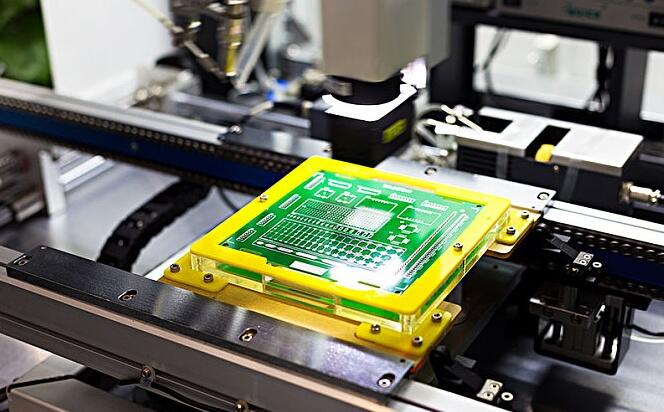
2. SMT Soldering and Component Placement
Challenge:
The flexible sections of a rigid-flex PCB provide little mechanical stability during pick-and-place operations. Vibrations or uneven suction can cause component shift or misalignment.
In addition, the difference in CTE (Coefficient of Thermal Expansion) between rigid and flex materials can lead to solder joint fatigue after multiple reflow cycles.
Solutions:
-Mount components only on the rigid areas whenever possible.
-Use custom assembly fixtures or vacuum plates to support flex zones during soldering.
-Employ low-stress solder alloys (e.g., SAC-X series) to improve thermal fatigue resistance.
-Perform X-ray inspection on BGA and fine-pitch components to detect hidden solder issues.
3. Bending Reliability and Mechanical Stress
Challenge:
Improper bend radius or repeated folding during assembly can crack copper traces, tear coverlays, or delaminate adhesive layers. Over-bending is a major cause of early product failure.
Solutions:
-Follow IPC-2223 standards: bend radius ≥ 10× flex thickness for dynamic bends.
-Limit the number of bend operations and avoid bending after soldering.
-Reinforce flex-to-rigid transition zones with epoxy or polyimide stiffeners.
-For wearable or folding devices, use rolled-annealed copper instead of electro-deposited copper for improved ductility.
4. Assembly Fixture and Process Control
Challenge:
Each rigid-flex PCB has a unique 3D structure, making standard SMT fixtures ineffective. Manual handling increases the risk of scratching or delamination.
Solutions:
-Develop customized 3D assembly fixtures that match the board contour.
-Use heat-resistant tapes to fix flex tails during reflow.
-Implement AOI (Automated Optical Inspection) and SPI (Solder Paste Inspection) after each critical step.
-Document a clear assembly process flow with temperature and pressure parameters for repeatable results.
5. Testing and Final Inspection
Challenge:
Testing rigid-flex assemblies requires specialized fixtures that can access both rigid and flexible areas. Traditional ICT probes may not reach flex circuits without risk of damage.
Solutions:
-Use custom functional test jigs with flexible connectors and spring probes.
-Perform continuity, insulation resistance, and bend cycle tests to verify reliability.
-Add test pads in accessible rigid zones during PCB design for easier inspection.
Conclusion: Experience Defines Quality
Rigid-flex PCBA assembly demands precision, experience, and process discipline. Every stage, from material selection to thermal profiling and testing, must be carefully managed to avoid costly rework or product failure.
At KingshengPCBA, we specialize in one-stop rigid-flex PCB manufacturing and assembly, providing expert DFM analysis, controlled reflow processes, and advanced inspection systems to ensure consistent quality.

Please send Email to kspcba@c-alley.com or call us through +86 13828766801 Or submit your inquiry by online form. Please fill out below form and attach your manufacturing files( PCB Gerber files and BOM List) if need quotation. We will contact you shortly.
 +86 13828766801
 kspcba@c-alley.com
 https://www.kingshengpcba.com/
 2/F, Building 6, Tangtou 3rd Industrial Zone, Tangtou Community, Shiyan Town, Baoan District, Shenzhen, China, 518108
We would also like to thank our customers for their trust and support. The company's outstanding achievements are mainly due to the loyalty of our customers, which also encourages and spurs our company to forge ahead.