* On your first PCB Assembly order!
* Up to $300 discount
 C - A L L E Y
 Home | Events | PCB | About Us | News | Contact Us
Starting your first PCB project? Don't let substrate selection confuse you! This guide from Shenzhen KingshengPCBA breaks down PCB materials like FR-4, High-Tg, and more for beginners.
So, you’ve designed your first circuit schematic, and you’re ready to bring your electronic idea to life by ordering a PCB. Congratulations! This is an exciting step.
However, many beginners focus solely on the circuit design and component placement, overlooking a critical factor that can make or break their project: the choice of PCB substrate.
Think of the PCB substrate as the foundation of your house. A weak or unsuitable foundation can lead to cracks, instability, and failure, no matter how well you build the walls. Similarly, the wrong PCB material can lead to overheating, signal distortion, or even physical breakdown.
At KingshengPCBA, with over 15 years of experience serving global clients from the USA to Australia and Russia, we've helped countless engineers and hobbyists navigate this crucial choice. This guide will simplify PCB substrate selection for your first project.
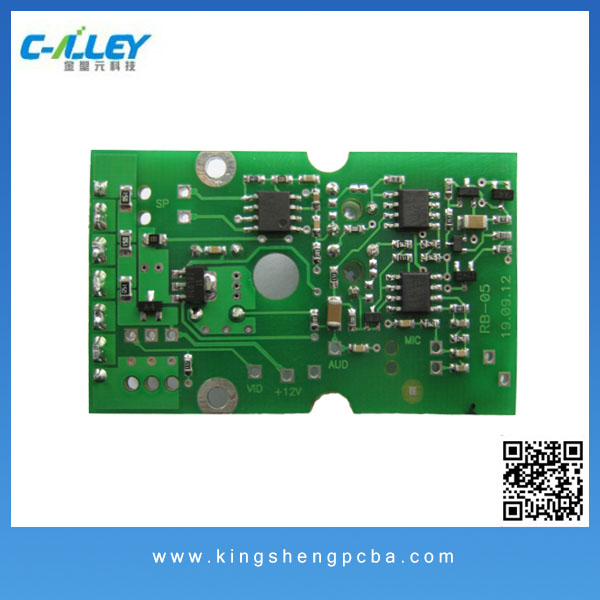
Understanding the Basics: What is a PCB Substrate?
The substrate, or base material, is the insulating core upon which the copper traces are laminated. Its primary job is to provide mechanical support and electrical insulation. The most common type is a glass-reinforced epoxy laminate, but many variations exist.
The key properties of a substrate that you need to consider are:
1.Thermal Performance (Tg - Glass Transition Temperature): This is the temperature at which the substrate changes from a rigid, glassy state to a soft, rubbery one. Exceeding Tg can lead to permanent deformation and failure.
2.Dielectric Constant (Dk): This measures how well the material insulates against electric fields. A stable Dk is crucial for high-frequency signals to prevent distortion and signal loss.
3.Loss Tangent (Df): This indicates the amount of signal energy lost as heat in the substrate material. Lower Df is better for high-speed and high-frequency applications.
4.Mechanical Strength and Moisture Absorption: The material must be robust enough for its operating environment and resist absorbing moisture from the air, which can affect its electrical properties.
A Beginner's Guide to Common PCB Materials
Here’s a breakdown of the most common PCB substrates, perfect for your first project.
1. FR-4: The Go-To Standard (For Most First Projects)
What it is: A composite material of woven fiberglass cloth with an epoxy resin binder. It's flame retardant (hence "FR").
Best for: The vast majority of beginner and hobbyist projects. Arduino shields, basic sensor boards, LED controllers, power supplies, and general-purpose digital circuits.
Why choose it: Cost-effective, widely available, offers a good balance of mechanical and electrical properties. It's the "default" for a reason.
KingshengPCBA Insight: Over 70% of the prototype boards we manufacture for students and startups are standard FR-4. It’s a reliable and economical starting point.
2. High-Tg FR-4: The Upgrade for Heat
What it is: An enhanced version of FR-4 with a higher Glass Transition Temperature (typically >170°C).
Best for: Projects that generate significant heat, like high-power LED systems, power converters, or devices destined for hot environments.
Why choose it: Provides better stability and resistance against thermal stress than standard FR-4 without a massive cost increase.
KingshengPCBA Insight: For our clients in automotive or industrial sectors, we often recommend High-Tg FR-4 as a robust, standard solution.
3. High-Frequency/Low-Loss Materials: For Specialized Signals
What they are: Specialty laminates like Rogers, Teflon, or ceramic-filled hydrocarbons. They have a very stable Dk and very low Df.
Best for: Advanced projects only. RF circuits, Wi-Fi/Bluetooth modules, radar systems, and high-speed digital applications (e.g., >1 GHz).
Why choose them: They preserve signal integrity where FR-4 would cause too much loss or distortion.
KingshengPCBA Insight: These materials are more expensive and require specialized manufacturing processes. We work closely with our clients in the telecommunications and aerospace sectors in the US and Australia on these advanced boards.
4. Metal-Core PCBs (MCPCBs): For Superior Cooling
What they are: PCBs with a metal base (usually aluminum) for heat dissipation, topped with a dielectric layer and the copper circuit.
Best for: High-power applications where heat is the primary enemy. Think high-brightness LED arrays, power supplies, and motor controllers.
Why choose it: The metal core acts as a heatsink, pulling heat away from critical components.
KingshengPCBA Insight: We have extensive experience producing high-quality MCPCBs for lighting solutions exported globally, ensuring long lifetimes for LED products.
Your Simple 4-Step Selection Checklist
Ask yourself these questions to narrow down your choice:
1.What is my project's operating frequency/speed?
*< 1 GHz & Digital Logic: Standard FR-4 is fine.
*> 1 GHz or Critical Analog Signals: Consider Low-Loss Materials.
2.How much heat will my project generate?
*Low to Moderate Heat: Standard FR-4.
*High Heat or Hot Environment: High-Tg FR-4 or Metal-Core.
3.What is my budget?
*Tight Budget: FR-4 is your friend.
*Performance-Critical (Cost Secondary): Explore High-Tg or Specialty materials.
4.What are the environmental conditions?
*Standard Indoor Use: FR-4.
*High Humidity or Harsh Conditions: FR-4 with specific protective coatings (like HASL or ENIG) is often sufficient. Discuss this with your manufacturer.
Conclusion:
When in Doubt, Start with FR-4
For your very first PCB project, the safest and most practical bet is almost always standard FR-4. It will perform perfectly for most applications without complicating the design or blowing your budget.
Partner with an Expert for Your First Build
The journey from a design file to a functional PCB is filled with small decisions. Partnering with an experienced manufacturer can save you time, cost, and frustration.
At KingshengPCBA, we don't just build boards; we build partnerships. With over 15 years of expertise and a deep understanding of international standards, we provide:
*Expert DFM (Design for Manufacturability) Feedback: We'll review your files and suggest improvements, including material suitability.
*Rapid Prototyping: Get your boards quickly to test and iterate.
*Global Support: We seamlessly serve clients across the United States, Australia, Russia, and beyond.
Ready to turn your idea into a reality?
Contact KingshengPCBA Today to get a fast quote and expert guidance on your first PCB order. Let our experience be your foundation for success.
Please send Email to kspcba@c-alley.com or call us through +86 13828766801 Or submit your inquiry by online form. Please fill out below form and attach your manufacturing files( PCB Gerber files and BOM List) if need quotation. We will contact you shortly.
 +86 13828766801
 kspcba@c-alley.com
 https://www.kingshengpcba.com/
 2/F, Building 6, Tangtou 3rd Industrial Zone, Tangtou Community, Shiyan Town, Baoan District, Shenzhen, China, 518108
We would also like to thank our customers for their trust and support. The company's outstanding achievements are mainly due to the loyalty of our customers, which also encourages and spurs our company to forge ahead.