10G Router/Switch PCBA: The Engine for Next-Gen Networks
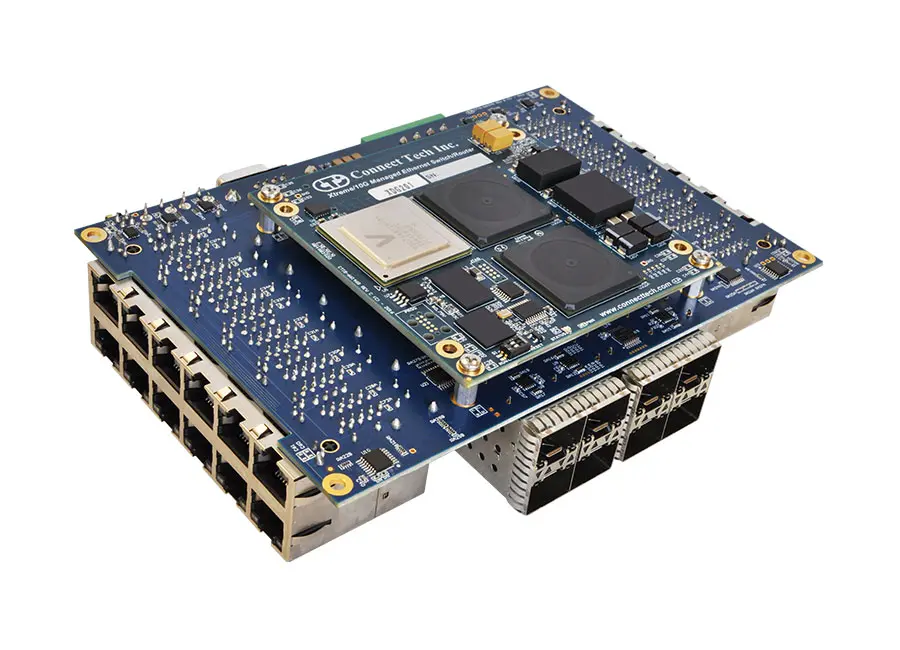
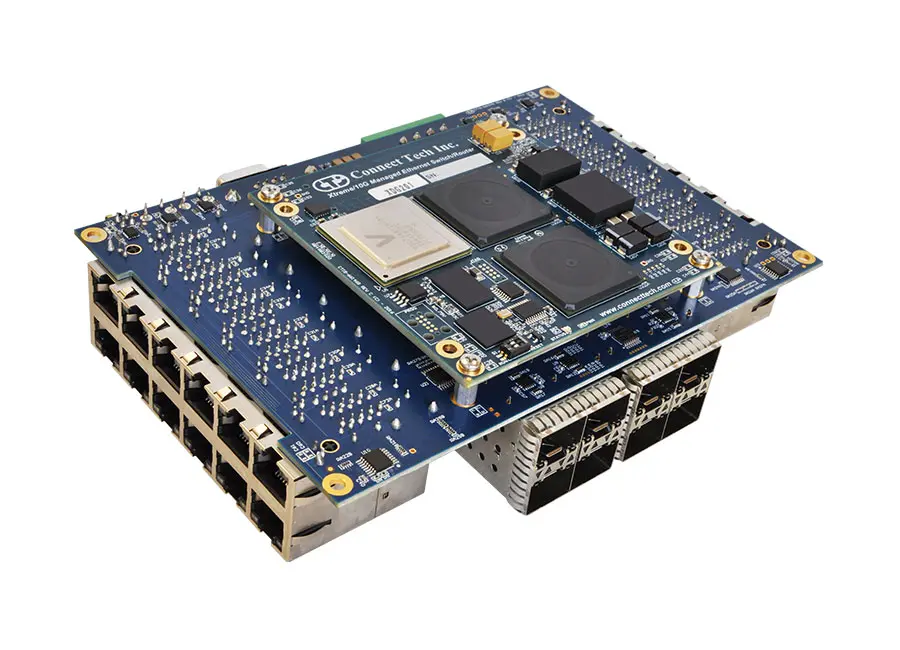
As digital transformation accelerates, network infrastructure has become the nervous system of the digital economy. The router—the central hub connecting the physical and digital worlds—is evolving from a single network device into an intelligent, scenario-driven platform. At the heart of this evolution lies the 10-gigabit enterprise router and switch motherboard PCBA. This article explores the product's market potential, core technologies, manufacturing barriers, and the production capabilities required from a PCBA factory.
 I. Core Technologies: The Hardware Backbone of 10G Routing
1. Heterogeneous Parallel Computing Architecture
Modern high-end routers adopt a "multi-core CPU + ASIC switching chip" architecture. The general-purpose CPU (x86 or ARM) handles control-plane tasks such as routing protocol calculation and management interfaces, while the ASIC chip takes care of data-plane high-speed forwarding—L2/L3 packet forwarding, QoS queue scheduling, etc. ASICs can achieve wire-speed forwarding of 10 Mpps, far exceeding pure software performance.
2. High-Density High-Speed Signal Transmission
A typical 8-port 10G daughter card must provide eight 10 Gb/s data channels to the mother card, supporting switching capacities up to 160 Gbps. As line rates climb from 10G to 25G, 56G, and even 112G, signal integrity, impedance matching, and differential pair length control become critical.
3. High-Layer Count PCBs & HDI Micro-via Technology
10G router motherboards typically require 12 or more PCB layers—some designs exceed 20 layers. Multi-step HDI blind/buried via technology is widely used to fan out high-density BGA packages. Line width/space can be as tight as 3 mil/3 mil, demanding nanometer-level alignment and high-precision laser drilling.
4. Signal Integrity (SI) & EMC Control
At 10G speeds, even minor impedance mismatches cause severe reflection, attenuation, and crosstalk. Precise differential impedance control (often ±5% tolerance) and rigorous EMC design are core technical barriers. PCB stackup, return path optimization, power integrity, and signal isolation must all be carefully engineered.
II. Manufacturing Barriers: From "Making" to "Mastering"
1. High-End Manufacturing Complexity
The manufacturing complexity of 10G enterprise router motherboards far exceeds that of consumer electronics. Interlayer registration of 12+-layer boards, plating quality of HDI micro-vias, precise placement of fine-pitch BGA chips (0.35 mm pitch), and consistent impedance control represent a true technological moat.
2. Customer Qualification Barriers
Customer qualification cycles are long and stringent—typically 6 to 12 months for communication equipment OEMs. Certifications such as IPC QML are reserved for only a handful of EMS providers. Once qualified, strong collaboration stickiness is formed.
3. Supply Chain & Localisation Barriers
Core components (switching chips, PHY chips) have long been dominated by foreign suppliers. Localisation requires component substitution, driver adaptation, protocol stack re-engineering, and compatibility validation—system-level challenges that demand close collaboration between the PCBA factory and upstream/downstream partners.
III. PCBA Factory Capabilities Required for Success
To successfully manufacture 10G enterprise router motherboards, a PCBA factory must demonstrate the following:
1. High-Layer, High-Precision PCB Fabrication
Ability to mass-produce 12+-layer boards
High-accuracy lamination for consistent dielectric thickness and controlled impedance
Multi-step HDI blind/buried via capability
Line width/space down to 3 mil/3 mil, registration ≤ ±1.5 μm
2. Precision Impedance Control & High-Speed Signal Testing
Full-process impedance control system from design simulation (e.g., SIwave pre-adjustment) to in-line TDR testing
Automated vector network analyzers for accurate frequency-domain measurement of differential/single-ended traces
Tolerance typically ≤ ±5%, with some high-frequency scenarios requiring ≤ ±10%
3. High-Accuracy SMT Assembly & BGA Soldering
Micron-level placement accuracy for fine-pitch BGAs (0.35 mm)
Nitrogen-reflow soldering to ensure complete ball melting and low-void IMC formation
Full coverage SPI + AOI to drive soldering defects toward zero
4. Robust Quality Management & Reliability Testing
Certifications: IATF 16949, ISO 13485, ISO 9001
Compliance with IPC-A-610 Class 2 or Class 3
In-house reliability testing: high-temperature burn-in, thermal shock, vibration, EMC/EMI
 IV. Conclusion: Your Trusted Manufacturing Partner for the 10G Era
The 10-gigabit enterprise router and switch motherboard PCBA is a strategic component of tomorrow's digital infrastructure. Its high technical barriers, manufacturing complexity, and tremendous market potential make it a premium, high-growth opportunity.
For PCBA factories, success in this field demands not only manufacturing excellence—high-layer HDI, precision impedance, fine-pitch BGA assembly—but also a one-stop service model from DFM review to full-process quality control. Only by combining "precision engineering" with "uncompromising reliability" can we become the trusted partner that equipment OEMs rely on to power the 10G era.
Contact us today for a custom 10G enterprise router/switch motherboard PCBA solution.
We offer one-stop EMS from PCB fabrication to SMT assembly and system integration—with 12+-layer production capability, ±5% precision impedance control, advanced BGA placement, and an IPC Class 3 quality system. Let's build the 10G future together.
Shenzhen Kingsheng Technology Co., Ltd. has rich experience and a professional technical team in PCBA.
Contact KingshengPCBA today to request a quote or discuss your PCBA project.
 +86 13828766801
 kspcba@c-alley.com
 https://www.kingshengpcba.com/
 2/F, Building 6, Tangtou 3rd Industrial Zone, Tangtou Community, Shiyan Town, Baoan District, Shenzhen, China, 518108