Modbus Control Board: The Universal PCB Platform for Industrial Device Communication
In modern automation systems, industrial machines are no longer built around isolated control units. Instead, they operate as integrated communication ecosystems where PLCs, sensors, HMIs, inverters, temperature controllers, meters, actuators, and remote I/O modules constantly exchange operating data.
To make this multi-device coordination possible, a stable and standardized communication layer is essential.
This is exactly where the
Modbus control board plays a critical role.
As one of the earliest and most widely adopted industrial fieldbus protocols, Modbus has remained a de facto communication standard for more than four decades because it offers:
- simple implementation,
- strong compatibility,
- low hardware cost,
- easy protocol expansion,
- and broad support across industrial equipment.
Originally developed by Modicon in 1979, Modbus was designed specifically to allow PLCs and industrial devices from different manufacturers to communicate through a unified data structure.
Today, Modbus RTU and Modbus TCP are still deeply embedded in countless new and legacy industrial installations worldwide.
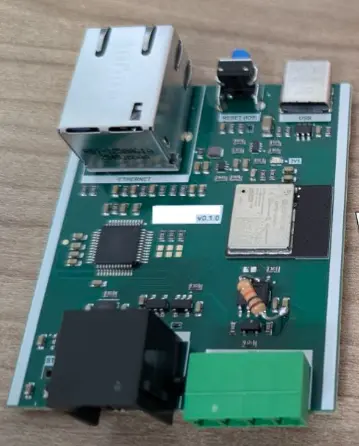 What Is a Modbus Control Board?
A Modbus control board is an embedded industrial communication PCB designed to support Modbus protocol data exchange between a master controller and multiple slave devices.
It generally integrates:
- MCU or industrial processor,
- Modbus RTU or Modbus TCP protocol stack,
- RS-485 / RS-232 / Ethernet interface,
- communication transceiver circuit,
- I/O signal acquisition,
- relay or actuator control outputs,
- isolation and surge protection,
- terminal communication connectors.
Its main function is to serve as the communication bridge that allows industrial controllers to:
- read sensor values,
- write control parameters,
- trigger outputs,
- collect machine alarms,
- monitor process status,
- exchange register data in real time.
Because Modbus is openly published and royalty-free, OEM equipment manufacturers continue to use Modbus boards as one of the most cost-efficient industrial communication solutions available.
Why Modbus Control Boards Are Still Widely Used by OEM Equipment Manufacturers
Despite the development of newer Ethernet-based industrial networks, Modbus remains highly popular for one simple reason:
It is practical, universal, and inexpensive.
Engineers in the PLC and SCADA community still widely report that Modbus RTU remains present in newly installed industrial systems because almost every automation platform can communicate with it, and field troubleshooting is straightforward.
Industrial OEMs prefer Modbus communication boards because they provide:
Universal Device Compatibility
Modbus can communicate with:
- PLCs,
- HMIs,
- VFDs,
- smart meters,
- temperature controllers,
- remote I/O,
- SCADA gateways,
- industrial sensors.
This dramatically reduces integration complexity.
Low Development Cost
Compared with proprietary industrial protocols, Modbus requires:
- less firmware overhead,
- simpler message parsing,
- lower licensing barriers.
Easy RS485 Multi-Drop Networking
Especially in Modbus RTU architecture, one master can poll multiple slave nodes over a single RS485 bus.
Ethernet Upgrade Flexibility
With Modbus TCP, the same register communication logic can be expanded into LAN or remote cloud architecture.
Mature Engineering Ecosystem
There are abundant debugging tools, protocol analyzers, software libraries, and HMI compatibility resources.
This reduces OEM R&D risk significantly.
Modbus RTU vs Modbus TCP: Two Main Control Board Architectures
A professional Modbus control PCB usually falls into two industrial categories:
Modbus RTU Control Board
Built on RS-485 differential communication.
Suitable for:
- long cable industrial environments,
- PLC slave devices,
- remote sensor networks,
- VFD parameter control,
- instrument communication.
Advantages:
- low cost,
- strong anti-noise capability,
- simple field deployment.
Modbus TCP Control Board
Built on Ethernet communication.
Suitable for:
- factory LAN monitoring,
- SCADA networking,
- industrial IoT gateways,
- cloud data acquisition,
- multi-controller integration.
Advantages:
- faster communication,
- easier remote diagnosis,
- larger network scalability.
Many advanced OEM products now combine both RTU + TCP on one communication motherboard for maximum interoperability.
Key Engineering Features of a High-Reliability Modbus Control Board
A stable Modbus board requires much more than firmware protocol coding.
Industrial field reliability depends heavily on PCB engineering details.
Robust Communication Transceiver Layer
Stable RS485 or Ethernet physical layer with low packet loss.
Surge and ESD Protection
Industrial communication terminals are vulnerable to:
- static discharge,
- inductive spikes,
- field cable plugging,
- lightning transient noise.
TVS protection and fuse design are critical.
Isolation Architecture
Isolated communication ports protect against:
- ground loop damage,
- unstable field grounding,
- common-mode voltage spikes.
Accurate Register Polling Response
MCU firmware must guarantee timing stability and CRC integrity.
Multi-Node Address Stability
Node address conflicts and timeout control must be carefully handled.
Industrial Power Supply Filtering
Clean DC power prevents communication resets during relay or motor switching.
Long-Term Connector Reliability
Terminal blocks must withstand field vibration and repeated maintenance.
Poorly engineered Modbus boards often result in:
- CRC communication errors,
- random slave offline alarms,
- register read failure,
- delayed control response,
- unstable SCADA monitoring.
And in actual field installations, these issues usually create expensive customer complaints.
Typical Applications of Modbus Control Boards
Custom Modbus communication PCBs are widely used in:
PLC Remote I/O Modules
Distributed field signal acquisition.
Variable Frequency Drive Interfaces
Motor speed and parameter monitoring.
HMI Data Acquisition Boards
Touchscreen machine communication.
Smart Energy Metering Devices
Power, water, gas, and environmental monitoring.
Building Automation Controllers
HVAC and centralized equipment control.
Industrial Sensor Concentrators
Temperature, pressure, humidity, flow collection.
SCADA Communication Gateways
Remote data upload and command dispatch.
Industrial IoT Edge Controllers
Legacy machine networking to cloud systems.
Common PCBA Manufacturing Challenges in Modbus Communication Boards
This category of PCB has one hidden difficulty:
Most failures happen after customer deployment, not during simple factory power-on tests.
Because real installation environments include:
- long RS485 cables,
- unstable grounding,
- inverter electromagnetic noise,
- outdoor surge,
- multiple slave polling loads.
Therefore OEM buyers increasingly require suppliers capable of:
- industrial communication PCB layout,
- original Modbus transceiver sourcing,
- protocol packet debugging,
- EMC optimization,
- full-load communication aging test,
- master-slave interoperability verification.
Without these controls, the board may pass functional testing but fail in customer field operation.
Why Choose a Professional PCBA Supplier for Modbus Control Boards
A Modbus control board is not merely a communication accessory.
It is often the central nervous interface that determines whether the entire industrial system can exchange commands, alarms, and operating data smoothly.
As a professional PCBA manufacturer, we provide complete OEM/ODM manufacturing services for industrial Modbus communication boards, including:
- multilayer PCB fabrication,
- SMT & DIP assembly,
- RS485/Ethernet communication module sourcing,
- isolated power integration,
- Modbus RTU/TCP firmware loading,
- protocol debugging,
- communication packet verification,
- long-term aging reliability testing.
We help global automation manufacturers build robust, field-stable, and scalable industrial Modbus communication solutions.
Looking for a Custom Modbus Control Board Manufacturer?
Whether your product involves:
- PLC communication modules,
- VFD control electronics,
- industrial monitoring terminals,
- SCADA data concentrators,
- smart instrumentation,
- industrial IoT gateways,
our engineering team can support your customized Modbus control PCB assembly from prototype to mass production.
Contact us today for OEM Modbus control board manufacturing and industrial communication PCBA solutions.
Shenzhen Kingsheng Technology Co., Ltd. has rich experience and a professional technical team in PCBA.
Contact KingshengPCBA today to request a quote or discuss your PCBA project.
 +86 13828766801
 kspcba@c-alley.com
 https://www.kingshengpcba.com/
 2/F, Building 6, Tangtou 3rd Industrial Zone, Tangtou Community, Shiyan Town, Baoan District, Shenzhen, China, 518108