RS-485 Transceiver: The Backbone of Stable Industrial Communication Networks
In industrial automation, stable communication is as critical as precise motion control. Modern machines are no longer isolated mechanical systems—they are intelligent electronic networks where sensors, controllers, motor drivers, HMIs, and remote monitoring units must exchange data continuously under harsh electrical conditions.
This makes communication reliability a decisive factor in machine performance.
Among all industrial serial communication standards, the RS-485 transceiver remains one of the most trusted and widely adopted interface solutions due to its long transmission distance, excellent noise immunity, simple wiring architecture, and low deployment cost.
From CNC machines and PLC systems to servo drives, smart meters, HVAC controllers, building automation, and Modbus fieldbus devices, RS-485 communication modules continue to serve as the fundamental physical layer connecting industrial electronics worldwide. RS-485 differential signaling is specifically designed for electrically noisy factory environments and long cable runs, which is why it remains dominant in automation networks decades after its introduction.
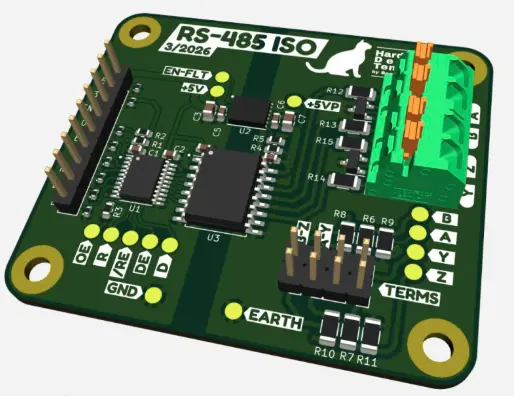 What Is an RS-485 Transceiver?
An RS-485 transceiver is an interface integrated circuit that converts standard UART/TTL serial signals from a microcontroller, FPGA, DSP, or industrial processor into balanced differential signals for transmission over twisted-pair communication lines. At the transmitting end, the RS485 transceiver converts logic-level data into:
- A (non-inverting line)
- B (inverting line)
At the receiving end, it detects the differential voltage between these two lines and reconstructs the original digital signal.
Because the receiver reads the voltage difference rather than absolute voltage to ground, RS-485 communication has extremely strong resistance to:
- electromagnetic interference (EMI),
- ground potential differences,
- transient voltage spikes,
- industrial inverter noise,
- and long cable attenuation.
This differential bus structure is the primary reason RS-485 is preferred over ordinary TTL UART or RS-232 in industrial control applications.
Why RS-485 Transceivers Are Still Widely Used in Modern Automation
Despite the rise of Industrial Ethernet and wireless communication, RS-485 remains highly relevant because industrial users prioritize three things above all:
1. Communication Stability in Noisy Environments
Factory floors are filled with:
- VFDs,
- spindle motors,
- servo amplifiers,
- switching power supplies,
- relay surges.
These create severe electrical noise that often causes ordinary serial interfaces to fail.
Industrial RS-485 transceivers use differential transmission plus high common-mode tolerance to maintain stable communication even when strong noise is present.
Modern industrial-grade devices further integrate:
- IEC ESD protection,
- EFT transient immunity,
- bus fault protection,
- thermal shutdown.
For example, many current industrial RS485 ICs are specifically designed with ±18kV or higher ESD robustness for harsh field deployment.
2. Long-Distance Multi-Node Networking
Unlike normal UART that is suitable only for short PCB-level communication, RS-485 supports:
- long cable transmission,
- multi-drop bus topology,
- multiple slave devices on one communication pair.
A standard RS-485 network can connect dozens of nodes through simple daisy-chain wiring, which is ideal for:
- PLC remote I/O,
- CNC distributed modules,
- building sensors,
- Modbus instruments,
- access control readers,
- energy monitoring devices.
Industrial engineers still favor RS485 because it is easy to troubleshoot, low-cost to wire, and highly scalable for field devices.
3. Low Cost with High Compatibility
RS-485 does not dictate the higher-layer protocol; it only defines the electrical physical layer.
That means it can be used under:
- Modbus RTU,
- Profibus physical links,
- BACnet MSTP,
- custom MCU protocols,
- CNC communication buses,
- proprietary industrial networks.
This gives OEM equipment manufacturers tremendous design flexibility while keeping BOM cost low.
Key Technical Features of a High-Performance RS-485 Transceiver PCB Design
For OEM communication boards, simply placing a MAX485 chip is far from sufficient.
Industrial-grade RS-485 communication PCB must be designed around several critical performance requirements:
Differential Signal Integrity
A/B traces must be impedance-controlled and routed symmetrically to minimize skew and reflection.
Proper Bus Termination
120Ω termination resistors should be placed at both physical ends of the RS485 bus to suppress signal reflections on long cable networks.
Fail-Safe Biasing
Bias resistors or integrated fail-safe receivers ensure known logic levels when the bus is idle or disconnected.
Surge / ESD Protection
TVS diodes, gas discharge tubes, resettable fuses, or integrated IEC ESD devices are often required for field wiring interfaces.
Isolation Design
For industrial equipment exposed to ground loop voltage or heavy transient noise, isolated RS-485 transceivers are increasingly preferred because they combine:
- digital isolation,
- communication transceiver,
- high-voltage protection
in one compact architecture.
Auto Direction or DE/RE Control
Half-duplex systems require stable management of driver enable and receiver enable timing to avoid bus contention.
Many engineers in practical field designs report that poorly handled DE/RE switching is one of the most common causes of unstable RS485 communication.
Typical Applications of RS-485 Transceiver Boards
RS485 communication transceiver modules are widely embedded in:
PLC Communication Modules
Industrial programmable logic controller slave communication.
CNC Motion Control Systems
Machine controller to servo driver / inverter / HMI communication.
Servo Drives & VFDs
Parameter setting and remote diagnostics.
Smart Metering Equipment
Electricity, water, gas, and energy monitoring terminals.
Building Automation
HVAC controllers, lighting buses, elevator communication.
Security & Access Control
Door controllers, card readers, distributed monitoring terminals.
Industrial Sensor Networks
Remote temperature, pressure, flow, and process monitoring.
PCB Manufacturing Challenges in RS-485 Communication Boards
For overseas OEM customers, the most underestimated issue is this:
Communication instability is often not caused by the RS485 chip itself, but by poor PCB engineering and assembly quality.
Common PCBA manufacturing risks include:
- unstable differential routing,
- weak grounding structure,
- missing decoupling capacitors,
- inadequate surge suppression,
- poor soldering on communication connectors,
- fake or inconsistent transceiver IC sourcing.
Even small PCB layout defects can lead to:
- intermittent packet loss,
- communication retries,
- false CRC alarms,
- field device disconnection,
- customer complaints after installation.
Therefore, industrial buyers increasingly require RS485 communication board suppliers with:
- industrial PCB layout experience,
- EMI/EMC understanding,
- original component sourcing,
- firmware programming,
- communication functional test,
- aging test verification.
Why OEM Manufacturers Need a Professional RS-485 Transceiver PCBA Supplier
An RS-485 transceiver board may look simple, but in industrial products it serves as the machine’s nervous system.
If communication fails:
- data fails,
- commands fail,
- motors stop,
- alarms misreport,
- production halts.
As an experienced PCBA manufacturer, we provide complete OEM/ODM manufacturing services for industrial RS485 communication boards, including:
- communication PCB fabrication,
- SMT & DIP assembly,
- isolated/non-isolated RS485 transceiver sourcing,
- TVS and surge protection integration,
- MCU firmware loading,
- Modbus communication debugging,
- functional signal integrity test,
- long-term burn-in reliability verification.
We help global automation equipment manufacturers build highly stable industrial communication interfaces with lower field failure rates and faster time to market.
Looking for a Custom RS-485 Transceiver Board Manufacturer?
Whether you are developing:
- PLC communication modules,
- CNC interface boards,
- Modbus slave devices,
- industrial sensor transmitters,
- servo communication adapters,
- building automation controllers,
a qualified PCBA supplier can help you turn communication schematics into robust industrial-grade products ready for mass deployment.
Contact us today for customized RS-485 transceiver PCB assembly and OEM industrial communication board manufacturing.
Shenzhen Kingsheng Technology Co., Ltd. has rich experience and a professional technical team in PCBA.
Contact KingshengPCBA today to request a quote or discuss your PCBA project.
 +86 13828766801
 kspcba@c-alley.com
 https://www.kingshengpcba.com/
 2/F, Building 6, Tangtou 3rd Industrial Zone, Tangtou Community, Shiyan Town, Baoan District, Shenzhen, China, 518108