Motor Controllers: The Brain Behind Intelligent Motion
Introduction
In the era of Industry 4.0 and the global electric vehicle (EV) revolution, the electric motor serves as the heart of modern industry. But every heart needs a brain—and that brain is the motor controller.
As we progress through 2026, motor controllers have evolved far beyond simple on/off switches. They are now intelligent nodes capable of real-time monitoring, predictive diagnostics, and precise energy management. For Original Equipment Manufacturers (OEMs) and design houses operating in this space, the challenge is clear: how do you turn a sophisticated PCB design into a reliable, high-power product that can withstand years of operation on the road or the
factory floor?
The answer lies in choosing the right manufacturing partner. Here's how a forward-thinking PCBA factory can serve as the critical ally in bringing next-generation motor controllers to market.
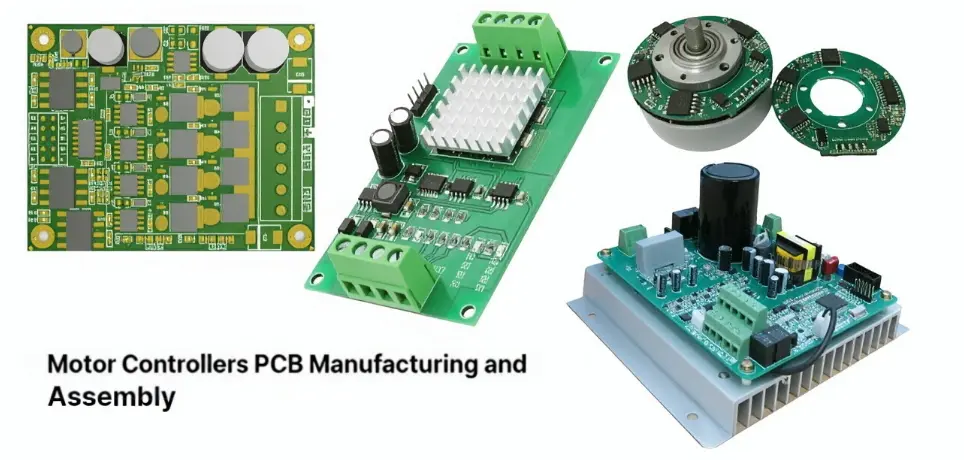 I. The Market Landscape: A Sector in Hypergrowth
The numbers tell a compelling story. The global intelligent motor controller market is projected to approach $2.45 billion by 2030, growing at a CAGR of over 7% according to recent industry forecasts. But this figure only captures part of the momentum—the broader motor control IC market alone is expected to exceed $20 billion within the same timeframe, highlighting the critical role of advanced control electronics.
This surge is driven by two major forces:
The Electrification of Everything:
The rapid expansion of electric vehicles, e-mobility, and industrial automation is reshaping demand. The automotive industry's shift to 800V architectures—and early explorations of 1200V systems—requires controllers capable of handling higher voltages with greater efficiency and safety.
The Push for Efficiency:
In industrial automation, the growing demand for predictive maintenance means controllers must now function as data collection hubs. By processing real-time telemetry—vibration, temperature, and load cycles—these devices help factories minimize downtime and extend equipment lifespan.
To capture market share in this environment, products must offer more than just torque control. They need to deliver both embedded intelligence and uncompromising reliability.
II. The Cutting Edge: Key Technologies Defining Success
To compete effectively in this market, your product design likely incorporates one or more of these advanced technologies:
Wide-Bandgap Semiconductors:
The shift from traditional silicon-based IGBTs to Silicon Carbide (SiC) and Gallium Nitride (GaN) is accelerating. These materials reduce switching losses by up to 80% compared to conventional silicon, enabling smaller, cooler, and more efficient controller designs while supporting higher switching frequencies.
Integrated Intelligence: Modern controllers leverage advanced communication protocols—such as Single Pair Ethernet (SPE) or Controller Area Network (CAN FD) —to transmit operational data to the cloud for AI-driven analytics. This connectivity transforms the motor controller from a simple actuator into a predictive maintenance node.
High-Density Design:
The push to pack more power into smaller enclosures—for applications like in-wheel motors, collaborative robots, or eVTOL aircraft—means PCB designs are becoming increasingly complex. This trend drives the need for fine-pitch components and heavy copper layers (often 4 oz. or more) to manage thermal loads within shrinking form factors.
III. The Barriers: Why Great Designs Fail
However, the journey from schematic to shipment is fraught with risk. Motor controllers present unique manufacturing challenges that standard electronics assembly houses are ill-equipped to handle:
Thermal Management:
Power components generate intense heat during operation. If the PCBA assembly does not facilitate optimal heat transfer—through proper via filling, solder joint integrity, and thermal interface materials—the controller's lifespan is significantly compromised, leading to premature failure in the field.
Reliability Under Duress:
A motor controller in an EV endures constant vibration, extreme thermal cycling (from -40°C to +150°C), and humidity exposure. Solder joints must withstand this punishment for 15+ years without failure. Achieving this requires meticulous process control to prevent micro-cracks and ensure mechanical robustness.
Component Sourcing & Handling:
Securing high-grade, automotive-qualified SiC MOSFETs, IGBTs, and advanced microcontrollers remains a significant challenge in a volatile global supply chain. Once procured, these moisture-sensitive and ESD-vulnerable components must be handled with extreme care—from dry-pack storage to controlled assembly environments—to preserve their reliability.
IV. The Manufacturing Advantage: Our Capabilities
This is where we stand apart. As a specialized PCBA factory, we don't just assemble boards—we engineer reliability into every motor controller.
Capability 1: High-Power & Mixed-Technology Assembly
Balancing tiny signal components alongside large power modules demands exceptional process control.
Heavy Copper & Thermal Management:
We specialize in soldering on heavy copper PCBs. Our nitrogen-assisted reflow ovens ensure proper fill and wetting on large thermal pads and high-current vias—minimizing resistance and maximizing heat extraction from SiC and GaN devices.
Advanced Placement:
Our lines handle large transformers and inductors alongside 01005 passives, ensuring the mechanical integrity needed to survive vibration in automotive and industrial environments.
Capability 2: Zero-Defect Quality Assurance
In motor control, there's no room for "minor" defects.
Automated X-Ray Inspection (AXI):
Many power stage defects—like voids in BGA balls or die attachments—are invisible optically. We use AXI to inspect internal solder joint integrity, keeping void rates below 5% for critical power connections.
Precision Conformal Coating:
Our robotic coating systems apply acrylic, silicone, or parylene precisely where needed—protecting against humidity and contaminants without affecting connectors or high-voltage clearance areas.
Capability 3: Supply Chain & Certification
IATF 16949 Compliance:
We operate under strict automotive quality standards. Every process—from material incoming to final shipping—is documented, controlled, and continuously improved.
Strategic Partnerships:
We maintain strong ties with authorized distributors of Infineon, Onsemi, STMicroelectronics, and Texas Instruments—giving our customers priority access to critical power semiconductors and protection against counterfeits.
From design for manufacturability to long-term reliability, we build motor controllers that perform—mile after mile, cycle after cycle.
Conclusion
The future of motion is intelligent, electric, and efficient. But even the most advanced motor controller design is only as strong as its execution.
If you're developing next-generation motor drives, traction inverters, or ECUs for automotive, industrial, or aerospace applications, you need a manufacturing partner who understands power electronics, thermal management, and the discipline of automotive-grade quality.
Let's build the future of motion together. Contact our engineering team today to discuss your next project.
Shenzhen Kingsheng Technology Co., Ltd. has rich experience and a professional technical team in PCBA.
Contact KingshengPCBA today to request a quote or discuss your PCBA project.
 +86 13828766801
 kspcba@c-alley.com
 https://www.kingshengpcba.com/
 2/F, Building 6, Tangtou 3rd Industrial Zone, Tangtou Community, Shiyan Town, Baoan District, Shenzhen, China, 518108