How PCBA Manufacturing Enables Autonomous Driving Controllers?
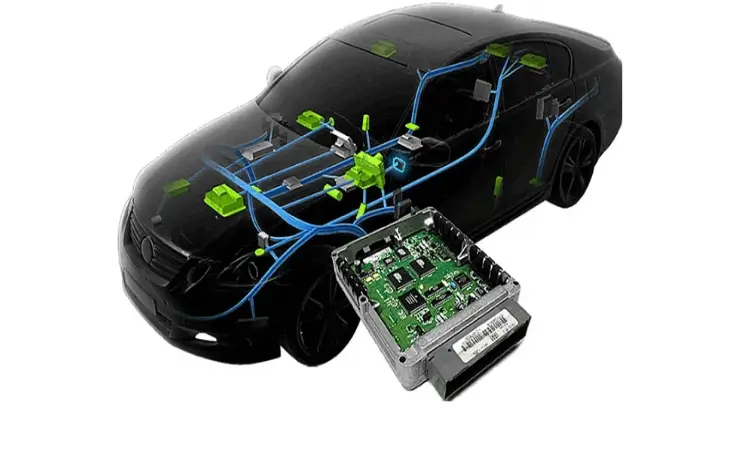
As the automotive industry accelerates toward a software-defined future, the Autonomous Driving Controller (ADC) or Domain Controller has emerged as the true "brain" of the intelligent vehicle. While much of the industry’s attention is focused on the race for higher TOPS (Trillions of Operations Per Second) and more sophisticated AI algorithms, a critical enabler of mass production is often overlooked:
the Printed Circuit Board Assembly (PCBA).
At Kingsheng PCBA, we believe that the transition from impressive prototype to reliable, road-ready product is won or lost on the manufacturing floor. In this article, we explore the exploding market for ADAS/AD controllers, the technical complexities of modern designs, the barriers to mass production, and how our advanced PCBA capabilities provide the bridge between innovation and large-scale deployment.
 I. Market Outlook: Seizing Position in a Multi-Billion Dollar Race
Industry forecasts paint a picture of explosive growth. The global market for autonomous driving domain controllers is projected to surpass $100 billion by 2025, driven by a compound annual growth rate exceeding 30%. As L2+ systems become standard and L3 conditional automation gradually enters the market, both the number of controllers per vehicle and their required processing power are increasing exponentially. The industry-wide shift from distributed ECUs to centralized domain control architectures is irreversible.
In this landscape, OEMs and Tier 1 suppliers face a dual challenge: they must innovate rapidly on algorithms while simultaneously solving the complex puzzle of mass production. The PCBA is the physical and electrical foundation of every controller. Its manufacturing quality directly dictates the performance ceiling, functional safety, and long-term reliability of the final product. A PCBA partner with advanced processes and rigorous quality control is no longer just a vendor, but a strategic partner essential for market success.
II. Technological Demands: When High Performance Meets High Density
Today’s high-end autonomous driving controllers typically feature heterogeneous multi-core architectures, integrating powerful AI System-on-Chips (like NVIDIA Orin, Qualcomm Snapdragon Ride, or Horizon Robotics Journey series), high-performance MCUs, memory modules, power management ICs, and a host of communication interfaces (Gigabit Ethernet, CAN FD, PCIe). This extreme level of integration places unprecedented demands on the PCBA:
2.1 Ultra-High Density Interconnect (HDI): BGA package pitches have shrunk to 0.4mm or even 0.3mm, requiring PCBs with 16 or more layers. Any-layer HDI technology is essential to route these complex connections while maintaining signal integrity.
2.2 High-Speed Signal Transmission: Interfaces like PCIe 4.0/5.0, MIPI, and GMSL2 operate at speeds exceeding 16 Gbps. This demands strict impedance control, minimal crosstalk, and low insertion loss, necessitating the use of ultra-low loss PCB materials (such as M6 or M7 grades) and precise trace design.
2.3 Stringent Thermal Management: High-performance AI chips can consume over 100 watts of power. Managing this heat requires a holistic approach, combining heavy copper layers and dense thermal via arrays within the PCB with external heatsinks, all working together to keep junction temperatures within safe limits.
2.4 Functional Safety (ISO 26262): To meet ASIL D requirements, the PCBA manufacturing process must be virtually defect-free and backed by complete, end-to-end traceability.
III. Breaking Through the "Wall" Between Design and Production
While design simulations are powerful, the transition to volume manufacturing presents a series of formidable technical barriers that a capable PCBA factory must overcome:
3.1 The Precision Barrier: Placing and soldering ultra-miniature components (like 01005 capacitors) and fine-pitch BGAs requires advanced placement machines and perfectly tuned reflow profiles. Controlling BGA voiding to less than 5% is critical for long-term reliability.
3.2 The Signal Integrity Barrier: Real-world variations in PCB materials can cause high-speed signals to degrade. A factory must possess TDR (Time Domain Reflectometry) testing capability to verify that critical high-speed channels meet design specifications on every production batch.
3.3 The Thermal Integration Barrier: Integrating advanced thermal solutions like embedded copper coins or vapor chambers requires specialized assembly processes and tooling to prevent voids and mechanical stress.
3.4 The Traceability Barrier: With automotive lifespans exceeding 15 years, a robust MES (Manufacturing Execution System) must track every component batch, placement parameter, and test result, creating a complete birth certificate for every single board.
IV. Our Solution: A PCBA Factory Built for the Autonomous Age
As a specialized manufacturer with years of deep experience in automotive electronics, [Your Company Name] has built its entire operation around the unique demands of products like autonomous driving controllers. We provide a complete solution through four key pillars:
4.1 State-of-the-Art Equipment: Our fully automated SMT lines feature high-precision ASM placement machines capable of handling 01005 components and 0.3mm pitch BGAs. Our ten-zone reflow ovens support nitrogen soldering to minimize oxidation and reduce voids. We complement this with 3D SPI and 3D AOI for unparalleled process control.
4.2 Proven Process Capabilities: We have mastered the mass production of complex PCBs, including any-layer HDI, embedded copper coin, and heavy copper technologies. Our rigorous DFM (Design for Manufacturing) reviews identify and resolve potential issues before production begins, saving time and cost.
4.3 Uncompromising Quality Systems: We are certified to IATF 16949 and align our component validation with AEC standards. Our MES provides full traceability from incoming material to final shipment. Every ADC board undergoes 100% AOI, X-Ray sampling, and ICT/FCT testing to guarantee zero-defect delivery.
4.4 Collaborative Engineering Support: Beyond manufacturing, we partner with our customers on DFM optimization and test strategy development. Our dedicated NPI (New Product Introduction) team ensures rapid, smooth transitions from prototype to high-volume production.
Conclusion
The golden age of autonomous driving has arrived, but every sophisticated software stack relies on a reliable hardware foundation. As the critical bridge between the chip and the system, the quality of the PCBA directly determines the performance, safety, and lifespan of the domain controller.
Choosing a PCBA partner with the right technology, processes, and experience is essential to winning in this competitive market. At kingsheng PCBA we are committed to removing the barriers to mass production, enabling our customers to deliver safe, intelligent vehicles at scale.
Ready to discuss your next autonomous driving project? Contact us today to learn how our advanced manufacturing capabilities can help you drive the future.
Shenzhen Kingsheng Technology Co., Ltd. has rich experience and a professional technical team in PCBA.
Contact KingshengPCBA today to request a quote or discuss your PCBA project.
 +86 13828766801
 kspcba@c-alley.com
 https://www.kingshengpcba.com/
 2/F, Building 6, Tangtou 3rd Industrial Zone, Tangtou Community, Shiyan Town, Baoan District, Shenzhen, China, 518108