Coffee Machine PCBA Design Essentials: Water Pump, Grinding, and Heating System Design
The PCBA design of a coffee machine is the core of its functionality; the reliability of its circuit design directly affects coffee quality and user experience. This article will delve into the key circuit design points of three crucial modules: water pump control, grinding motor drive, and heating system.
 Water Pump Control System Design
The water pump control system typically uses a 12V or 24V DC motor drive. Design considerations include:
Drive Circuit Design: PWM control is implemented using MOSFETs or a dedicated motor driver chip (such as the DRV8870). Water flow and pressure are precisely controlled by adjusting the duty cycle. It is recommended to add a freewheeling diode or TVS diode protection circuit to prevent back EMF generated when the motor stops from damaging the main control chip.
Pressure Feedback Mechanism: High-end models should integrate a pressure sensor (such as the Honeywell ASDX series) to monitor the extraction pressure (typically 9-15 bar) in real time. The PWM output is dynamically adjusted using a PID algorithm to ensure stable extraction pressure. The sensor signal needs to be amplified and filtered by a precision operational amplifier circuit before being sent to the MCU's ADC pin.
Safety Protection Design: Overcurrent detection (using an ACS712 current sensor), no-load protection, and water shortage detection must be included in the circuit. For water shortage detection, a photoelectric sensor or capacitive level sensor is recommended to avoid the mechanical failure problems of traditional float switches.
Grinding Motor Drive Design
Coffee bean grinding motors typically use DC brushed motors or stepper motors. Key design considerations are as follows:
Motor Selection and Drive: Brushed motors are low-cost but require maintenance; stepper motors (e.g., 42-step) offer precise control but are expensive. The driving circuit needs to take into account the starting current (usually 3 to 5 times the rated current). A driver chip with current detection (e.g., TMC2209) is recommended, along with a heat dissipation design.
Grinding Control: Particle size closed-loop control is achieved through feedback from a high-precision rotary encoder (e.g., a 1000-line photoelectric encoder). The encoder signal needs to be shaped by a Schmitt trigger before being connected to the encoder interface of the MCU timer.
Intelligent Control Strategy: A "fast-then-slow" grinding strategy is adopted—the high-speed grinding stage rapidly crushes the coffee beans, while the low-speed fine grinding stage ensures uniform particle size. The circuit design requires a dual-speed control circuit, which can change the motor speed by switching the series resistor using a MOSFET.
Heating System Circuit Design
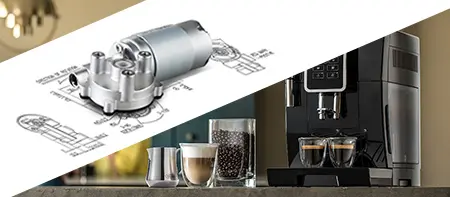
The coffee machine's heating system includes brewing head heating and steam/hot water heating, and its design is the most complex.
Heating Components Selection: An instant-heating stainless steel heating element (800-1500W) is recommended for the brewing head. A separate boiler should be used for steam/hot water. Instant heating requires a high-power bidirectional thyristor (such as BTA41-600B) and zero-crossing detection circuit to reduce interference with the power grid.
Precise Temperature Control: Multi-channel NTC thermistors or PT1000 platinum resistance thermometers must be used, along with a 24-bit ADC chip (such as ADS124S08) to achieve a resolution of 0.1℃. The control algorithm uses fuzzy PID, achieving precise power adjustment through thyristor phase control.
Safety Protection Design-Triple Protection is Essential:
- 1.Hardware Over-Temperature Protection: An independent comparator circuit directly cuts off heating when the temperature exceeds the limit.
- 2.Dry Burn Protection: Electrode-type water level detection ensures the heating element is always submerged in water.
- 3.Leakage Protection: GFCI (Ground Fault Circuit Interrupter) circuit detects leakage current.
System Integration Considerations:
- 1.Power Supply Layering Design: Completely isolate the motor drive (12-24V), heating control (220V/110V), and MCU (3.3V/5V) power supplies, using optocouplers or magnetic couplers for signal transmission.
- 2.EMC Design: All motor and heater power lines must be equipped with ferrite cores; a π-type filter location is reserved on the PCBA.
- 3.Thermal Design: Power devices and the MCU are laid out in separate zones; sufficient heat dissipation area and mounting holes are provided for the heating drive section.
- 4.Fault Diagnosis: Design multiple diagnostic circuits for current detection, temperature anomalies, and motor stall, reporting fault codes via LEDs or Wi-Fi modules.
An excellent coffee machine PCBA design requires a balance between performance, safety, and cost. By adopting a modular design approach, the three major systems are designed independently and then organically integrated. Coupled with rigorous testing and verification (especially temperature cycle testing and continuous operation testing), it is possible to ensure that the coffee machine maintains stable and reliable performance output during long-term use, ultimately presenting a cup of coffee with the right temperature and perfect extraction.
Shenzhen Kingsheng Technology Co., Ltd. has rich experience and a professional technical team in PCBA.
Contact KingshengPCBA today to request a quote or discuss your PCBA project.
 +86 13828766801
 kspcba@c-alley.com
 https://www.kingshengpcba.com/
 2/F, Building 6, Tangtou 3rd Industrial Zone, Tangtou Community, Shiyan Town, Baoan District, Shenzhen, China, 518108