From the agile perspectives of consumer-grade aerial photography to the precision operations of industrial-grade inspections, and on to the life-saving missions of emergency rescue, drones have become the core engine of the low-altitude economy. As their “neural network”, PCBA (printed circuit board assemblies) directly determine flight stability, endurance, and mission reliability. With China's civil drone market projected to exceed ¥176.1 billion by 2025, industry demands for miniaturised, high-power, and anti-interference PCBA continue to escalate. Rigorous PCB specifications form the core foundation for meeting these requirements. From substrate selection to process details, every parameter impacts flight safety and operational efficiency.
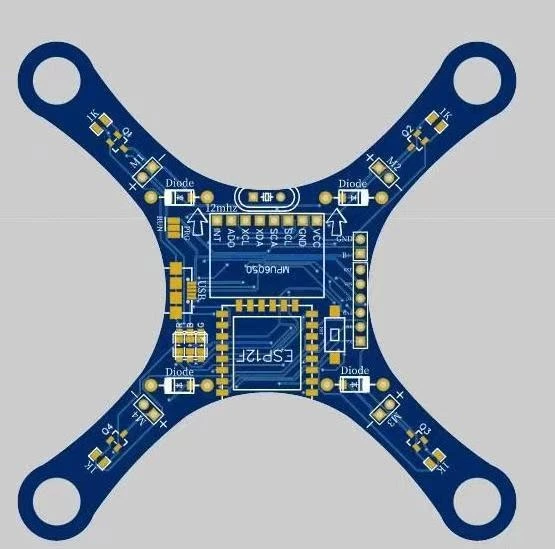 一.Core Specification Standards for UAV PCBs: Adapting to All-Scenario Flight Requirements
UAV PCBs must simultaneously balance three core demands: lightweight construction, robust thermal dissipation, and high-frequency transmission. Specification design must encompass critical dimensions including materials, structure, and electrical performance, whilst complying with the ‘one aircraft, one code’ traceability policy and industry certification requirements:
1.Base Materials and Physical Specifications
• Substrate Selection: Mainstream adoption of high-Tg (≥170°C) FR-4 substrates with dielectric constant εr=4.2±0.2, meeting halogen-free environmental standards; High-frequency modules (video transmission, GPS) employ Rogers RO4003/4350 series low-loss substrates (Dk=3.38±0.05) to reduce 5.8GHz signal attenuation; power systems may utilise hybrid FR4/Rogers laminates balancing cost and performance.
• Layer count and thickness: Consumer-grade aerial photography drones typically employ 4-6 layer boards with thicknesses of 1.2-1.6mm; industrial-grade inspection and logistics drones require 6-8 layer HDI boards at 1.6-2.0mm thickness; racing FPV drones prioritise lightweight construction using 6-layer ultra-thin boards (1.0-1.2mm) or flexible FPC (≤0.5mm).
• Copper Thickness and Surface Treatment: Standard signal layers employ 1oz copper (35μm), while power circuits (ESC, power modules) utilise 2-10oz copper (70-350μm), enhancing current-carrying capacity by 3-5 times. Surface finishes prioritise electroless gold plating (gold thickness 0.05–0.1μm over 3–6μm nickel) or electroless nickel-palladium-gold. Gold finger areas may be selectively thickened to 3–10μm to meet high-frequency signal transmission and repeated insertion/removal requirements.
2.Precision Manufacturing and Process Specifications
• Routing and Hole Specifications: Minimum line width/spacing ≥ 4/4 mil (0.10/0.10 mm), reducible to 5/5 mil (0.127/0.127 mm) for racing drones; minimum mechanical hole diameter ≥ 0.2 mm; blind/buried via minimum diameter 0.15 mm; BGA pad minimum pitch 0.25 mm; supports μBGA packaging.
• Solder Mask and Protection: Low-halogen solder mask employed, predominantly green or black in colour, with thickness 10-30μm; outdoor-operated drones require coating with conformal coating (acrylic or polyurethane material), achieving IP65 protection rating, resistant to salt spray, moisture, and dust corrosion.
• Specialised Processes: Power modules employ resin plugging combined with laser-induced etching, achieving >95% uniformity in via copper thickness. High-frequency modules utilise press-fit optimisation to control copper surface roughness (Ra ≤ 0.3μm), minimising signal scattering. Select premium models incorporate semi-via technology to enhance integration density.
二.Electrical and Reliability Specifications
• Impedance Control: RF links (video transmission, WiFi) impedance 50Ω ±1.2Ω; differential signal lines (MIPI CSI/DSI) 90-100Ω ±5%; 40GHz signal insertion loss ≤0.18dB/cm, ensuring centimetre-level positioning and high-definition video transmission.
• Environmental Adaptability: Withstands -40°C to 125°C wide-temperature cycling tests (1000 cycles without failure), passes 20-2000Hz sinusoidal vibration testing (20G acceleration), with high-mass components requiring reinforced soldering; performance degradation ≤3% after high-temperature/high-humidity testing (60°C/90%RH, 500 hours).
• Electromagnetic Compatibility: Incorporates an internal copper shielding layer with ≥30dB radiation interference attenuation. Power input features a π-type filter circuit and common-mode choke. ESD immunity ≥±15kV (air discharge). Sensitive components (magnetometer, IMU) employ magnetically isolated routing, positioned away from high-current loops.
Scenario-Specific Specification Adaptation and Industry Compliance Requirements
PCB specifications for drones vary significantly across different application scenarios, necessitating compliance with regulatory policies and authoritative certification standards to ensure reliability throughout the entire lifecycle:
三.Typical Scenario Specification Adaptation
• Consumer-grade aerial photography drones: 4-6 layer FR4 board, thickness 1.6mm, copper thickness 1oz, electroless gold plating; Minimum line width/spacing 6/5 mil, impedance controlled at 50Ω; prioritise GPS antenna clearance design for rapid positioning and stable hovering.
• Industrial inspection/logistics drones: 6-8 layer HDI boards, 3-5oz copper thickness for power circuits using thick copper technology to enhance thermal efficiency; support CAN bus expansion interfaces for multi-sensor integration (LiDAR, infrared thermal imaging); IP65-rated protection and salt spray testing for outdoor environmental resilience.
• Racing FPV Drones: 6-layer high-Tg (170°C) FR4 boards, 1.2mm thickness, 2/2.5oz copper; blind/buried vias with resin-filled holes, minimum aperture 0.25mm; lightweight construction with robust vibration resistance, enabling millisecond-level low-latency control.
• Specialised Mission Drones (Emergency Response/Communication Relay): 8-layer hybrid laminate (FR4 + Rogers), 2.0mm thickness; incorporates redundant routing design with wire breakage rate <0.01%; salt spray and electromagnetic interference resistant, meeting extreme operational environment requirements.
四.Industry Compliance and Certification
All drone PCBs must comply with IATF 16949 automotive-grade certification, while industrial-grade models must meet AS9100D aerospace standards. Establish a comprehensive traceability system covering raw material procurement, production processing, and finished product inspection to align with the ‘one machine, one code’ policy requirements. Certain export models require FCC and CE electromagnetic compatibility certification to ensure global market access.
Technological Trends: Specification Upgrades Empowering UAV Industry Innovation
With the implementation of low-altitude economy policies and technological iteration, UAV PCB specifications are evolving in three key directions: For high-density integration, HDI technology and micro-via applications (≤0.1mm) are becoming widespread, enabling greater functional module integration within the same footprint; For high-performance breakthroughs, ultra-thick copper processes exceeding 10oz combined with low-loss substrates meet the high-power demands of long-endurance models like hydrogen fuel cell drones. Regarding green compliance, halogen-free and low-residue processes become standard, while biodegradable materials and eco-friendly manufacturing are progressively adopted.
Concurrently, the integration of AI algorithms and 5G communications drives PCB support for higher-frequency signal transmission (≥6GHz), with impedance control precision enhanced to ±3%, providing hardware foundations for intelligent obstacle avoidance and autonomous formation capabilities. Moving forward, collaborative customisation between PCB manufacturers, OEMs, and chip suppliers will become mainstream. Through integrated optimisation of materials, processes, and design, this approach will further overcome technical bottlenecks in drone miniaturisation, extended endurance, and high reliability. Innovation in drone PCB specifications constitutes the cornerstone for high-quality development within the low-altitude economy. From micron-level routing precision to reliability validation under extreme conditions, each parameter optimisation propels drones' evolution from mere ‘tools’ to ‘intelligent terminals’. Driven by both policy and market forces, stringent PCB specification standards will continue empowering the drone industry, unlocking new application scenarios and injecting sustained momentum into the low-altitude economy.
Shenzhen Kingsheng Technology Co., Ltd. has rich experience and a professional technical team in PCBA.
Contact KingshengPCBA today to request a quote or discuss your PCBA project.
 +86 13828766801
 kspcba@c-alley.com
 https://www.kingshengpcba.com/
 2/F, Building 6, Tangtou 3rd Industrial Zone, Tangtou Community, Shiyan Town, Baoan District, Shenzhen, China, 518108