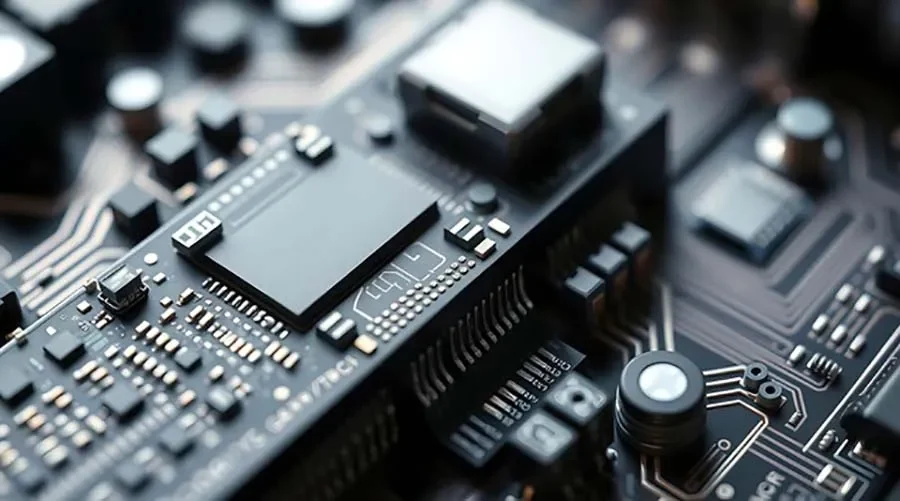
Driven by both new energy vehicles and intelligent driving technologies, automotive electronics are undergoing a revolutionary transformation characterised by domain control centralisation and functional intelligence. As the core carrier of in-vehicle electronic systems, automotive-grade PCBs (printed circuit boards) serve not only as the “neural network” connecting various components, but also directly determine driving safety, operational stability, and intelligent user experience. Unlike consumer electronics PCBs, automotive-grade PCBs must operate reliably for over 15 years under extreme conditions including temperature fluctuations from -40°C to 150°C, 10G acceleration vibration, and salt spray corrosion. Their specifications and technical requirements set the benchmark for stringent standards within the electronics manufacturing sector.
 I. Industry Development: The Intelligent Revolution Drives PCB Technology Upgrades
China's automotive PCB market is undergoing a period of rapid expansion, with market value reaching RMB 58 billion in 2023. Projections indicate this figure will surpass RMB 180 billion by 2030, reflecting a compound annual
growth rate exceeding 15%. This growth is primarily driven by three core factors:
The continuous rise in new energy vehicle penetration, where PCB usage per vehicle increases by 3-5 times compared to traditional fuel-powered cars; The proliferation of ADAS (Advanced Driver Assistance Systems) and
autonomous driving technologies, driving surging demand for high-frequency, high-speed, and high-density interconnect PCBs; The replacement of traditional distributed ECUs by domain controller architectures, imposing higher requirements on PCB integration and reliability.
Currently, automotive-grade PCBs exhibit four key development trends: miniaturisation (line width/spacing evolving below 30μm), high-frequency capabilities (explosive demand for PTFE substrates in millimetre-wave radar applications), integration (increased penetration of HDI arbitrary-layer interconnection technology), and flexibility (FPCs exceeding 60% market share in in-vehicle display modules).
Concurrently, the mass production of 800V high-voltage platform vehicles has generated new demands, requiring PCBs to meet higher insulation withstand voltage and thermal management standards. This has created explosive growth opportunities for novel products such as ceramic-based PCBs.
II. Core Specifications: Rigorous Technical Requirements for Automotive-Grade PCBs
The specification design of automotive-grade PCBs centres on three core dimensions: environmental adaptability, electrical stability, and mechanical reliability. Key parameters must strictly comply with industry standards including the AEC-Q series, ISO 26262, and IATF 16949:
1. Environmental Adaptability Specifications
• Temperature Tolerance: Operating range spans -40°C to 150°C (covering extreme environments like engine compartments). Substrate glass transition temperature (Tg) ≥170°C; polyimide substrates (Tg ≥280°C) employed for extreme scenarios.
- Weather Resistance: Passes 1000-hour acid salt spray testing; solder mask thickness >40μm; incorporates nano-coating or conformal coating for moisture, mould, and chemical corrosion resistance (including engine oil and antifreeze);
- Vibration and shock resistance: Withstands vibration at 10–2000 Hz frequencies and 10G acceleration (up to 200 m/s² in chassis areas), copper foil elongation ≥15%, reinforced pad design prevents cracking.
2. Electrical performance specifications
• Substrate and dielectric properties: High-frequency radar boards utilise PTFE hybrid-laminated substrates with a dielectric constant (Dk) of 2.55±0.05@10GHz and signal loss <0.2dB/inch; BMS boards employ high-voltage-resistant substrates with breakdown voltage ≥30kV/mm and interlayer withstand voltage >5kV (800V platform);
• Routing and Impedance: Minimum line width/spacing of 3/3μm achievable, with etching precision of ±0.01mm; impedance control tolerance of ±5%, supporting differential signal transmission to optimise high-speed signal integrity;
• Insulation and Conductivity: Long-term stable insulation resistance, creepage distance >8.0mm (high-voltage platform); copper foil thickness ≥70μm (up to 2oz for powertrain systems), current carrying capacity up to 200A.
3. Structural and Process Specifications
• Layer Count and Interconnectivity: Mainstream 4-12 layer boards; domain controllers utilise HDI arbitrary layer interconnect technology; laser drilling precision ±10μm; microvia diameter as low as 0.1mm;
• Surface Treatment: Employing electroplated gold + OSP composite process; nickel layer thickness ≥5μm; gold layer thickness ≥0.1μm, ensuring over 15 years of connection stability;
• Dimensional Tolerances: Hole diameter tolerance ±0.02mm, via positioning accuracy ≤0.008mm, with edge reinforcement enhancing structural rigidity.
4. Quality and Reliability Specifications
• Defect Control: Defect tolerance ≤0.1ppm, verified through AOI+AXI+flying probe full inspection, BGA solder joint void rate ≤5%;
• Lifespan and Testing: MTBF (Mean Time Between Failures) >150,000 hours; passes 1000 cycles of -40°C → 25°C → 125°C thermal cycling and 1000 hours at 85°C/85% RH CAF testing;
• Environmental Compliance: Complies with EU RoHS 3.0 and ELV directives, meets VOC emission standards, and achieves UL 94 V-0 flame retardancy rating.
III. Application Scenarios: Differentiated Specifications Tailored to Core Vehicle Systems
Significant variations exist in PCB specification requirements across different vehicle systems, necessitating precise alignment to ensure functional safety:
• Powertrain Systems (ECU/Inverters): Must withstand 150°C temperatures with electromagnetic shielding design, employing high-Tg FR4 or ceramic substrates with copper thickness ≥2oz to enhance thermal conductivity;
• Autonomous Driving Domain Controllers: Rely on HDI high-density routing and PTFE high-frequency substrates to support 77GHz millimetre-wave radar data processing, certified to ISO 26262 functional safety standards;
• Battery Management Systems (BMS): Primarily focus on high-voltage resistance and thermal conductivity, employing aluminium substrates (thermal conductivity ≥8W/(m·K)) with insulation layers rated >4kV; • Intelligent Cockpit:
Favours flexible PCB (FPC) and HDI hybrid solutions to accommodate multi-screen integration and spatial layouts, balancing weight reduction with signal transmission efficiency.
IV. Industry Trends: Dual-Drive of Domestic Substitution and Technological Innovation
Presently, China's automotive PCB sector is transitioning from scale expansion to value enhancement, with domestic substitution of high-end products emerging as a pivotal trend. Through breakthroughs in high-frequency material R&D and precision manufacturing equipment upgrades, local enterprises are progressively narrowing the technological gap with international giants in specialised segments such as automotive radar PCBs and domain controller PCBs. By 2023, domestic substitution rates in mid-to-low-end markets had reached 75%.
Looking ahead, with the implementation of Level 4 autonomous driving and vehicle-to-infrastructure (V2I) technologies, automotive-grade PCBs will evolve towards ‘higher integration, superior thermal management, and enhanced interference resistance.’ Concurrently, supply chain localisation and full-process traceability (with MES systems recording 217 process parameters) have become critical considerations for automakers when selecting suppliers. Enterprises possessing IATF 16949 certification and AEC-Q series validation capabilities will maintain a competitive edge.
The specification upgrades of automotive-grade PCBs consistently resonate with the intelligent and electrified transformation of the automotive industry. From material selection to process control, from environmental adaptation to functional safety, every refinement in specification metrics constitutes a vital safeguard for driving safety. Driven by accelerated domestic substitution and technological innovation, China's automotive PCB sector is entering a golden era of high-quality development, providing robust core component support for the global intelligent vehicle industry.
Shenzhen Kingsheng Technology Co., Ltd. has rich experience and a professional technical team in PCBA.
Contact KingshengPCBA today to request a quote or discuss your PCBA project.
 +86 13828766801
 kspcba@c-alley.com
 https://www.kingshengpcba.com/
 2/F, Building 6, Tangtou 3rd Industrial Zone, Tangtou Community, Shiyan Town, Baoan District, Shenzhen, China, 518108