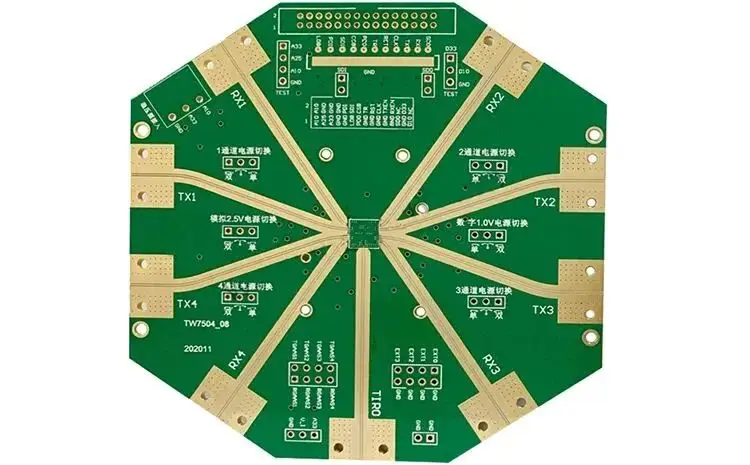
Application Scenario: Advanced Driver Assistance Systems (ADAS) in Modern Vehicles
The 3W principle (3 times the trace width spacing) is a critical design rule for high-speed digital circuits in automotive ADAS systems, which include radar, camera, and LiDAR modules. These systems operate at frequencies up to 77GHz and must maintain signal integrity while withstanding automotive environmental stresses.
Why 3W Matters in ADAS:
Crosstalk Mitigation
In ADAS radar PCBs, differential pairs carrying high-frequency signals (24GHz and 77GHz) require strict 3W spacing to prevent crosstalk between adjacent traces. Crosstalk can cause false detections in radar systems, potentially leading to incorrect collision warnings or emergency braking events. The 3W rule ensures that mutual capacitance and inductance between traces are minimized, maintaining signal integrity over the 10-15 year vehicle lifespan.
Impedance Control
ADAS camera modules use high-speed interfaces like MIPI CSI-2 with data rates up to 2.5Gbps per lane. Applying the 3W principle helps maintain consistent 100Ω differential impedance throughout the signal path, preventing reflections and signal degradation that could cause image artifacts or data corruption.
Manufacturing Yield
Automotive PCBs must meet IPC Class 3 standards with zero defects. The 3W spacing provides sufficient clearance for manufacturing processes like solder mask application and conformal coating, reducing the risk of shorts and improving production yield in high-volume automotive manufacturing.
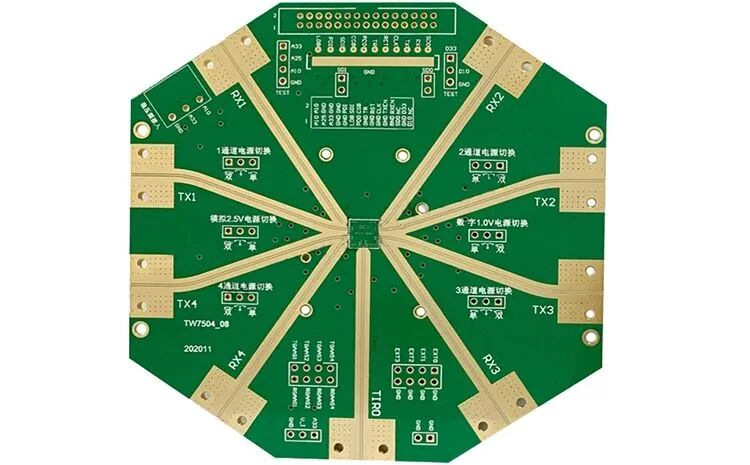
Implementation in ADAS Design:
Layer Stackup Strategy
A typical 6-layer ADAS PCB stackup includes dedicated signal layers with 3W spacing for high-speed interfaces, separated by ground planes to provide return paths and shielding. This structure minimizes electromagnetic interference (EMI) that could affect other vehicle systems.
Differential Pair Routing
For MIPI and LVDS interfaces, differential pairs are routed with 3W spacing to adjacent signals and 5W spacing to other high-speed traces. This ensures that crosstalk remains below -40dB, meeting automotive EMI/EMC requirements.
Via Stitching
Ground vias are placed at 3W intervals around high-speed signal vias to provide continuous return paths and prevent signal integrity issues at layer transitions.
By rigorously applying the 3W principle in ADAS PCB routing, automotive manufacturers can ensure reliable operation of safety-critical systems that must perform flawlessly in all driving conditions.
Shenzhen Kingsheng Technology Co., Ltd. has rich experience and a professional technical team in PCBA. Contact KingshengPCBA today to request a quote or discuss your PCBA project.
Please send Email to kspcba@c-alley.com or call us through +86 13828766801 Or submit your inquiry by online form. Please fill out below form and attach your manufacturing files( PCB Gerber files and BOM List) if need quotation. We will contact you shortly.
 +86 13828766801
 kspcba@c-alley.com
 https://www.kingshengpcba.com/
 2/F, Building 6, Tangtou 3rd Industrial Zone, Tangtou Community, Shiyan Town, Baoan District, Shenzhen, China, 518108
We would also like to thank our customers for their trust and support. The company's outstanding achievements are mainly due to the loyalty of our customers, which also encourages and spurs our company to forge ahead.