1. Overview
The Thermostat Control PCBA is a critical component in modern HVAC (Heating, Ventilation, and Air Conditioning) systems, designed to regulate temperature with precision, energy efficiency, and reliability. This PCBA integrates microcontroller units (MCUs), sensors, power management ICs, and communication modules to achieve seamless control of heating/cooling systems.
Key Features:
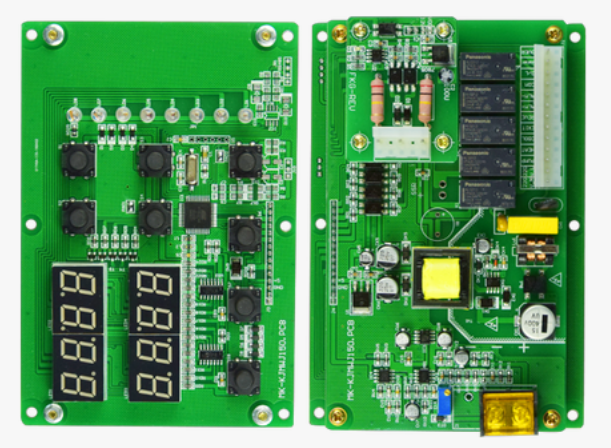
2. Brief Description
The PCBA consists of:
Applications: Residential thermostats, industrial HVAC, automotive climate control.
3. PCBA Manufacturing Process Flow
Step 1: Design & DFM Review
Schematic/PCB layout optimization for thermal management (e.g., heat dissipation near power components).
DFM (Design for Manufacturing) checks: Avoid fine-pitch components if high-volume production is planned.
Step 2: PCB Fabrication
Material: FR-4 (standard) or high-Tg for high-temperature environments.
Layer count: 2–4 layers (cost vs. signal integrity trade-off).
Step 3: SMT Assembly
Stencil Printing: SAC305 solder paste (lead-free).
Pick-and-Place: Automated placement of 0402/0603 passives, QFN/DFN ICs.
Reflow Soldering: Profile optimization to prevent tombstoning or voids.
Step 4: Through-Hole Assembly (if applicable)
Wave soldering for connectors or bulky components.
Step 5: Testing & QA
ICT (In-Circuit Test): Validates component placement and shorts.
FCT (Functional Test): Verifies temperature calibration, relay switching, and communication protocols.
Burn-in Testing: Stress tests under extreme temperatures (e.g., -20°C to 85°C).
4. Key Considerations & Challenges
A. Design Challenges
Thermal Management: MCUs and power ICs generate heat; thermal vias or heatsinks may be required.
Signal Integrity: Noise from relays/motors can disrupt sensor readings; proper grounding is critical.
B. Manufacturing Pain Points
Component Sourcing: Long lead times for MCUs (plan procurement early).
Yield Issues: Sensor calibration drift during reflow (pre-baking moisture-sensitive parts is advised).
C. Compliance & Reliability
Certifications: FCC/CE for EMI, UL/IEC 60730 for safety.
Environmental Robustness: Conformal coating may be needed for humid environments.
5. Conclusion
The Thermostat Control PCBA demands a balance of precision design, rigorous manufacturing controls, and thorough testing to ensure longevity in diverse operating conditions. Collaboration between design engineers and PCBA operations teams is essential to address challenges like thermal performance and supply chain volatility.
6. Why Choose Our Thermostat Control PCBA?
End-to-End Ownership: From schematic design to after-sales support.
Scalability: Prototype to mass production (up to 100k units/month).
Customization: Tailored solutions for robotics, HVAC, EV charging, and more.
Contact KingshengPCBA today to discuss your project or request a customized quotation
Please send Email to kspcba@c-alley.com or call us through +86 13828766801 Or submit your inquiry by online form. Please fill out below form and attach your manufacturing files( PCB Gerber files and BOM List) if need quotation. We will contact you shortly.
 +86 13828766801
 kspcba@c-alley.com
 https://www.kingshengpcba.com/
 2/F, Building 6, Tangtou 3rd Industrial Zone, Tangtou Community, Shiyan Town, Baoan District, Shenzhen, China, 518108
We would also like to thank our customers for their trust and support. The company's outstanding achievements are mainly due to the loyalty of our customers, which also encourages and spurs our company to forge ahead.